AI for nonprofits: fundraising materials and program plans.
Prepare fundraising and donor materials, review a restricted grant budget and turn a program proposal into an implementation plan. Connect the story you tell to the activity and evidence your team can document.
The Bridge Reading pilot delivered six sessions, with 18 learners attending at least once. The records show participation and delivery; they do not establish a reading-improvement result.
Your follow-up
Give me a more inviting sentence for a donor update.
Arya
Eighteen learners took part in at least one Bridge Reading session across the six-session pilot. We are using what we learned from delivery to prepare the next program.
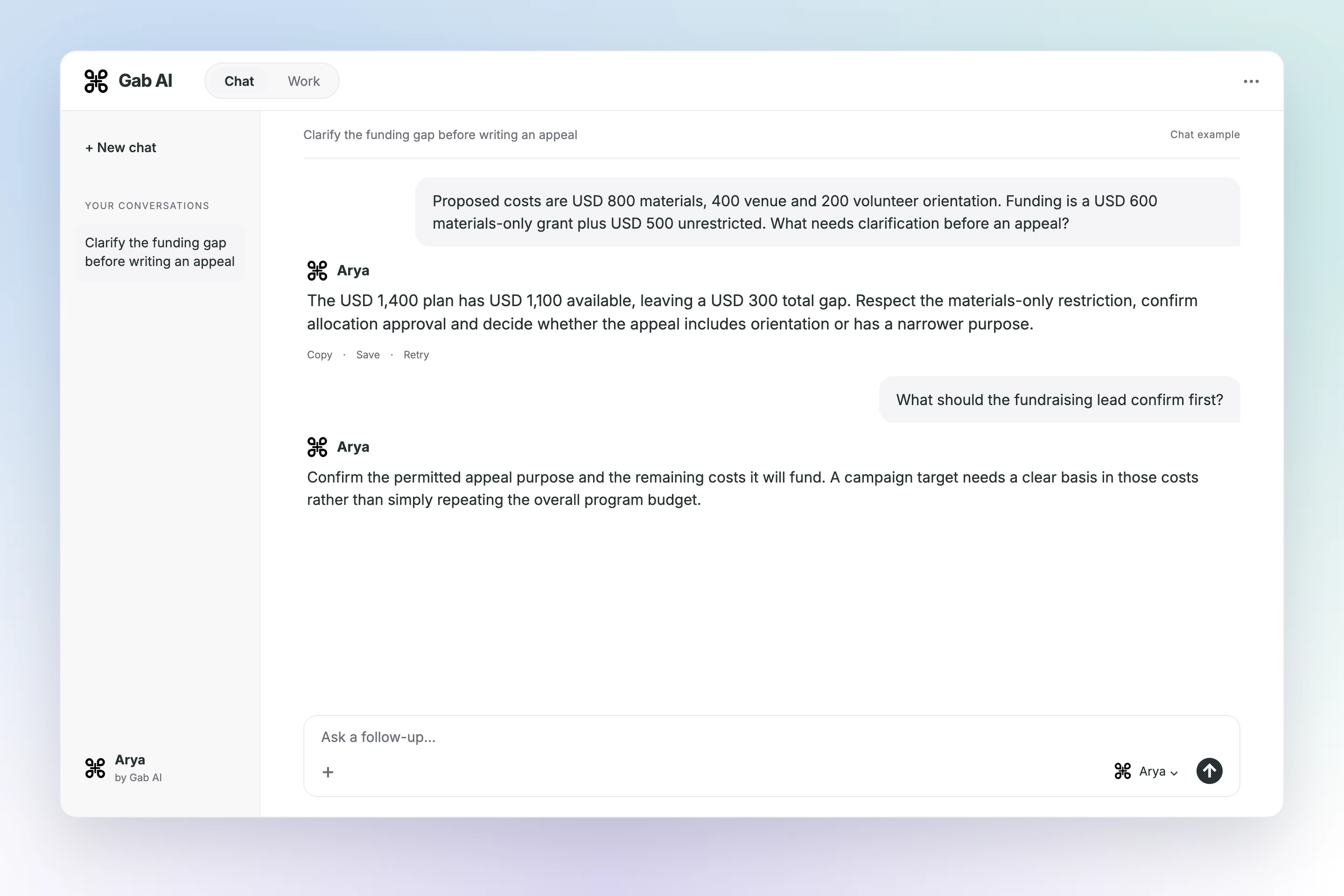
Clarify the funding gap before writing an appeal
The USD 1,400 plan has USD 1,100 available, leaving a USD 300 total gap.
The USD 1,400 plan has USD 1,100 available, leaving a USD 300 total gap. Respect the materials-only restriction, confirm allocation approval and decide whether the appeal includes orientation or has a narrower purpose.
Your follow-up
What should the fundraising lead confirm first?
Arya
Confirm the permitted appeal purpose and the remaining costs it will fund. A campaign target needs a clear basis in those costs rather than simply repeating the overall program budget.
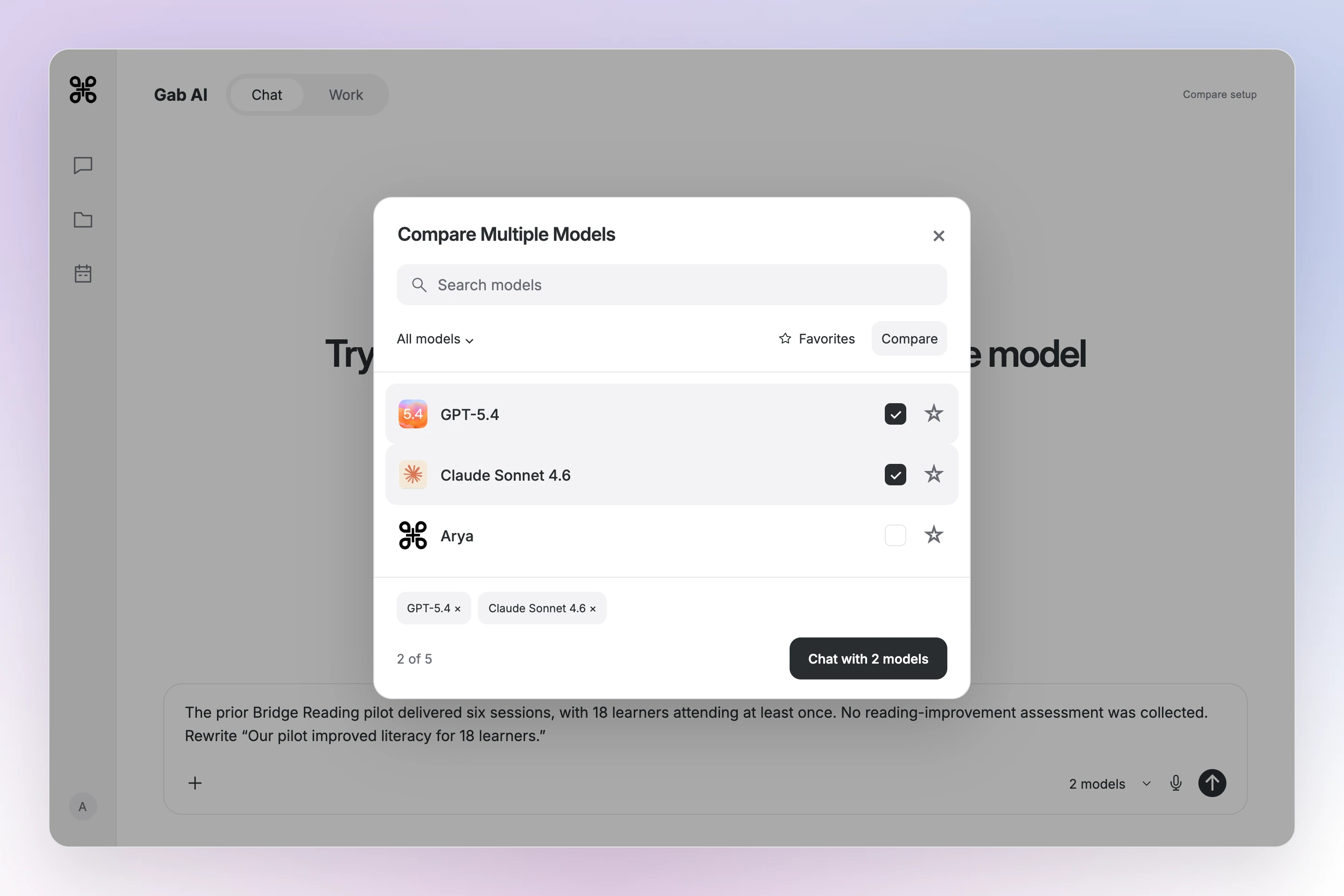
Try the same question with more than one model
Choose compatible models, compare their reasoning and decide which answer helps with your task.
In the model picker, turn on Compare and choose compatible models before sending the same prompt. Compare requires Plus; model access and credit use depend on the selection. Check facts and omissions rather than assuming a winner.
Review a restricted budget and build a program plan
Turn program records into an implementation plan, a funding review and a campaign brief. See the numbers, approval owners and evidence behind each result.
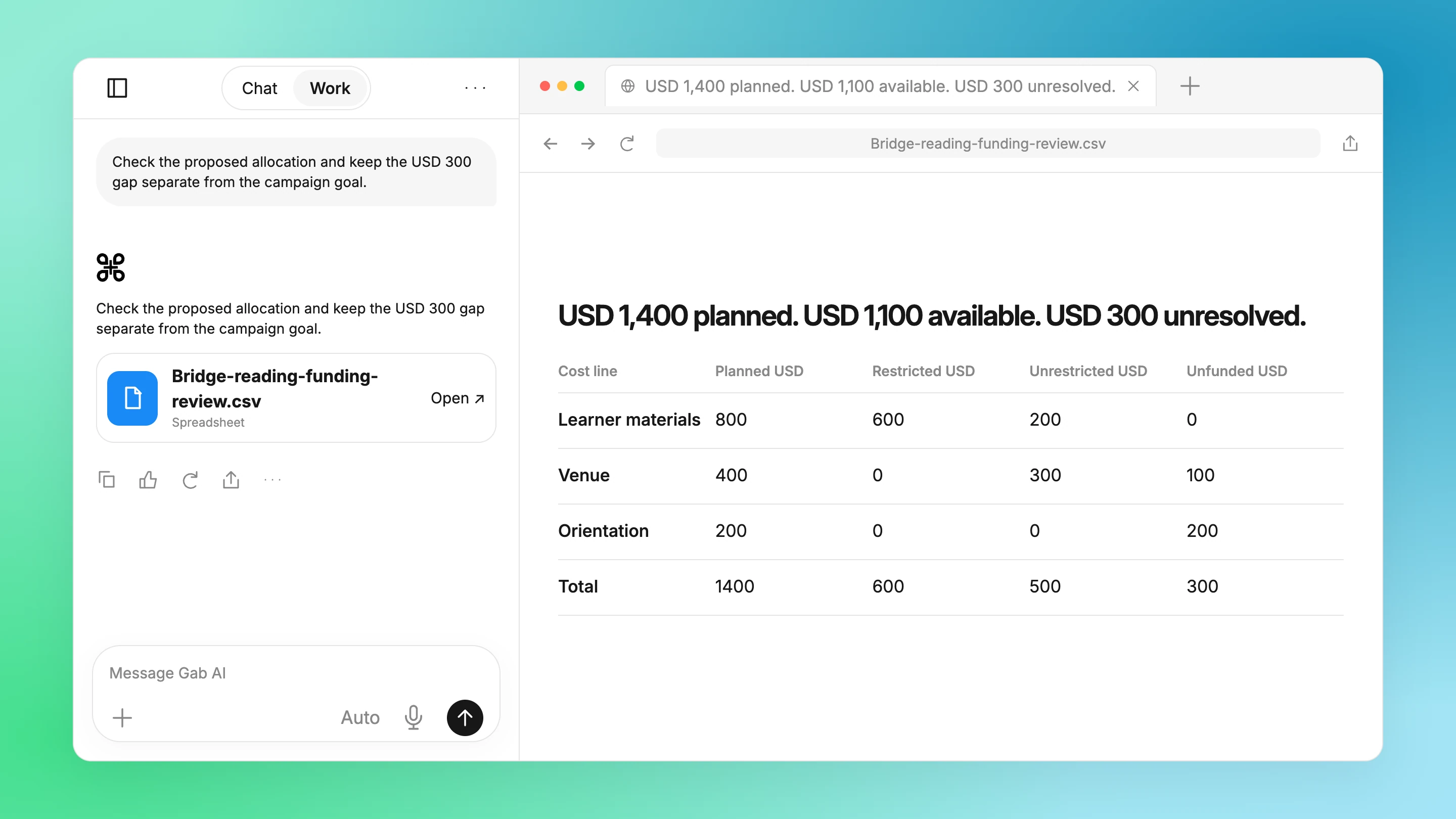
Build a restricted-funding review from the budget
Check the proposed allocation and keep the USD 300 gap separate from the campaign goal.
Bridge Reading proposes six weekly reading sessions for 20 learners. Each session is planned for 60 minutes with two volunteer facilitators. Two volunteer orientation sessions occur before the first learner session. Launch date, venue and safeguarding review are not yet approved.
Documented prior activity
The prior pilot recorded 18 learners attending at least one session and delivered six sessions. No assessment or reading-improvement result was collected. These are participation and delivery counts, not evidence of learning gains.
Campaign request and restrictions
Proposed campaign goal: USD 1,200 toward learner materials and venue costs. Describe the six-session plan as proposed. Do not promise learning gains, create named donors or suggest any funds may be used outside recorded restrictions. Any donor communication requires review and consent.
Approval responsibilities
Program manager: confirm venue, launch date, facilitator readiness and safeguarding review. Finance reviewer: check the proposed allocation against each funding restriction. Fundraiser: approve the campaign wording and stewardship plan before outreach.
Restricted learner-material grant USD 600: learner materials only. Unrestricted funding USD 500: available to any of the three planned lines after internal approval. Total current funding USD 1,100.
Funding review
A possible allocation uses USD 600 restricted plus USD 200 unrestricted for materials, USD 300 unrestricted for venue and leaves USD 100 venue plus USD 200 orientation unfunded. Total gap USD 300. This allocation is a proposal, not a finance approval. The separate USD 1,200 campaign goal is not recorded as secured funding.
Turn a program proposal into an owner-based plan
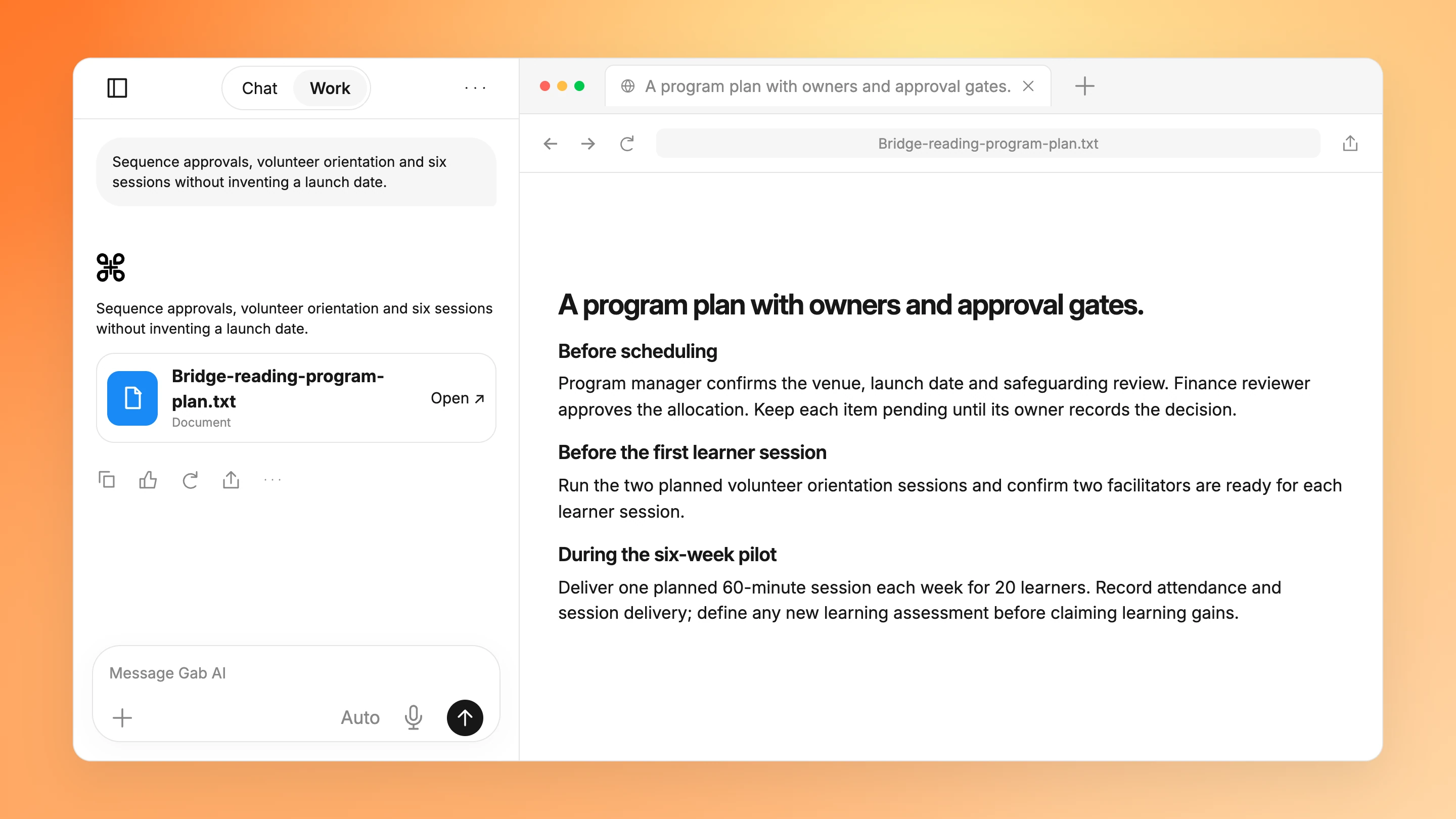
Sequence approvals, volunteer orientation and six sessions without inventing a launch date.
Sequence approvals, volunteer orientation and six sessions without inventing a launch date.
Loading…
This content could not load.
Your source material stays available.
A program plan with owners and approval gates.
01
Before scheduling
Program manager confirms the venue, launch date and safeguarding review. Finance reviewer approves the allocation. Keep each item pending until its owner records the decision.
02
Before the first learner session
Run the two planned volunteer orientation sessions and confirm two facilitators are ready for each learner session.
03
During the six-week pilot
Deliver one planned 60-minute session each week for 20 learners. Record attendance and session delivery; define any new learning assessment before claiming learning gains.
Bridge-reading-program.txt
Bridge-reading-program.txt
Bridge-reading-program.txt
Proposed sequence for the sample pilot, without inventing launch dates or approvals.
Bridge Reading proposes six weekly reading sessions for 20 learners. Each session is planned for 60 minutes with two volunteer facilitators. Two volunteer orientation sessions occur before the first learner session. Launch date, venue and safeguarding review are not yet approved.
Documented prior activity
The prior pilot recorded 18 learners attending at least one session and delivered six sessions. No assessment or reading-improvement result was collected. These are participation and delivery counts, not evidence of learning gains.
Campaign request and restrictions
Proposed campaign goal: USD 1,200 toward learner materials and venue costs. Describe the six-session plan as proposed. Do not promise learning gains, create named donors or suggest any funds may be used outside recorded restrictions. Any donor communication requires review and consent.
Approval responsibilities
Program manager: confirm venue, launch date, facilitator readiness and safeguarding review. Finance reviewer: check the proposed allocation against each funding restriction. Fundraiser: approve the campaign wording and stewardship plan before outreach.
Build a fundraising brief from documented program evidence
Build the appeal from recorded activity, then check whether its funding target is justified.
Bridge Reading proposes six weekly reading sessions for 20 learners. Each session is planned for 60 minutes with two volunteer facilitators. Two volunteer orientation sessions occur before the first learner session. Launch date, venue and safeguarding review are not yet approved.
Documented prior activity
The prior pilot recorded 18 learners attending at least one session and delivered six sessions. No assessment or reading-improvement result was collected. These are participation and delivery counts, not evidence of learning gains.
Campaign request and restrictions
Proposed campaign goal: USD 1,200 toward learner materials and venue costs. Describe the six-session plan as proposed. Do not promise learning gains, create named donors or suggest any funds may be used outside recorded restrictions. Any donor communication requires review and consent.
Approval responsibilities
Program manager: confirm venue, launch date, facilitator readiness and safeguarding review. Finance reviewer: check the proposed allocation against each funding restriction. Fundraiser: approve the campaign wording and stewardship plan before outreach.
Restricted learner-material grant USD 600: learner materials only. Unrestricted funding USD 500: available to any of the three planned lines after internal approval. Total current funding USD 1,100.
Funding review
A possible allocation uses USD 600 restricted plus USD 200 unrestricted for materials, USD 300 unrestricted for venue and leaves USD 100 venue plus USD 200 orientation unfunded. Total gap USD 300. This allocation is a proposal, not a finance approval. The separate USD 1,200 campaign goal is not recorded as secured funding.
About these examples
Plan fundraising, review funding and prepare program materials
Open an example to inspect the prompt, sample inputs and completed result.
A useful result, with the details behind it
Build a restricted-funding review from the budget
Check the proposed allocation and keep the USD 300 gap separate from the campaign goal.
Add the proposed budget and funding restrictions before sending. Keep donor and participant details out unless needed and authorized.
Read all source material
Bridge-reading-program.txt
Proposed program plan
Bridge Reading proposes six weekly reading sessions for 20 learners. Each session is planned for 60 minutes with two volunteer facilitators. Two volunteer orientation sessions occur before the first learner session. Launch date, venue and safeguarding review are not yet approved.
Documented prior activity
The prior pilot recorded 18 learners attending at least one session and delivered six sessions. No assessment or reading-improvement result was collected. These are participation and delivery counts, not evidence of learning gains.
Campaign request and restrictions
Proposed campaign goal: USD 1,200 toward learner materials and venue costs. Describe the six-session plan as proposed. Do not promise learning gains, create named donors or suggest any funds may be used outside recorded restrictions. Any donor communication requires review and consent.
Approval responsibilities
Program manager: confirm venue, launch date, facilitator readiness and safeguarding review. Finance reviewer: check the proposed allocation against each funding restriction. Fundraiser: approve the campaign wording and stewardship plan before outreach.
Restricted learner-material grant USD 600: learner materials only. Unrestricted funding USD 500: available to any of the three planned lines after internal approval. Total current funding USD 1,100.
Funding review
A possible allocation uses USD 600 restricted plus USD 200 unrestricted for materials, USD 300 unrestricted for venue and leaves USD 100 venue plus USD 200 orientation unfunded. Total gap USD 300. This allocation is a proposal, not a finance approval. The separate USD 1,200 campaign goal is not recorded as secured funding.
Review a program budget
Check the proposed allocation and keep the USD 300 gap separate from the campaign goal.
Refine funding and impact statements
Compare the draft with a focused revision, keeping the source facts in view.
Try one focused revision
Suggested follow-up using the same source facts.
Focused follow-up
What change should I ask for?
Rewrite as a short action log. Retain both responsible reviewers and keep all decisions pending until recorded.
Original excerpt
What does the existing example say?
Program manager confirms the venue, launch date and safeguarding review. Finance reviewer approves the allocation. Keep each item pending until its owner records the decision.
Suggested revision
What could that revision look like?
Pending — Program manager: confirm venue, launch date and safeguarding review. Pending — Finance reviewer: approve the allocation. Update each status only when its owner records the decision.
Budget gap USD 1,400 in planned costs minus USD 1,100 in current funding leaves USD 300 unfunded: USD 100 venue and USD 200 orientation in this proposed allocation.
Can the USD 600 grant cover the venue?
Restricted grant The supplied restriction allows learner materials only. The proposed venue allocation uses unrestricted funds and still leaves USD 100 unfunded.
Does the USD 1,200 campaign goal match the remaining costs?
Campaign target The sources propose a USD 1,200 campaign for learner materials and venue costs. In the current allocation, materials are covered and only USD 100 of venue costs remains unfunded. The other USD 200 gap is volunteer orientation, outside that stated campaign purpose. The sources do not explain the larger target. Ask the finance reviewer and fundraiser to justify or revise the target and permitted uses before outreach.
Keep participation evidence distinct from measured learning gains.
Did 20 learners complete the previous pilot?
Attendance No. Twenty is the proposed next-pilot capacity. The prior record says 18 learners attended at least one session; it does not establish completion.
Can the appeal promise improved reading?
Learning gains The prior pilot collected no reading-improvement assessment. The sample appeal reports participation and delivered sessions without claiming learning gains.
Use Chat to discuss the request and refine the result with follow-up questions.
Deliverable: Grant narrative review
What to provide
Funder criteria, your draft and verified program evidence
Example prompt
Review this grant narrative against the supplied funder criteria. Identify missing evidence, unclear outcomes and unsupported impact claims. Suggest targeted revisions without inventing beneficiaries, partnerships, funding or results.
What to check
Verify impact and budget evidence
Confirm restrictions and consent
Approve before submission or outreach
Work
Build a restricted-funding review from the budget
Check the proposed allocation and keep the USD 300 gap separate from the campaign goal.
Use Work to create the named sample file and review it alongside the conversation.
Deliverable: Bridge-reading-funding-review.csv
What to provide
Bridge-reading-program.txt
Bridge-reading-budget.csv
Example prompt
Create Bridge-reading-funding-review.csv from Bridge-reading-program.txt and Bridge-reading-budget.csv. Show each planned cost, restricted and unrestricted allocation, and unfunded remainder. Check totals of USD 1,400 costs and USD 1,100 current funding. Keep the USD 1,200 campaign goal separate from secured funding. Label the allocation proposed and retain finance approval.
What to check
Inspect the supplied input files
Check the result against the source material
Review and adapt the result before using it
Work
Turn a program proposal into an owner-based plan
Sequence approvals, volunteer orientation and six sessions without inventing a launch date.
Use Work to create the named sample file and review it alongside the conversation.
Deliverable: Bridge-reading-program-plan.txt
What to provide
Bridge-reading-program.txt
Example prompt
Create Bridge-reading-program-plan.txt using Bridge-reading-program.txt. Separate approval gates, volunteer orientation and six weekly learner sessions. Name the supplied approval owners, keep dates and venue pending, and distinguish attendance records from learning-outcome evidence.
What to check
Inspect the supplied input files
Check the result against the source material
Review and adapt the result before using it
Work
Build a fundraising brief from documented program evidence
Build the appeal from recorded activity, then check whether its funding target is justified.
Use Work to create the named sample file and review it alongside the conversation.
Deliverable: Bridge-reading-campaign-brief.html
What to provide
Bridge-reading-program.txt
Bridge-reading-budget.csv
Example prompt
Create Bridge-reading-campaign-brief.html from Bridge-reading-program.txt and Bridge-reading-budget.csv. Present the proposed six-session pilot, the supplied USD 1,200 campaign goal and the actual prior participation counts. Trace the funding gap by cost line and compare it with the campaign’s materials-and-venue purpose. Flag the unexplained target; do not invent future costs, new restrictions or reading gains. Include source excerpts and a finance/fundraiser review gate before outreach.
What to check
Check the participation counts against the source
Resolve the target and permitted uses with finance
Approve wording and consent before outreach
More prompts
Chat
Draft a donor thank-you
A donor acknowledgment that accurately describes the gift's purpose and verified impact.
Use Chat to discuss the request and refine the result with follow-up questions.
Deliverable: Donor thank-you draft
What to provide
Verified gift purpose, approved impact facts and contact rules
Example prompt
Draft a donor thank-you from the verified gift purpose and approved impact facts. Distinguish what the gift supports from outcomes already achieved, avoid invented testimonials and return a draft without contacting the donor.
What to check
Verify impact and budget evidence
Confirm restrictions and consent
Approve before submission or outreach
Work
Create an editable grant proposal
A proposal document with source-linked answers and a list of application requirements still needing attention.
Use Work to build and revise Grant proposal draft.docx from your source material.
Deliverable: Grant proposal draft.docx
What to provide
Application questions, approved project plan and evidence sources
Example prompt
Create an editable proposal using the supplied application structure, approved project plan and verified evidence. Add a requirements checklist and flag missing answers or source support. Do not submit the application or invent partner commitments. Deliver "Grant proposal draft.docx" as the requested editable artifact. Ask for missing source material rather than inventing facts.
What to check
Verify impact and budget evidence
Confirm restrictions and consent
Approve before submission or outreach
Work
Build a restricted-funds budget workbook
A program budget workbook with visible funding restrictions, assumptions and checked total formulas.
Use Work to build and revise Program budget workbook.xlsx from your source material.
Deliverable: Program budget workbook.xlsx
What to provide
Approved cost inputs, funding restrictions and reporting period
Example prompt
Build a budget workbook separating cost inputs, restricted uses, other funding and assumptions. Include transparent totals and a clearly formula test. Do not infer allowable costs or tax treatment without the supplied grant terms. Deliver "Program budget workbook.xlsx" as the requested editable artifact. Ask for missing source material rather than inventing facts.
What to check
Verify impact and budget evidence
Confirm restrictions and consent
Approve before submission or outreach
Chat
Draft a program implementation plan
A program implementation plan connecting approved goals, activities, resources and evidence to collect.
Use Chat to question the source material and revise the response before preparing a file.
Deliverable: Response in Chat
What to provide
Approved program objectives, service scope and staff responsibilities
Example prompt
Draft an implementation plan from these approved community program goals and resources. Include activities, responsible roles, supplied milestones and evidence to collect. Separate confirmed commitments from proposals and do not invent funding or partner capacity.
What to check
Check service definitions
Verify reporting period
Program-team review
Work
Build a campaign evidence workbook
A workbook linking campaign messages to verified impact evidence, gift-use restrictions, approval owners and planned stewardship actions.
Use Work to create and revise Fundraising campaign workbook.xlsx alongside the conversation.
Deliverable: Fundraising campaign workbook.xlsx
What to provide
Approved campaign goals, gift restrictions and audience
Appeal draft, substantiated impact figures and source dates
Example prompt
Create a workbook linking campaign messages to verified impact evidence, gift-use restrictions, approval owners and planned stewardship actions. Separate goals from achieved outcomes and keep donor details anonymized; do not invent testimonials or solicit gifts automatically. Deliver an editable artifact named "Fundraising campaign workbook.xlsx". If source material is missing, ask for it instead of filling factual gaps.
What to check
Trace impact statements to verified program evidence
Check gift-use restrictions and campaign approval owners
Can Gab AI help with both program planning and fundraising?
Yes. Supply the program proposal, responsibilities, budget and verified activity evidence. Use Work to prepare a program plan, funding review or campaign draft, then have the responsible staff check the result.
Can it check restricted funds in a budget?
It can compare your proposed allocation with the restrictions you provide and calculate remaining gaps. Have your finance reviewer verify the restrictions and approve the allocation. A calculated proposal is not an authorization to spend.
How does it keep fundraising claims tied to evidence?
Ask for source references beside attendance counts, delivered services and outcome claims. The sample distinguishes 18 prior attendees from the next pilot’s planned capacity of 20 and does not invent learning gains.
Does a campaign draft contact donors or submit a grant?
No. Opening the example creates a draft. Review the generated material, permissions and approvals before using your authorized submission or outreach process.
How can nonprofits use Gab AI for donor engagement?
Supply approved campaign facts, gift-use restrictions and communication rules. Use Chat to draft thank-you notes or explain a proposed appeal; use Work to prepare a reviewable campaign brief. Check every impact claim, consent and approval before outreach. Gab AI does not gain access to your donor database merely because you open a prompt.
How can a small nonprofit decide whether Gab AI is worth the cost?
Start with one representative task, such as reviewing a program brief or drafting a donor update. Compare preparation and review effort with your usual process, and check the credit use and quality of the result. Do not assume that a draft saves time until your team has reviewed it.
Does an activity plan establish a program’s impact?
No. A planned weekly 60-minute session for 20 learners describes intended delivery. Attendance would measure participation, not establish learning gains. Keep proposed activities, actual delivery and measured outcomes separate in donor or grant copy, and support each impact claim with relevant evidence.
Can I start in Chat, or do I need Work?
Use Chat for questions and text drafts. Choose Work when you want a project with tools and editable files. Work requires Plus and uses credits; see Pricing for plans and allowances. Opening a draft does not send it or attach the example files.