AI for developers: debug, test and explain a focused change.
Debug a reproducible failure, write regression tests and explain a pull request with the relevant code in view. Follow an order-total bug from its failing calculation to a proposed patch and reviewer note.
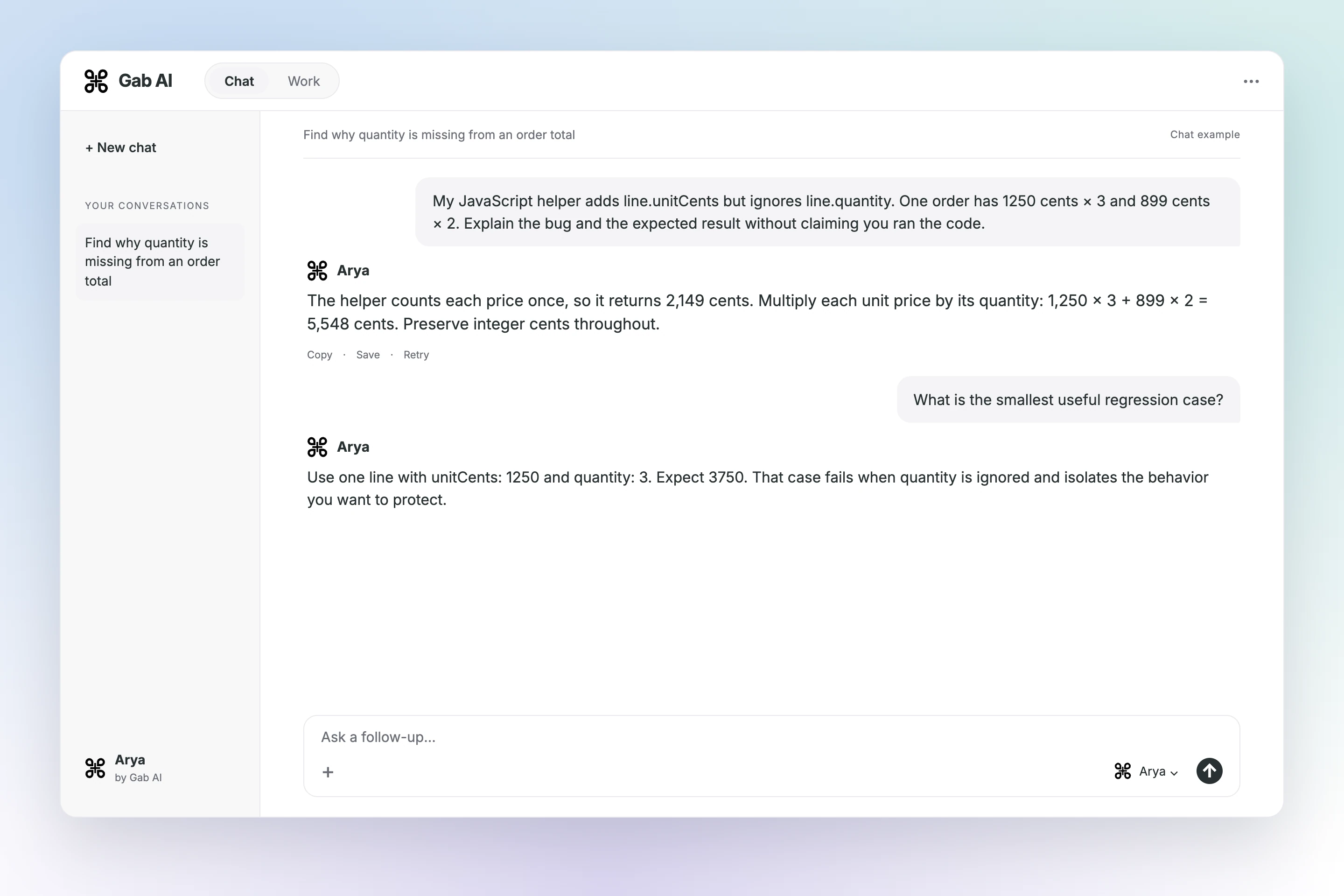
The helper counts each price once, so it returns 2,149 cents. Multiply each unit price by its quantity: 1,250 × 3 + 899 × 2 = 5,548 cents. Preserve integer cents throughout.
Your follow-up
What is the smallest useful regression case?
Arya
Use one line with unitCents: 1250 and quantity: 3. Expect 3750. That case fails when quantity is ignored and isolates the behavior you want to protect.
Turn the fix into a useful reviewer note
The proposed change includes quantity in each line subtotal while preserving the totalCents interface and integer-cent result.
The proposed change includes quantity in each line subtotal while preserving the totalCents interface and integer-cent result. Review empty input and quantities greater than one before merging.
Your follow-up
Split the note into behavior and validation.
Arya
Behavior: sum unitCents × quantity for every line; keep totalCents and integer cents.
Validation: run empty-input, single-line quantity and multi-line order checks.
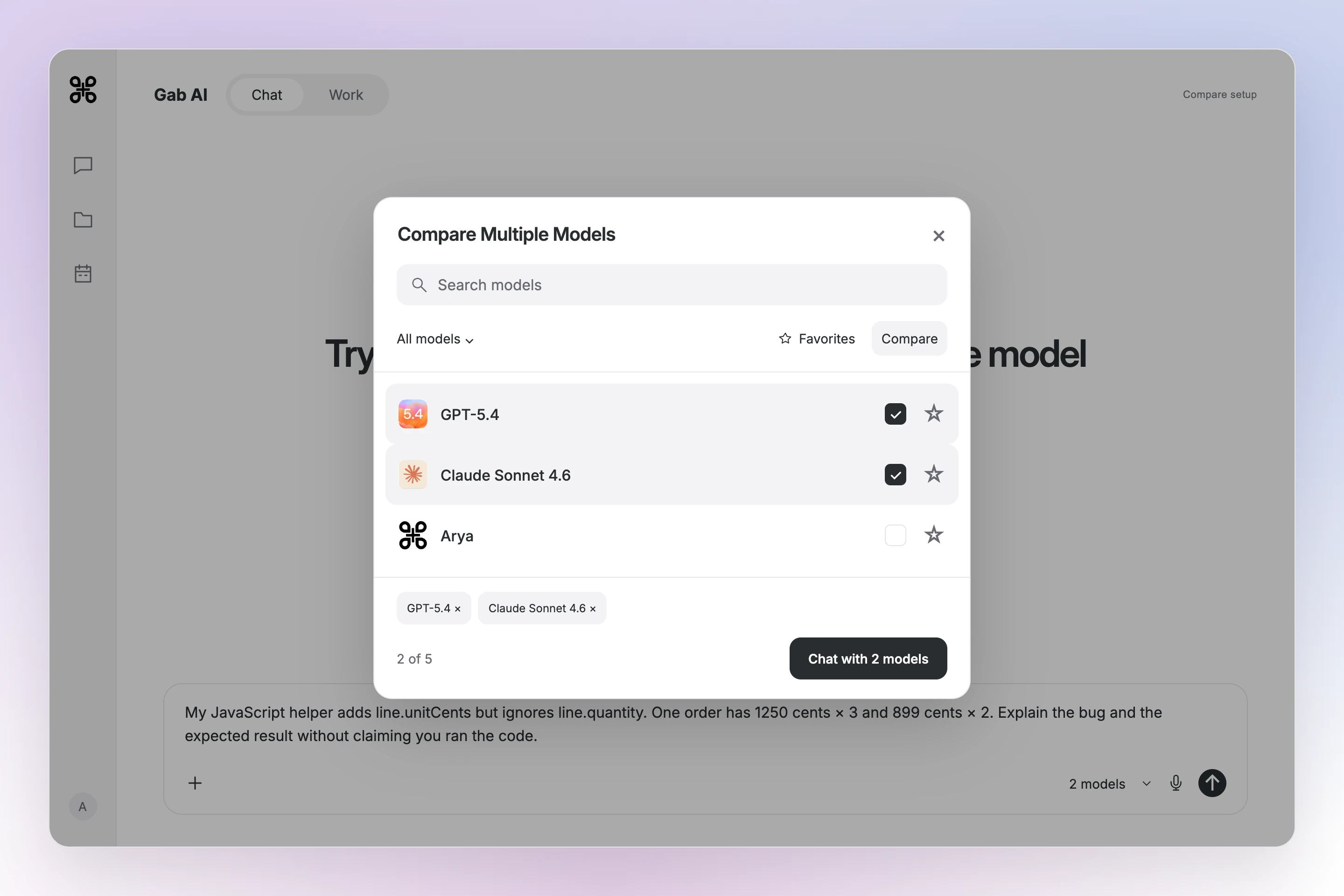
Try the same question with more than one model
Choose compatible models, compare their reasoning and decide which answer helps with your task.
In the model picker, turn on Compare and choose compatible models before sending the same prompt. Compare requires Plus; model access and credit use depend on the selection. Check facts and omissions rather than assuming a winner.
Fix an order total and reproduce the regression
Inspect the patch, switch to regression cases, or prepare the review note.
Fix a quantity-sensitive order total
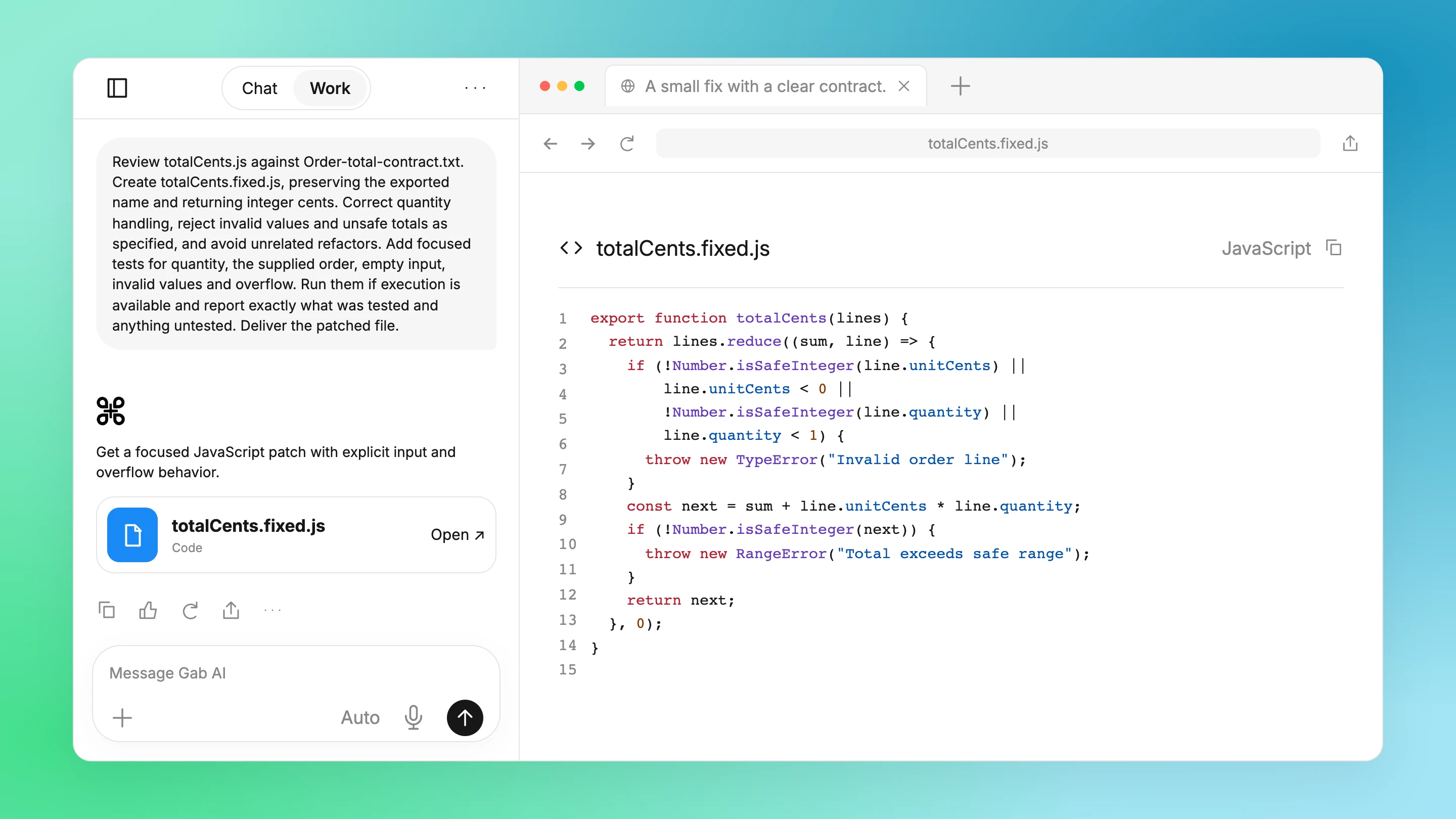
Get a focused JavaScript patch with explicit input and overflow behavior.
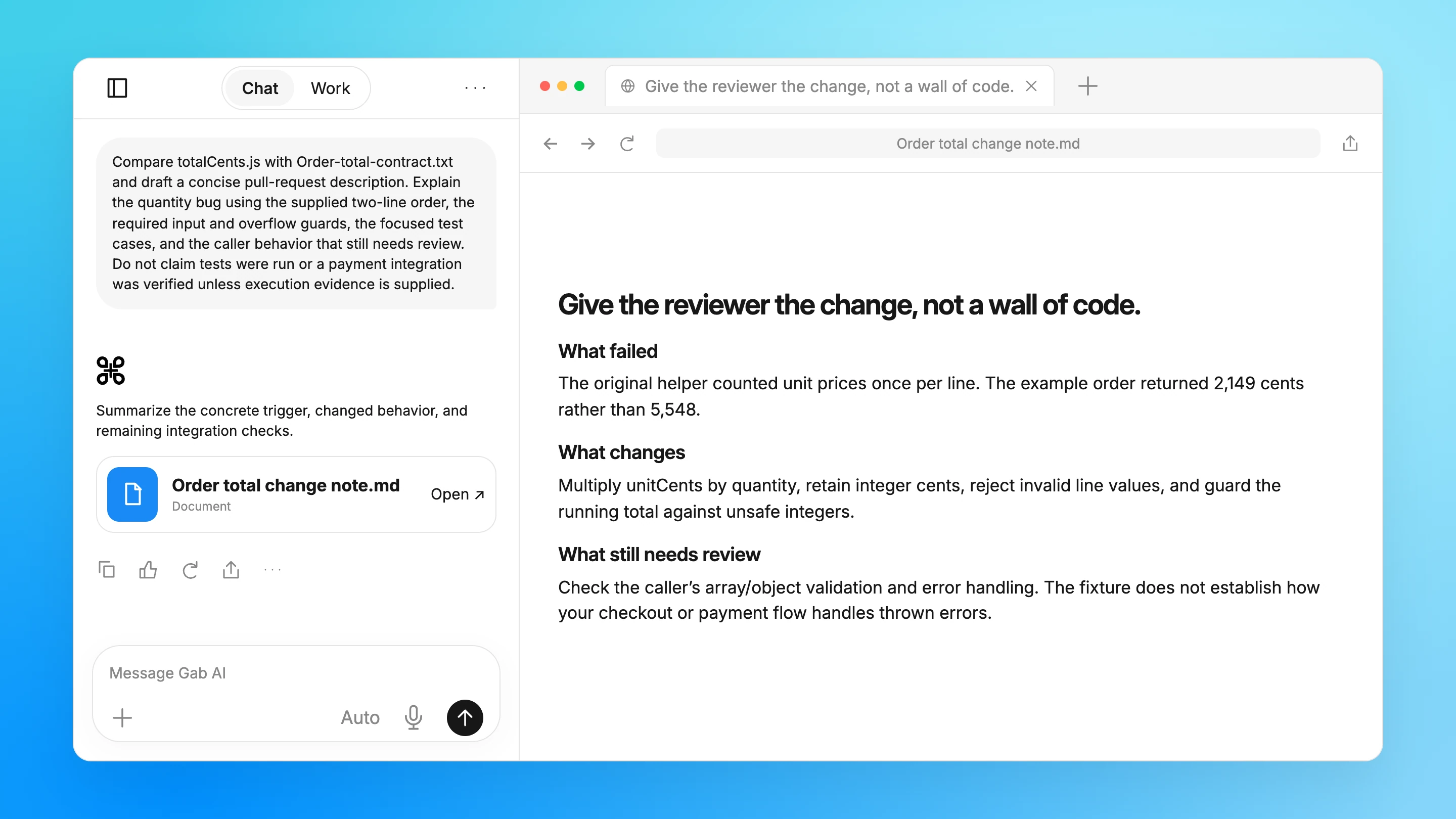
The helper adds each line.unitCents once and never reads line.quantity. It returns 2,149 cents for the supplied two-line order.
Order-total-contract.txt
Function contract
totalCents(lines) returns the sum of unitCents × quantity for every line. unitCents is a non-negative safe integer; quantity is a positive safe integer. Empty input returns 0. Keep the exported function name and return integer cents.
Example order
Line A: unitCents 1250, quantity 3. Line B: unitCents 899, quantity 2. Correct total: 3750 + 1798 = 5548 cents.
Invalid input and overflow
Reject a zero, negative, or non-integer quantity, and negative or non-integer unitCents, with TypeError. If the total is outside the safe integer range, throw RangeError. The sample scope assumes lines is an array of line objects; external API validation is separate.
Make the regression easy to reproduce
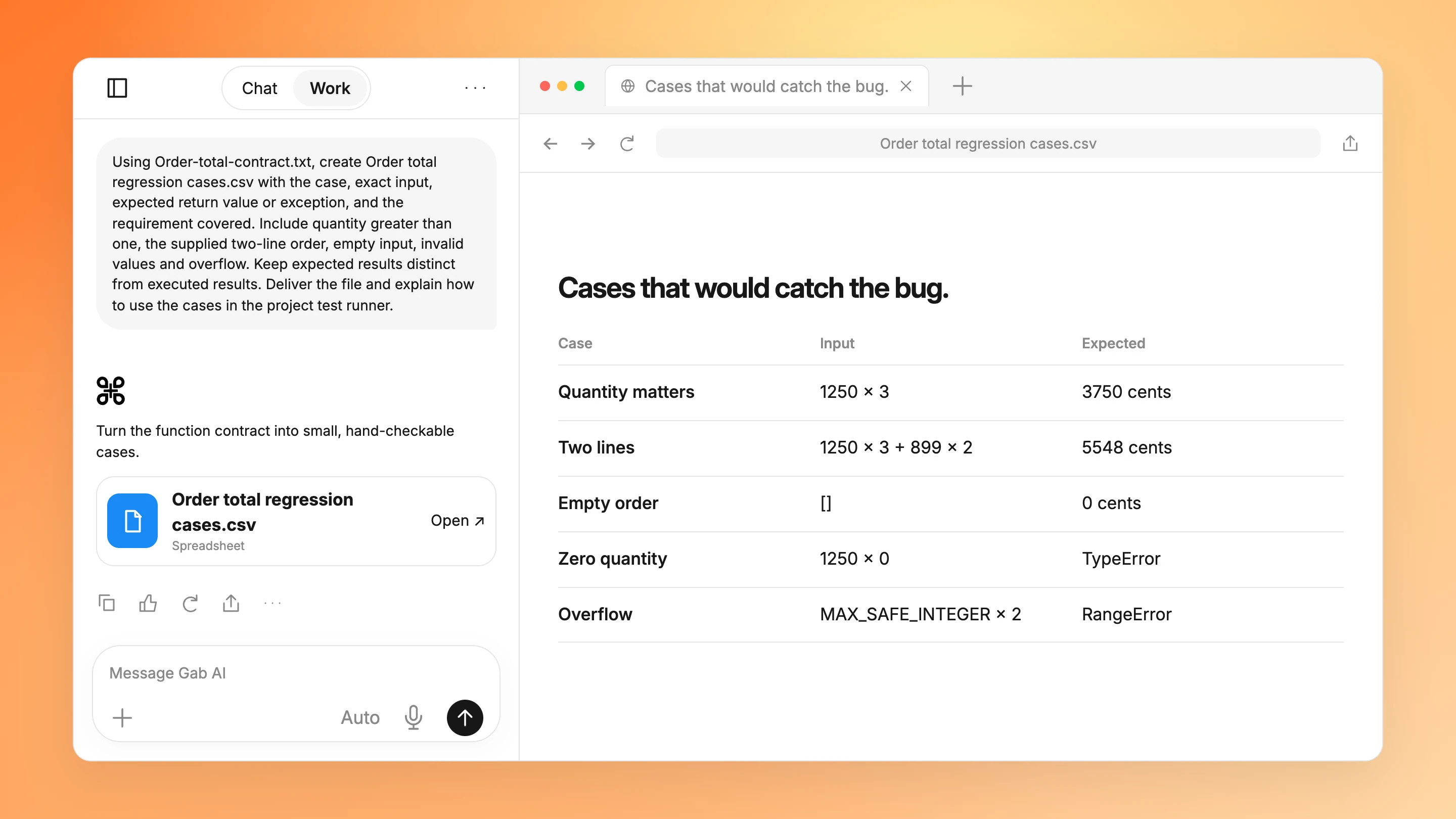
Turn the function contract into small, hand-checkable cases.
totalCents(lines) returns the sum of unitCents × quantity for every line. unitCents is a non-negative safe integer; quantity is a positive safe integer. Empty input returns 0. Keep the exported function name and return integer cents.
Example order
Line A: unitCents 1250, quantity 3. Line B: unitCents 899, quantity 2. Correct total: 3750 + 1798 = 5548 cents.
Invalid input and overflow
Reject a zero, negative, or non-integer quantity, and negative or non-integer unitCents, with TypeError. If the total is outside the safe integer range, throw RangeError. The sample scope assumes lines is an array of line objects; external API validation is separate.
Explain the patch for a reviewer
Summarize the concrete trigger, changed behavior, and remaining integration checks.
The helper adds each line.unitCents once and never reads line.quantity. It returns 2,149 cents for the supplied two-line order.
Order-total-contract.txt
Function contract
totalCents(lines) returns the sum of unitCents × quantity for every line. unitCents is a non-negative safe integer; quantity is a positive safe integer. Empty input returns 0. Keep the exported function name and return integer cents.
Example order
Line A: unitCents 1250, quantity 3. Line B: unitCents 899, quantity 2. Correct total: 3750 + 1798 = 5548 cents.
Invalid input and overflow
Reject a zero, negative, or non-integer quantity, and negative or non-integer unitCents, with TypeError. If the total is outside the safe integer range, throw RangeError. The sample scope assumes lines is an array of line objects; external API validation is separate.
About these examples
Debug code, write tests and explain a change
See the patch, the cases, and the context a reviewer needs.
A useful path from bug to review
Fix the behavior that actually failed
Quantity is part of the contract, so it is part of the calculation.
Add the relevant source, runtime versions and failing case before sending.
Read all source material
totalCents.js
Current behavior
The helper adds each line.unitCents once and never reads line.quantity. It returns 2,149 cents for the supplied two-line order.
Order-total-contract.txt
Function contract
totalCents(lines) returns the sum of unitCents × quantity for every line. unitCents is a non-negative safe integer; quantity is a positive safe integer. Empty input returns 0. Keep the exported function name and return integer cents.
Example order
Line A: unitCents 1250, quantity 3. Line B: unitCents 899, quantity 2. Correct total: 3750 + 1798 = 5548 cents.
Invalid input and overflow
Reject a zero, negative, or non-integer quantity, and negative or non-integer unitCents, with TypeError. If the total is outside the safe integer range, throw RangeError. The sample scope assumes lines is an array of line objects; external API validation is separate.
Prepare a code fix
Fix the order total helper against this contract. Keep the change focused.
Refine a code change and its explanation
Compare the draft with a focused revision, keeping the source facts in view.
Try one focused revision
Suggested follow-up using the same source facts.
Focused follow-up
What change should I ask for?
Explain the bug in one reviewer-facing sentence, retaining both totals and the omitted quantity calculation. Do not claim a production fix.
Original excerpt
What does the existing example say?
The original helper counted unit prices once per line. The example order returned 2,149 cents rather than 5,548.
Suggested revision
What could that revision look like?
The original helper added each line’s unit price once instead of multiplying by quantity, returning 2,149 cents rather than the expected 5,548 in the sample order.
Use Chat to question the source material and revise the response before preparing a file.
Deliverable: Response in Chat
What to provide
Project files, acceptance criteria and test command
Example prompt
Here is a feature request and the relevant code. Propose the smallest implementation plan, identify files likely to change, and list acceptance criteria and unanswered questions. Preserve the current API and avoid adding dependencies unless the requirement needs them.
What to check
Check requirements
Run relevant tests
Review the change
Work
Fix a quantity-sensitive order total
Get a focused JavaScript patch with explicit input and overflow behavior.
Use Work to create the named artifact, inspect its sources, and request a focused revision.
Deliverable: totalCents.fixed.js
What to provide
totalCents.js: A small JavaScript helper that omits quantity when summing order lines.
Order-total-contract.txt: Expected integer-cent behavior, one example order, and invalid-input rules.
Example prompt
Review totalCents.js against Order-total-contract.txt. Create totalCents.fixed.js, preserving the exported name and returning integer cents. Correct quantity handling, reject invalid values and unsafe totals as specified, and avoid unrelated refactors. Add focused tests for quantity, the supplied order, empty input, invalid values and overflow. Run them if execution is available and report exactly what was tested and anything untested. Deliver the patched file.
What to check
Review the patch
Run relevant project tests
Check caller behavior
Work
Make the regression easy to reproduce
Turn the function contract into small, hand-checkable cases.
Use Work to create the named artifact, inspect its sources, and request a focused revision.
Deliverable: Order total regression cases.csv
What to provide
Order-total-contract.txt: Expected integer-cent behavior, one example order, and invalid-input rules.
Example prompt
Using Order-total-contract.txt, create Order total regression cases.csv with the case, exact input, expected return value or exception, and the requirement covered. Include quantity greater than one, the supplied two-line order, empty input, invalid values and overflow. Keep expected results distinct from executed results. Deliver the file and explain how to use the cases in the project test runner.
What to check
Review the patch
Run relevant project tests
Check caller behavior
Chat
Explain the patch for a reviewer
Summarize the concrete trigger, changed behavior, and remaining integration checks.
Use Chat to compare the supplied source excerpts and revise an answer before using it.
Deliverable: Response in Chat
What to provide
totalCents.js: A small JavaScript helper that omits quantity when summing order lines.
Order-total-contract.txt: Expected integer-cent behavior, one example order, and invalid-input rules.
Example prompt
Compare totalCents.js with Order-total-contract.txt and draft a concise pull-request description. Explain the quantity bug using the supplied two-line order, the required input and overflow guards, the focused test cases, and the caller behavior that still needs review. Do not claim tests were run or a payment integration was verified unless execution evidence is supplied.
What to check
Review the patch
Run relevant project tests
Check caller behavior
More prompts
Work
Build and test a small implementation
Changed source files implementing the supplied acceptance criteria, plus a test report showing exact commands, results and unresolved checks.
Use Work to create and revise Source code and test report.zip alongside the conversation.
Deliverable: Source code and test report.zip
What to provide
Project files, acceptance criteria and test command
Example prompt
Implement the supplied acceptance criteria in the uploaded project, follow its conventions, and run the stated tests where supported. Deliver changed source files and a test report listing exact commands, results and remaining failures. Ask before using credentials, installing services or making external changes; do not commit or deploy. Deliver an editable artifact named "Source code and test report.zip". If source material is missing, ask for it instead of filling factual gaps.
What to check
Inspect the changed files against acceptance criteria
Read the exact test commands and their results
Resolve untested behavior before merging any code
Chat
Investigate a reproducible bug
Evidence-ranked bug hypotheses with a minimal diagnostic or regression check to run.
Use Chat to question the source material and revise the response before preparing a file.
Deliverable: Response in Chat
What to provide
Minimal reproduction and exact error output
Example prompt
Analyze this error trace, reproduction and source excerpt. Rank plausible causes by evidence, explain what supports each, and suggest one minimal diagnostic or regression test. Do not claim a cause is proven without evidence.
What to check
Check requirements
Run relevant tests
Review the change
Chat
Explain a pull request
A pull-request description explaining the diff, resulting behavior, tradeoffs and tests actually performed.
Use Chat to question the source material and revise the response before preparing a file.
Deliverable: Response in Chat
What to provide
Pull-request diff and intended behavior
Example prompt
Write a pull request description from this diff. Explain the bug or requirement, resulting behavior, important tradeoffs and tests actually run. Highlight migration or compatibility concerns visible in the diff; do not invent test results.
What to check
Check requirements
Run relevant tests
Review the change
Chat
Check an API change for compatibility
An API compatibility review listing changed fields, status codes and affected callers or regression cases visible in the supplied diff.
Use Chat to question the source material and revise the response before preparing a file.
Deliverable: Response in Chat
What to provide
The draft API change.diff and the source it should match
Example prompt
Review this API diff and the supplied endpoint contract. List changed request fields, response shapes, status codes and error behavior. Trace each change to the diff and identify callers or tests that may need updates. Separate observed breaking changes from questions about unavailable code. Do not claim you have executed tests or verified compatibility.
What to check
Check requirements
Run relevant tests
Review the change
Chat
Scaffold a new feature
A routes-and-controller draft with validation failures, request examples and explicit runtime assumptions.
Use Chat to question the source material and revise the response before preparing a file.
Deliverable: Response in Chat
What to provide
task-resource requirements, Node version and existing project conventions
Example prompt
Draft a Node/Express REST API for a tasks resource with create, read, update and delete routes. Use Zod for request validation. Show controller boundaries, validation failures, not-found handling and example requests. State runtime assumptions and list dependencies and tests needed before I use the draft in a project.
What to check
Check requirements
Run relevant tests
Review the change
Chat
Write tests for my function
Jest test drafts linked to the supplied function contract, with untested behavior and setup questions identified.
Use Chat to question the source material and revise the response before preparing a file.
Deliverable: Response in Chat
What to provide
Function source, documented contract and project Jest configuration
Example prompt
Using the attached function and its stated contract, draft Jest tests for normal inputs, boundary values and documented errors. Explain which requirement each test checks and flag unspecified behavior. Use the project's existing test setup rather than assuming dependencies, and do not claim the tests have been run.
What to check
Check requirements
Run relevant tests
Review the change
Chat
Convert code between languages
A TypeScript translation draft with types, behavior differences and proposed equivalence checks.
Use Chat to question the source material and revise the response before preparing a file.
Deliverable: Response in Chat
What to provide
Python source, documented behavior and target TypeScript runtime
Example prompt
Convert this supplied Python script to TypeScript while preserving its documented behavior. State runtime and input assumptions, add types, and flag differences in date handling, numeric behavior or library APIs. Propose equivalence checks for the translated functions and do not claim the conversion has been tested.
What to check
Check requirements
Run relevant tests
Review the change
Chat
Write a SQL query
A SQL query draft with date and revenue assumptions, plus execution-plan checks to perform.
Use Chat to question the source material and revise the response before preparing a file.
Deliverable: Response in Chat
What to provide
Database schema, SQL dialect and revenue/refund definitions
Example prompt
Using this supplied schema, write a SQL query for the ten customers with the highest total revenue in the last 90 days, with order count and average order value. State the SQL dialect, date-boundary assumptions and treatment of refunds or cancelled orders. Identify indexes to inspect and explain how I should verify the execution plan.
What to check
Check requirements
Run relevant tests
Review the change
Chat
Find the bug
An evidence-based debounce diagnosis, proposed correction and regression cases to execute.
Use Chat to question the source material and revise the response before preparing a file.
Deliverable: Response in Chat
What to provide
Debounce source, expected delay and callback behavior
Example prompt
Compare this debounce function with the expected behavior: one callback after the user stops typing for the stated delay. Trace how the timer is created and cancelled, identify evidence for the bug, and propose a minimal correction with regression cases. Do not claim a fix is verified without executing it.
What to check
Check requirements
Run relevant tests
Review the change
Chat
Explain this error
A trace-based hypothesis list with supporting evidence, missing environment details and focused diagnostic checks.
Use Chat to question the source material and revise the response before preparing a file.
Deliverable: Response in Chat
What to provide
Redacted trace, source excerpt, runtime versions and reproduction attempts
Example prompt
Analyze this redacted production trace, source excerpt and reproduction attempts. Rank hypotheses by the evidence provided, explain what supports or contradicts each, and suggest a focused diagnostic check. Flag missing version or environment details rather than inventing probabilities or declaring a root cause.
What to check
Check requirements
Run relevant tests
Review the change
Chat
Review my pull request
A diff review with referenced behavior changes, supported findings and missing regression questions.
Use Chat to question the source material and revise the response before preparing a file.
Deliverable: Response in Chat
What to provide
Pull-request diff, requirements and surrounding source code
Example prompt
Review this diff against the feature requirements and supplied surrounding code. Identify behavior changes, observable bugs, security questions and missing regression cases with file references. Separate supported findings from questions requiring more context and do not invent executed test results.
What to check
Check requirements
Run relevant tests
Review the change
Chat
Refactor for readability
A refactor proposal preserving public interfaces, with explanations and behavior checks to run.
Use Chat to question the source material and revise the response before preparing a file.
Deliverable: Response in Chat
What to provide
Module source, public interfaces and existing regression checks
Example prompt
Refactor this module for readability while preserving the supplied behavior and public interfaces. Explain each proposed change, flag code whose intent is unclear, and identify regression checks for the changed paths. Use existing dependencies and do not silently change error handling or data formats.
What to check
Check requirements
Run relevant tests
Review the change
Chat
Compare rate-limiting approaches
A comparison of rate-limiting behavior, storage requirements and concurrency questions for the API.
Use Chat to question the source material and revise the response before preparing a file.
Deliverable: Response in Chat
What to provide
API traffic assumptions, authenticated/anonymous policies and storage constraints
Example prompt
Compare token bucket, leaky bucket and fixed-window rate limiting for a public API. Assume authenticated requests have a per-account limit and anonymous requests need a separate policy. Explain burst behavior, storage requirements and concurrent-request edge cases, then list questions I must answer before choosing an implementation.
What to check
Check requirements
Run relevant tests
Review the change
Chat
Explain a concept simply
An explanation of index tradeoffs using an orders table and dialect-specific query-plan checks.
Use Chat to question the source material and revise the response before preparing a file.
Deliverable: Response in Chat
What to provide
Target SQL dialect and learning level; use a clearly orders table
Example prompt
Explain database indexes to a junior developer using an orders table. Compare a query with and without an index, discuss write and storage costs, and show how to inspect a query plan for the SQL dialect I specify. Label estimated figures and do not promise a performance gain without measurement.
What to check
Check requirements
Run relevant tests
Review the change
Chat
Design a system
An architecture discussion with explicit traffic assumptions, failure modes and load tests needed.
Use Chat to question the source material and revise the response before preparing a file.
Deliverable: Response in Chat
What to provide
URL-shortener brief, traffic ratio, retention and availability assumptions
Example prompt
Draft an architecture discussion for a URL shortener targeting 10,000 requests per second. State assumptions about read-write ratio, retention and availability. Cover data model, ID generation, cache behavior and failure modes. Identify measurements and load tests needed rather than claiming the design meets the target.
What to check
Check requirements
Run relevant tests
Review the change
Chat
Document my code
Source-based function documentation with actual parameters, return values, errors and a checked-interface example.
Use Chat to question the source material and revise the response before preparing a file.
Deliverable: Response in Chat
What to provide
Source file, usage notes and public-interface tests
Example prompt
Draft documentation from this source file and its supplied usage notes. Describe actual functions, parameters, return values and error behavior, and include one example matching the public interface. Flag unclear behavior instead of inventing guarantees and list documentation statements I should check against tests.
What to check
Check requirements
Run relevant tests
Review the change
Work
Build and run a test fixture
A focused test fixture for the supplied behavior, run it in the available environment and deliver code plus exact execution results.
Use Work to create and revise Test fixture and execution report.zip alongside the conversation.
Deliverable: Test fixture and execution report.zip
What to provide
Acceptance criteria, risk areas and approved test environment
Reproduction steps, expected/actual behavior and logs
Example prompt
Create a focused test fixture for the supplied behavior, run it in the available environment and deliver code plus exact execution results. Separate proposed tests from executed checks, include reproducible failures and do not label a release as approved or fully tested. Deliver an editable artifact named "Test fixture and execution report.zip". If source material is missing, ask for it instead of filling factual gaps.
What to check
Inspect fixtures against the supplied acceptance criteria
Read exact executed commands and failure output
Document skipped cases and unresolved environment limitations
How can software developers use Gab AI in their work?
Explore code, investigate bugs, draft tests, and explain implementation tradeoffs with the context from your project. Provide the relevant source, runtime versions, expected behavior and constraints.
Can Gab AI check an API change for compatibility?
Compare old and new request and response behavior, then identify callers and regression cases that need checking.
What needs my professional review?
Run generated code and tests in your own environment. Check security, dependencies, licensing and edge cases; avoid including credentials or private data you are not authorized to share.
What is a practical first prompt?
Use the bug-investigation example with a reproduction, error trace, expected result and relevant source; ask for hypotheses tied to evidence.
How should I compare model responses to a coding problem?
Give each available model the same requirements, runtime versions and source excerpt. Compare the proposed behavior and assumptions, then run the relevant tests in your environment. Agreement between responses does not prove that an implementation works.
Can I use Gab AI from coding scripts?
Gab AI has an OpenAI-compatible API. Use the documented endpoint and model options for your script, and keep API keys out of source control and prompts. Verify the behavior and response handling your application needs.
What source should I provide for code review?
Provide the files involved in the behavior, their interfaces, the expected result and relevant tests. State the runtime versions and the review question. For a large repository, begin with the smallest useful set of files and add dependencies as needed.
Can Gab AI explain a production error?
It can organize a redacted trace, reproduction attempts and source into plausible causes and diagnostic questions. It cannot confirm a production cause from a trace alone. Test the proposed explanation and report only checks actually performed.
Can I build an editable source code and test report?
Use the "Build and test a small implementation" Work example with the listed source material. Inspect the delivered file and its source references before using it. Opening the draft does not start the task.
What should I look for when comparing Codex alternatives?
Start with a concrete task: fix a reproducible bug, review a patch or add regression tests. Gab AI Work can work from supplied project files and report the checks it actually runs. For your own coding client, consult the OpenAI-compatible API guide and check its required endpoints and model/tool support. Test the workflow with your project’s runtime and permissions before adopting it.
Can I try these prompts with my own code?
Yes. Supply the relevant source files, runtime versions, expected behavior and reproduction steps. Ask for a focused change and regression cases, then run and review the result in your environment. The page’s examples use sample code.
Which regression cases should I check after a proposed fix?
Start with the supplied failing order, then test an empty order, invalid quantities and unsafe integer totals against the stated contract. The example expects 5,548 cents for the quantity-sensitive order and zero for an empty order. Run the tests in your own environment; a proposed case list is separate from execution evidence.
Can I start in Chat, or do I need Work?
Use Chat for questions and text drafts. Choose Work when you want a project with tools and editable files. Work requires Plus and uses credits; see Pricing for plans and allowances. Opening a draft does not send it or attach the example files.