
What did the Samaritan do to help the man?
He bound up the wounds, poured in oil and wine, set the man on his own beast, brought him to an inn, and took care of him (Luke 10:34).
Bring a passage. Develop questions and read the verses together.
Read the Bible studyStart with Scripture and shape a reflection in your own voice.
See devotional ideasPrepare for a family discussion, a small group or church.
Find preparation ideasFaith, study and writing
Bring the Scripture, sources and people you have in mind. Ask Arya to help you shape the next step.
Turn a passage into questions that open a thoughtful discussion, with verse references to read together.

Work from Scripture to draft a reflection, then shape it in your own voice for the people you have in mind.
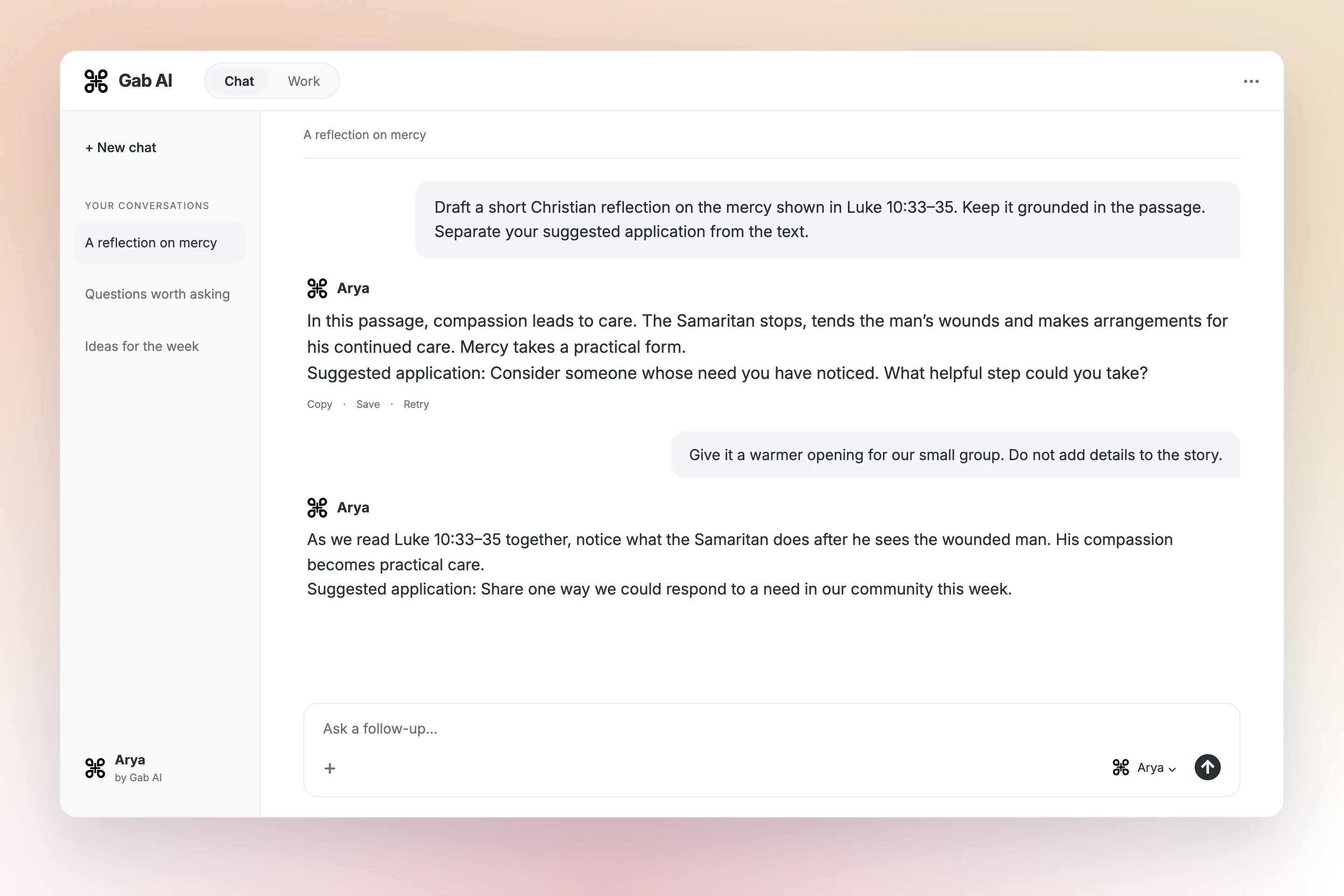
Explore a question or compare supplied writings. Ask how an interpretation connects to the passage or author’s words.
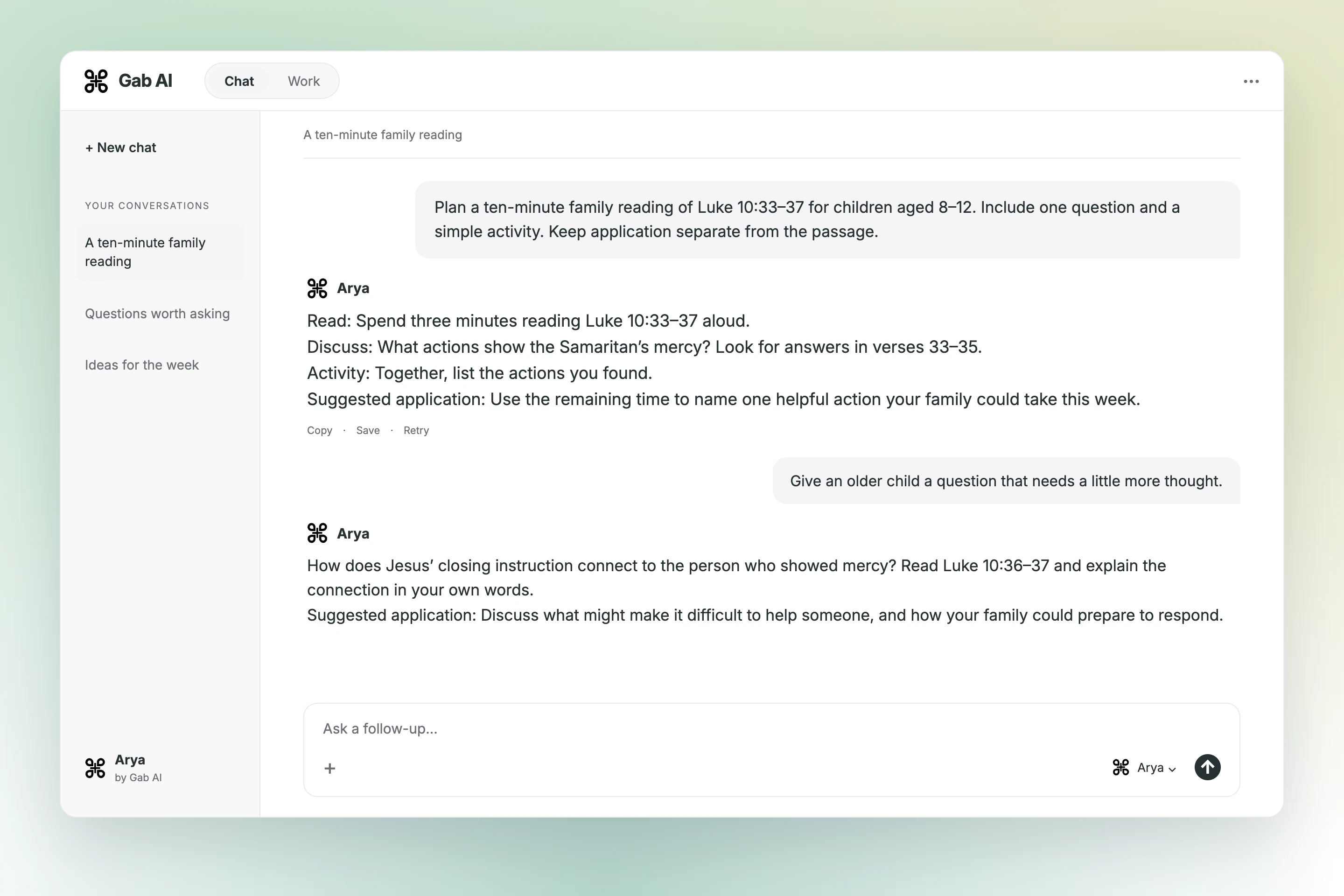
Adapt a study for your family, plan a small-group discussion or turn approved details into a church announcement.
Bring the Scripture, sources and people you have in mind. Ask Arya to help you shape the next step.

Turn a passage into questions that open a thoughtful discussion, with verse references to read together.
Work from Scripture to draft a reflection, then shape it in your own voice for the people you have in mind.
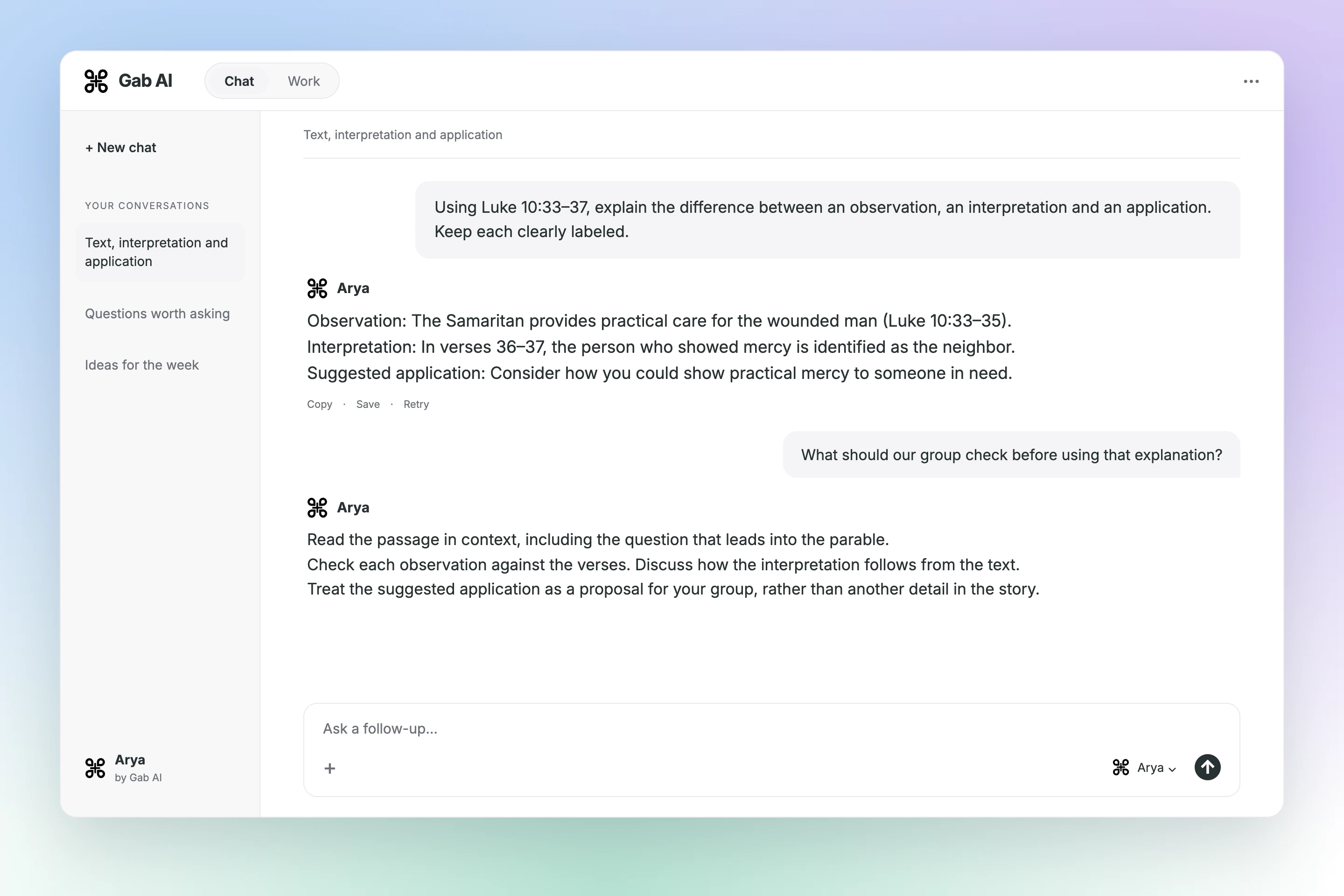
Explore a question or compare supplied writings. Ask how an interpretation connects to the passage or author’s words.
Adapt a study for your family, plan a small-group discussion or turn approved details into a church announcement.
Family Bible study
Three questions, short answer notes and a practical application to discuss together. This family Bible study from Arya explores Luke 10:30–37.
Luke 10:30–37, KJV
He bound up the wounds, poured in oil and wine, set the man on his own beast, brought him to an inn, and took care of him (Luke 10:34).
A neighbor is the person who shows mercy to someone in need (Luke 10:36–37).
He tells us to go and show mercy in the same way (Luke 10:37).
Discuss one person in our community who is currently in need and plan a specific, helpful action to serve them this week, reflecting the mercy described in the text.
Read the passage together and check how each answer connects to the verses.
The adult study became shorter questions with simpler language. The family application stays separate from what the passage says. An earlier answer added a purpose for the inn that the text did not state; the revision removed it.
Use only the supplied passage and context below to draft a 15-minute adult small-group Bible study. Give three numbered questions: one textual observation, one question about the passage's message, and one suggested application. After each question, give a one-sentence answer note and exact verse reference. Label suggested application separately from what the text states. Do not invent quotations or extra historical claims. Keep your study under 180 words. Context: Luke 10:25–29 introduces a lawyer’s questions about eternal life and who his neighbour is.
This study examines Christ’s teaching on the nature of neighborly love. Textual Observation: What specific physical actions did the Samaritan take to care for the wounded man? Note: He bound his wounds, applied oil and wine, provided transport, and funded his ongoing recovery at an inn (Luke 10:34–35). Message: How does Jesus redefine the identity of a "neighbor" in this parable? Note: Jesus shifts the focus from who is worthy of receiving help to who chooses to demonstrate mercy, regardless of social or ethnic distance (Luke 10:36–37). Suggested Application: In what practical ways can you proactively show mercy to someone in your community who is currently overlooked or neglected? Note: While the text commands us to be neighbors through active mercy, the application requires identifying specific individuals in your life who have immediate, tangible needs that you are equipped to meet (Luke 10:37).
Adapt those same three questions for a family with children ages 8–12, in about ten minutes. Use short, gentle language, preserve accurate verse references and the distinction between text and suggested application. Give one simple action the family could discuss for this week. Do not add invented details. Keep it under 140 words. Remove the phrase “regardless of social or ethnic distance”: that background was not established by the supplied text. Keep the interpretation clearly distinct from the text’s wording.
Keep the three numbered questions and Suggested application, under 130 words total. Correct only the first answer’s action wording to follow Luke 10:34 exactly: he bound up the wounds, poured in oil and wine, set the man on his own beast, brought him to an inn, and took care of him. Do not say oil and wine were used to bind the wounds. Return the complete revised discussion only.
30 And Jesus answering said, A certain man went down from Jerusalem to Jericho, and fell among thieves, which stripped him of his raiment, and wounded him, and departed, leaving him half dead.
31 And by chance there came down a certain priest that way: and when he saw him, he passed by on the other side.
32 And likewise a Levite, when he was at the place, came and looked on him, and passed by on the other side.
33 But a certain Samaritan, as he journeyed, came where he was: and when he saw him, he had compassion on him,
34 And went to him, and bound up his wounds, pouring in oil and wine, and set him on his own beast, and brought him to an inn, and took care of him.
35 And on the morrow when he departed, he took out two pence, and gave them to the host, and said unto him, Take care of him; and whatsoever thou spendest more, when I come again, I will repay thee.
36 Which now of these three, thinkest thou, was neighbour unto him that fell among the thieves?
37 And he said, He that shewed mercy on him. Then said Jesus unto him, Go, and do thou likewise.
Read Luke 10:25–37 in context on Bible Gateway. The example uses the King James Version, labelled Public Domain by the source.
A useful Bible study prompt starts with the text and the people who will read it.
Supply the text and name the translation. Add an original source when asking about a theologian or interpretation.
Say who it is for and what you want: three questions, a short reflection or an outline. Name your theological perspective when it matters.
Check the verses and interpretation. Ask for simpler wording or a different focus, then shape the material for your group.
For example: “Using the passage below, write three Bible study questions for our family. Add a short answer note with each verse reference, and keep suggested applications separate from the text.”
Study, devotional and announcement examples. Adapt learning material for your family.
Arya is Gab’s model with a Christian worldview. Open Chat and choose Arya in the model picker before you send your question.
Use it as a study and writing aid. Check Scripture in context, verify quotations and draw on trusted pastoral guidance for questions of faith.
Continue the conversation with the same Gab AI account, on your phone or computer.
A question at home. A follow-up on the go.
Open Chat in your browser or an official Gab AI app and choose Arya. Keep developing your study or reflection in the same conversation.
Your computer project, continued from your phone.
Pair your iPhone or Android phone with a Windows or compatible direct-download Mac host through Remote. Continue in the project folders you choose to share; keep the computer awake, online and Gab AI running.
Local folders and Remote hosting require Windows or a compatible direct-download Mac app. The Mac App Store edition uses cloud Work. Work requires Plus and uses credits.
Keep useful context
Bring supported ChatGPT, Claude, Grok and Gab text history into Gab AI, then choose Arya to continue your conversation.
Download a supported provider export and retain an original copy.
In Settings → Import, select the provider and choose a supported ZIP or JSON file.
Check imported, skipped and error counts and open a representative conversation. Choose Arya in the model picker for your next question.
Text-history imports do not transfer memories, settings, credentials or original file contents. Recreate useful instructions and attach the source files you need.
Try Arya with the signup credits available to your Free account. The allowance is finite; Pricing explains the current plans.
Your prompt and enabled context may be processed by the selected AI provider. Consider what you share in personal prayer requests or ministry material.
Yes. Arya is Gab’s AI model with a Christian worldview. Choose Arya in Chat to ask Christian questions, study a passage or work on a piece of writing.
Use it to develop discussion questions, explain unfamiliar wording or organize notes from a passage. Keep your Bible open and check the text, verse references and interpretation before using the answer.
Name the translation and perspective in your request, and supply the relevant text you are permitted to use. For questions about a theologian, provide the original work and ask for quotations to be separated from the explanation.
Yes. Tell Arya who will take part, the passage and how much time you have. Ask for simpler wording, fewer questions or a different focus, then review the material for your group.
You can try Arya with a Free account’s available signup credits. See Pricing for the current allowance and paid options.
No. Use it as a study and writing aid. Read Scripture in context, verify quotations and bring pastoral or doctrinal questions to people you trust.
A passage to explore. A reflection to write. A discussion to prepare.