AI for podcasters: show notes and episode planning.
Turn an episode transcript into podcast show notes, proposed chapters and an editing handoff. Find better follow-up questions in what the guest actually said.
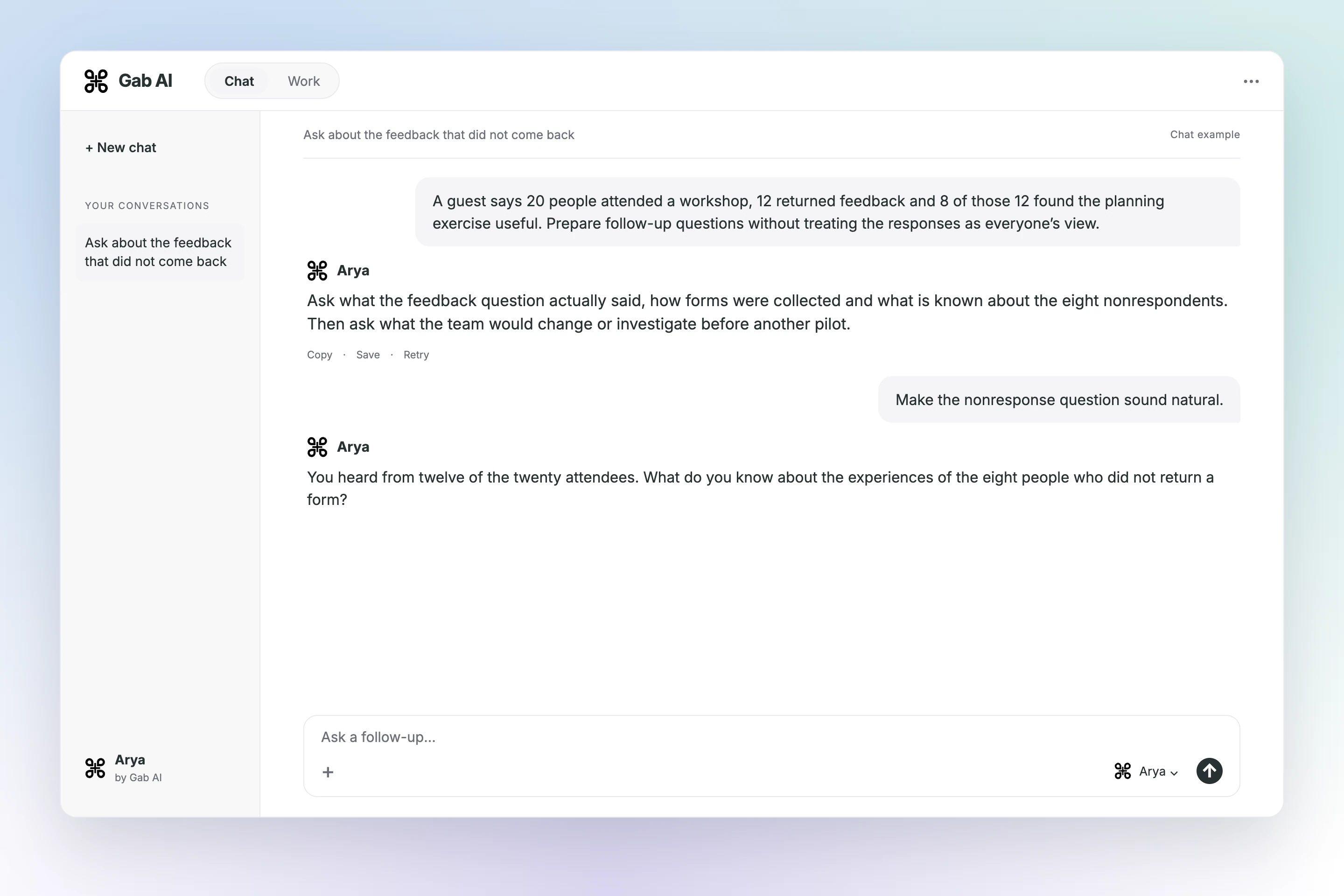
Ask what the feedback question actually said, how forms were collected and what is known about the eight nonrespondents. Then ask what the team would change or investigate before another pilot.
Your follow-up
Make the nonresponse question sound natural.
Arya
You heard from twelve of the twenty attendees. What do you know about the experiences of the eight people who did not return a form?
Make the opening match the evidence
Twenty people attended the pilot, and twelve returned feedback.
Twenty people attended the pilot, and twelve returned feedback. Eight of those twelve found the planning exercise useful. Today we ask what those responses tell us, what they leave open and what to try next.
Your follow-up
Make it more conversational.
Arya
A small pilot gives you something to learn from, but rarely the whole picture. Today we look at twelve feedback forms from twenty attendees and ask what the next workshop should investigate.
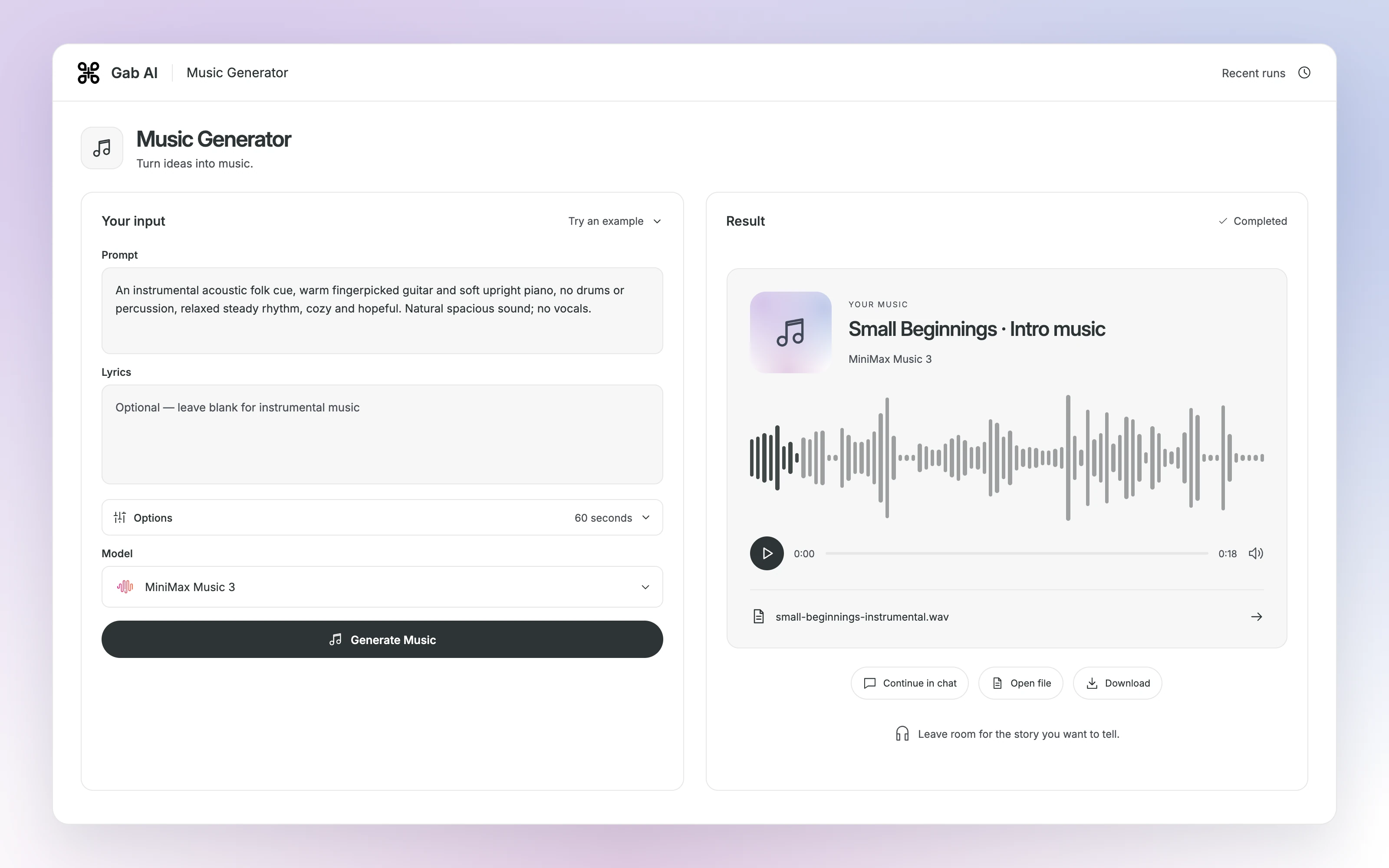
Find a sound that leaves room for the spoken story
Describe the arrangement and review how the finished track fits the project.
1An instrumental acoustic folk cue, warm fingerpicked guitar and soft upright piano, no drums or percussion, relaxed steady rhythm, cozy and hopeful. Natural spacious sound; no vocals.
Use Prompt for the sound and Lyrics for words you have permission to use. Check the available model and estimate before generating another take.
Turn a transcript into show notes and an editing handoff
Create show notes from your transcript, prepare a production handoff and find better follow-up questions in what the guest actually said.
Turn a supplied transcript into inspectable show notes
Read four chapter excerpts and keep the feedback figures in their proper context.
Twenty attendees; twelve feedback forms; eight respondents found the exercise useful. There is no measured change in practice and no feedback from eight attendees.
Workshop-podcast-transcript.txt
Four supplied chapter ranges
00:00 opening; 00:30 pilot feedback; 02:00 limits and follow-up; 03:30 next steps. Each selection reveals its source excerpt, not a playable clip.
Workshop-podcast-transcript.txt
Review episode notes and excerpts. Use the chapter buttons to jump between passages.
Read the prompt and inspect the full example
Read four chapter excerpts and keep the feedback figures in their proper context.
HOST: Today we are talking about a small workshop pilot: what its feedback tells us and what it leaves unanswered.
00:30–02:00 · Guest
GUEST: Twenty people attended our pilot. Twelve returned the feedback form. Eight of those twelve said the planning exercise was useful. We did not receive feedback from the other eight attendees.
02:00–03:30 · Guest
GUEST: It was one small, self-selected group. We have not measured whether anyone changed their practice afterward. I would repeat the exercise and ask a more specific follow-up question.
03:30–04:00 · Host
HOST: Before the next workshop, we will ask which part of the planning exercise participants used. The date, signup link and contact address are still to be confirmed.
Timing and quotation scope
The four supplied chapter ranges cover 00:00–04:00. These are transcript excerpts, not a word-aligned transcript or an audio recording. Do not invent exact quotation offsets, playable clips, audio edits or measured audio quality.
Workshop-podcast-editorial-brief.txt
Episode purpose
Working title: Small experiments, honest feedback. Audience: workshop facilitators. Guest role: workshop coordinator; no personal name or further credentials are supplied. Explain the pilot without turning feedback into a promised outcome.
Show-note format
Use a short summary and four chapter buttons. Each button displays the corresponding supplied transcript excerpt. Show guest role, a factual takeaway and an editorial review note. Do not add a player, RSS publication, outside links or invented resources.
Production handoff
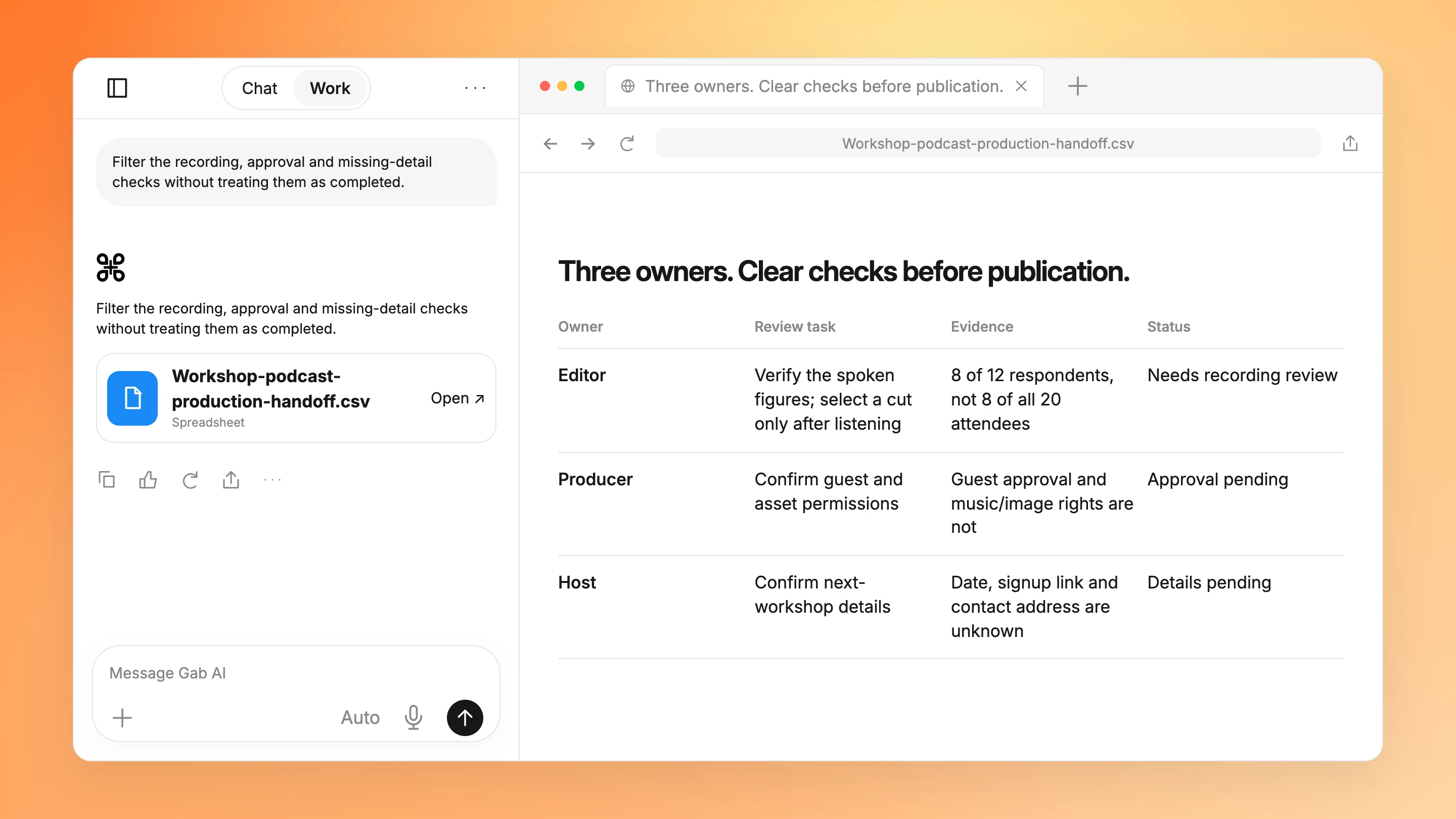
Editor: check numerical wording against the transcript and actual recording before selecting a cut. Producer: confirm guest approval, permitted quotations and any music or image rights. Host: confirm the next-workshop date, signup link and contact address. No approvals or dates are recorded in this brief.
Give the editor, producer and host specific review tasks
Filter the recording, approval and missing-detail checks without treating them as completed.
HOST: Today we are talking about a small workshop pilot: what its feedback tells us and what it leaves unanswered.
00:30–02:00 · Guest
GUEST: Twenty people attended our pilot. Twelve returned the feedback form. Eight of those twelve said the planning exercise was useful. We did not receive feedback from the other eight attendees.
02:00–03:30 · Guest
GUEST: It was one small, self-selected group. We have not measured whether anyone changed their practice afterward. I would repeat the exercise and ask a more specific follow-up question.
03:30–04:00 · Host
HOST: Before the next workshop, we will ask which part of the planning exercise participants used. The date, signup link and contact address are still to be confirmed.
Timing and quotation scope
The four supplied chapter ranges cover 00:00–04:00. These are transcript excerpts, not a word-aligned transcript or an audio recording. Do not invent exact quotation offsets, playable clips, audio edits or measured audio quality.
Workshop-podcast-editorial-brief.txt
Episode purpose
Working title: Small experiments, honest feedback. Audience: workshop facilitators. Guest role: workshop coordinator; no personal name or further credentials are supplied. Explain the pilot without turning feedback into a promised outcome.
Show-note format
Use a short summary and four chapter buttons. Each button displays the corresponding supplied transcript excerpt. Show guest role, a factual takeaway and an editorial review note. Do not add a player, RSS publication, outside links or invented resources.
Production handoff
Editor: check numerical wording against the transcript and actual recording before selecting a cut. Producer: confirm guest approval, permitted quotations and any music or image rights. Host: confirm the next-workshop date, signup link and contact address. No approvals or dates are recorded in this brief.
Prepare questions around the gaps in the episode
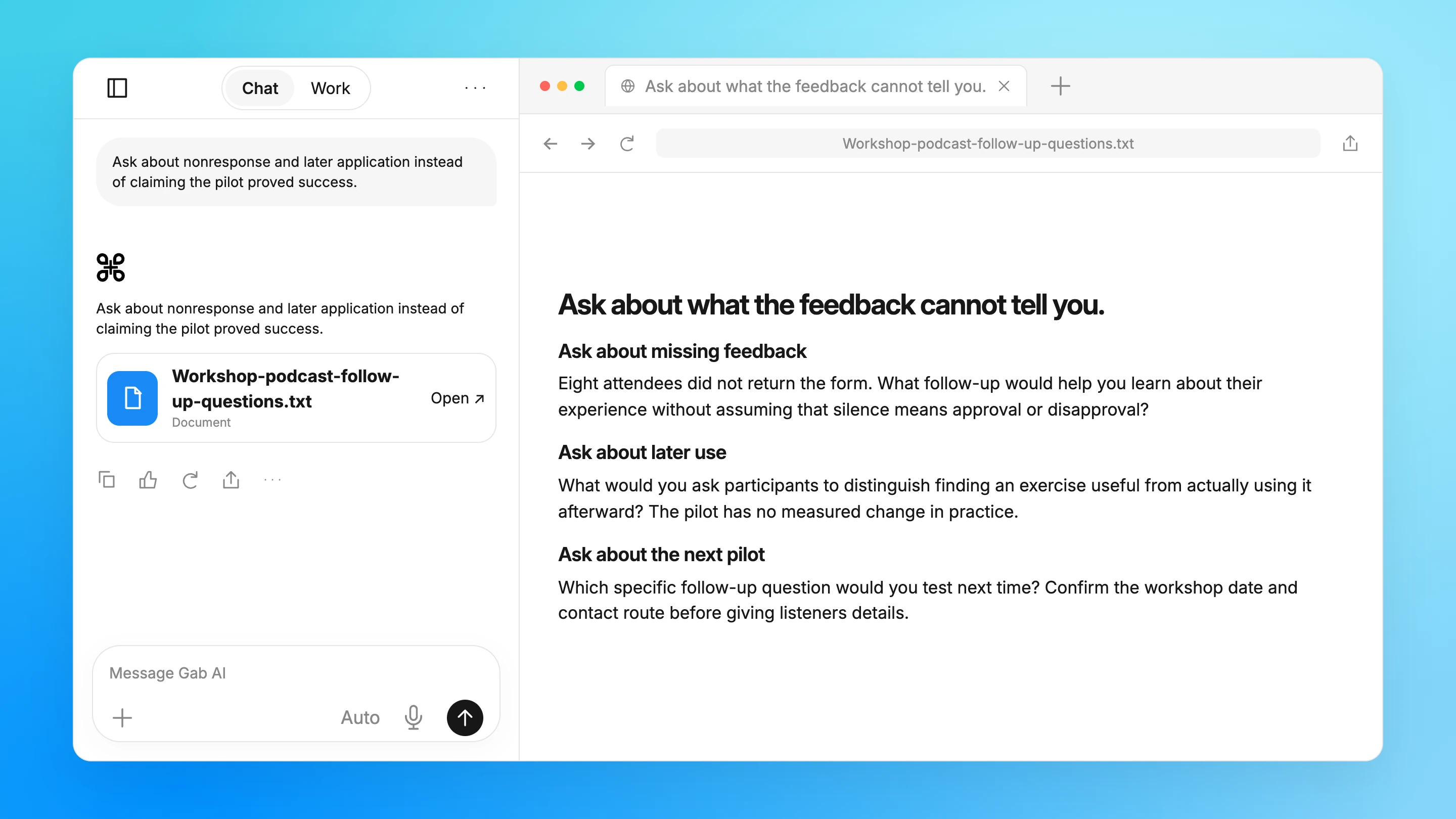
Ask about nonresponse and later application instead of claiming the pilot proved success.
Ask about nonresponse and later application instead of claiming the pilot proved success.
Loading…
This content could not load.
Your source material stays available.
Ask about what the feedback cannot tell you.
Ask about missing feedback
Eight attendees did not return the form. What follow-up would help you learn about their experience without assuming that silence means approval or disapproval?
Workshop-podcast-transcript.txt
Workshop-podcast-editorial-brief.txt
View full example
Ask about later use
What would you ask participants to distinguish finding an exercise useful from actually using it afterward? The pilot has no measured change in practice.
Workshop-podcast-transcript.txt
Workshop-podcast-editorial-brief.txt
Ask about the next pilot
Which specific follow-up question would you test next time? Confirm the workshop date and contact route before giving listeners details.
Workshop-podcast-transcript.txt
An interview guide based on the supplied pilot evidence, without a new guest biography or invented findings.
HOST: Today we are talking about a small workshop pilot: what its feedback tells us and what it leaves unanswered.
00:30–02:00 · Guest
GUEST: Twenty people attended our pilot. Twelve returned the feedback form. Eight of those twelve said the planning exercise was useful. We did not receive feedback from the other eight attendees.
02:00–03:30 · Guest
GUEST: It was one small, self-selected group. We have not measured whether anyone changed their practice afterward. I would repeat the exercise and ask a more specific follow-up question.
03:30–04:00 · Host
HOST: Before the next workshop, we will ask which part of the planning exercise participants used. The date, signup link and contact address are still to be confirmed.
Timing and quotation scope
The four supplied chapter ranges cover 00:00–04:00. These are transcript excerpts, not a word-aligned transcript or an audio recording. Do not invent exact quotation offsets, playable clips, audio edits or measured audio quality.
Workshop-podcast-editorial-brief.txt
Episode purpose
Working title: Small experiments, honest feedback. Audience: workshop facilitators. Guest role: workshop coordinator; no personal name or further credentials are supplied. Explain the pilot without turning feedback into a promised outcome.
Show-note format
Use a short summary and four chapter buttons. Each button displays the corresponding supplied transcript excerpt. Show guest role, a factual takeaway and an editorial review note. Do not add a player, RSS publication, outside links or invented resources.
Production handoff
Editor: check numerical wording against the transcript and actual recording before selecting a cut. Producer: confirm guest approval, permitted quotations and any music or image rights. Host: confirm the next-workshop date, signup link and contact address. No approvals or dates are recorded in this brief.
About these examples
Prepare podcast show notes, chapters and interview questions
Open an example to inspect the prompt, sample inputs and completed result.
A useful result, with the details behind it
Turn a supplied transcript into inspectable show notes
Read four chapter excerpts and keep the feedback figures in their proper context.
Add the permitted transcript and editorial brief before sending. The sample chapter controls reveal text excerpts.
Read all source material
Workshop-podcast-transcript.txt
00:00–00:30 · Host
HOST: Today we are talking about a small workshop pilot: what its feedback tells us and what it leaves unanswered.
00:30–02:00 · Guest
GUEST: Twenty people attended our pilot. Twelve returned the feedback form. Eight of those twelve said the planning exercise was useful. We did not receive feedback from the other eight attendees.
02:00–03:30 · Guest
GUEST: It was one small, self-selected group. We have not measured whether anyone changed their practice afterward. I would repeat the exercise and ask a more specific follow-up question.
03:30–04:00 · Host
HOST: Before the next workshop, we will ask which part of the planning exercise participants used. The date, signup link and contact address are still to be confirmed.
Timing and quotation scope
The four supplied chapter ranges cover 00:00–04:00. These are transcript excerpts, not a word-aligned transcript or an audio recording. Do not invent exact quotation offsets, playable clips, audio edits or measured audio quality.
Workshop-podcast-editorial-brief.txt
Episode purpose
Working title: Small experiments, honest feedback. Audience: workshop facilitators. Guest role: workshop coordinator; no personal name or further credentials are supplied. Explain the pilot without turning feedback into a promised outcome.
Show-note format
Use a short summary and four chapter buttons. Each button displays the corresponding supplied transcript excerpt. Show guest role, a factual takeaway and an editorial review note. Do not add a player, RSS publication, outside links or invented resources.
Production handoff
Editor: check numerical wording against the transcript and actual recording before selecting a cut. Producer: confirm guest approval, permitted quotations and any music or image rights. Host: confirm the next-workshop date, signup link and contact address. No approvals or dates are recorded in this brief.
Draft podcast show notes
Read four chapter excerpts and keep the feedback figures in their proper context.
Refine episode claims and production notes
Compare the draft with a focused revision, keeping the source facts in view.
Try one focused revision
Suggested follow-up using the same source facts.
Focused follow-up
What change should I ask for?
Write a plain show-note summary. Retain the twenty attendees, twelve forms and eight useful ratings; make the missing outcome evidence explicit.
Original excerpt
What does the existing example say?
Twenty attendees; twelve feedback forms; eight respondents found the exercise useful. There is no measured change in practice and no feedback from eight attendees.
Suggested revision
What could that revision look like?
Twenty people attended; twelve returned feedback forms, and eight respondents found the exercise useful. Eight attendees supplied no feedback, and no change in practice was measured.
Open the numbers and the limitation beside the takeaway.
Did all twenty attendees recommend the exercise?
Useful ratings No. Eight of twelve respondents said the exercise was useful. Feedback from the other eight attendees is absent, and recommendation was not the stated measure.
Did the exercise change participants’ practice?
Later use That was not measured. The guest explicitly separates feedback from later use.
Use Chat to discuss the request and refine the result with follow-up questions.
Deliverable: Interview question guide
What to provide
Verified guest background, episode aim and topic boundaries
Example prompt
Draft interview questions from this verified guest background and episode aim. Include evidence-testing follow-ups and clear transitions, flag biographical claims needing confirmation and do not fabricate achievements or quotations.
What to check
Verify guest and topic facts
Clear quotations and media rights
Review before recording or publishing
Work
Turn a supplied transcript into inspectable show notes
Read four chapter excerpts and keep the feedback figures in their proper context.
Use Work to create and revise the named file from the supplied sources.
Deliverable: Workshop-podcast-show-notes.html
What to provide
Workshop-podcast-transcript.txt
Workshop-podcast-editorial-brief.txt
Example prompt
Create Workshop-podcast-show-notes.html from Workshop-podcast-transcript.txt and Workshop-podcast-editorial-brief.txt. Use the working title, supplied guest role and four chapter ranges. Let chapter buttons reveal their exact transcript excerpts. State 20 attendees, 12 responses and 8 useful ratings among those respondents; keep absent feedback and unmeasured later use explicit. Make a self-contained, keyboard-accessible HTML resource. Do not add audio playback, exact quote offsets, invented links or publication.
What to check
Inspect the supplied sample files
Check the result against your own sources
Review before sharing or acting
Work
Give the editor, producer and host specific review tasks
Filter the recording, approval and missing-detail checks without treating them as completed.
Create Workshop-podcast-production-handoff.csv from Workshop-podcast-transcript.txt and Workshop-podcast-editorial-brief.txt. Assign the supplied editor, producer and host checks with source references and outstanding status. Require actual-recording review before cuts, guest and asset permission checks, and confirmation of workshop details. Do not invent dates, approvals, audio edits or automatic publishing.
What to check
Inspect the supplied sample files
Check the result against your own sources
Review before sharing or acting
Chat
Prepare questions around the gaps in the episode
Ask about nonresponse and later application instead of claiming the pilot proved success.
Using Workshop-podcast-transcript.txt and Workshop-podcast-editorial-brief.txt, prepare three follow-up questions for the workshop coordinator about missing feedback, later application and the next pilot. Keep questions distinct from findings, use only the supplied guest role and do not invent biography or dates.
What to check
Inspect the supplied sample files
Check the result against your own sources
Review before sharing or acting
More prompts
Chat
Tighten an episode introduction
A concise spoken introduction with accurate guest details and factual checks identified.
Use Chat to discuss the request and refine the result with follow-up questions.
Deliverable: Introduction revision
What to provide
Your draft, approved guest details and target running time
Example prompt
Revise this podcast introduction for the stated spoken running time. Keep the guest facts accurate, explain the listener's reason to care and mark any statement needing a source. Do not invent endorsements or exaggerated credentials.
What to check
Verify guest and topic facts
Clear quotations and media rights
Review before recording or publishing
Work
Create an episode preparation pack
An episode document combining the approved outline, source notes and recording preparation questions.
Use Work to build and revise Episode preparation pack.docx from your source material.
Deliverable: Episode preparation pack.docx
What to provide
Approved outline, source links and guest permissions
Example prompt
Build an editable episode pack with outline, interview questions, source notes, pronunciation queries and recording checklist. Distinguish planned talking points from statements already recorded and flag permissions still needing confirmation. Deliver "Episode preparation pack.docx" as the requested editable artifact. Ask for missing source material rather than inventing facts.
What to check
Verify guest and topic facts
Clear quotations and media rights
Review before recording or publishing
Work
Build a podcast production workbook
A production workbook linking episode deliverables to dependencies, rights checks and approvals.
Use Work to build and revise Podcast production workbook.xlsx from your source material.
Deliverable: Podcast production workbook.xlsx
What to provide
Episode list, team availability, confirmed dates and deliverables
Example prompt
Create a workbook tracking recording, editing, fact-checking, asset permissions, review owner and planned publication. Flag dependencies and unconfirmed dates; do not upload episodes or create automatic publishing jobs. Deliver "Podcast production workbook.xlsx" as the requested editable artifact. Ask for missing source material rather than inventing facts.
Can Gab AI create podcast show notes from a transcript?
Supply a permitted transcript and your editorial brief. Ask Work for summaries, chapters and a completed notes document. This example lets you inspect each supplied excerpt; it does not demonstrate live audio transcription.
Can it prepare podcast editing notes?
It can organize an editor’s review tasks from supplied notes and timestamps. Exact cuts, sound quality and quotation timing still require the actual recording. The sample is a production handoff, not an edited audio file.
How can I keep a guest’s claims accurate?
Keep quotations, sample sizes and caveats together. The example preserves eight useful ratings among twelve respondents and leaves missing feedback and later outcomes unresolved.
Does selecting a chapter play or publish the episode?
No. The chapter buttons reveal text from the transcript. Nothing is played, uploaded, scheduled or published.
How should I summarize feedback figures in show notes?
Keep the denominators visible. The sample has twenty attendees, twelve returned forms and eight respondents who found the exercise useful. That is not eight measured improvements or evidence about all twenty attendees. Check any quotation and proposed chapter time against the final episode.
Can I start in Chat, or do I need Work?
Use Chat for questions and text drafts. Choose Work when you want a project with tools and editable files. Work requires Plus and uses credits; see Pricing for plans and allowances. Opening a draft does not send it or attach the example files.