AI for teachers: lesson plans and classroom materials.
Develop lesson plans, create worksheets with answer keys and adapt materials for different reading levels. Start with the learning goal and keep it consistent as you change the activity and support.
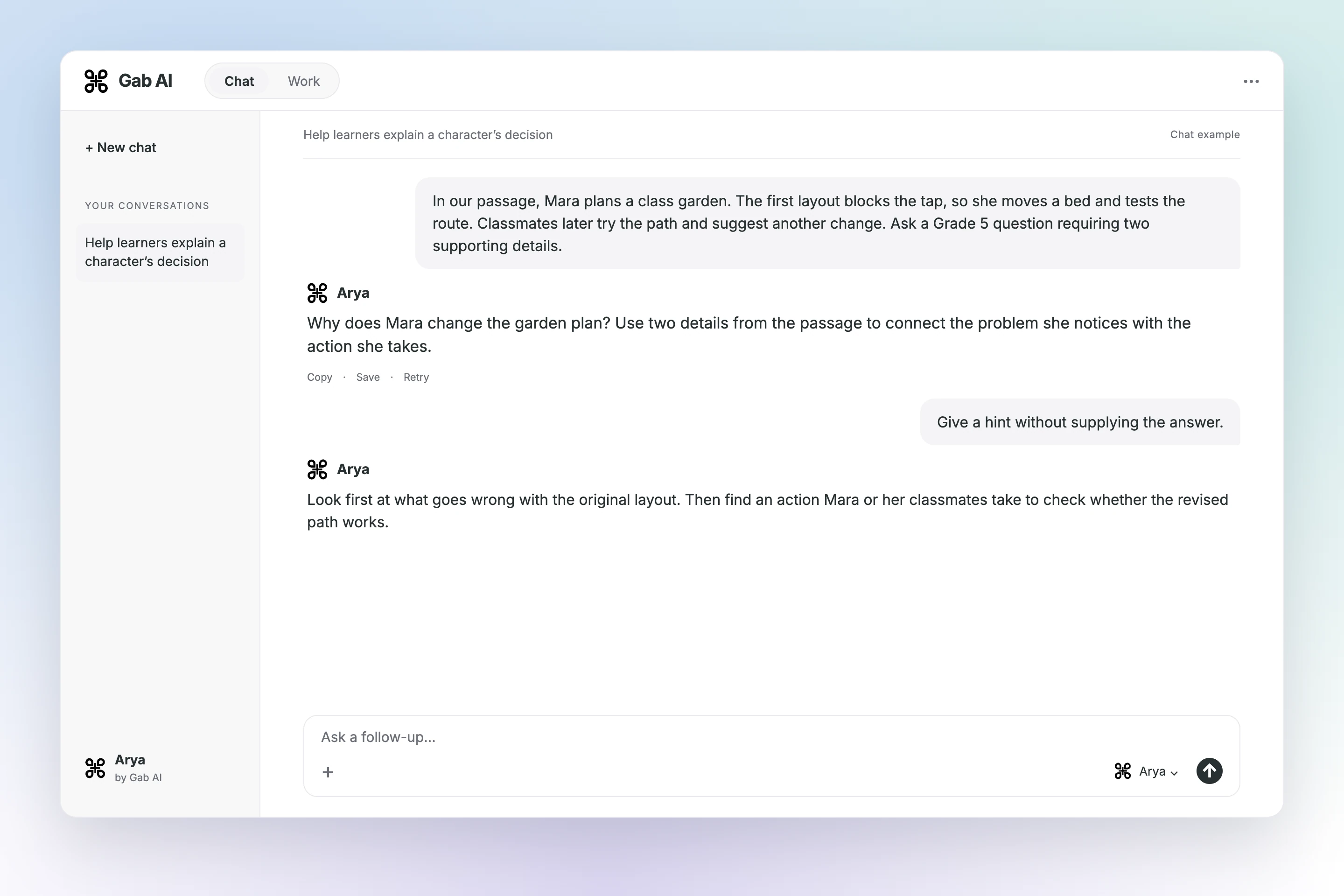
You connected the change to a clear problem: the blocked tap. Add a second detail about how Mara or the class checked the new layout, and explain how it supports your answer.
Your follow-up
Turn that into one short next step.
Arya
Keep your point about the blocked tap. Add what happened when Mara tested the route, then explain why that mattered.
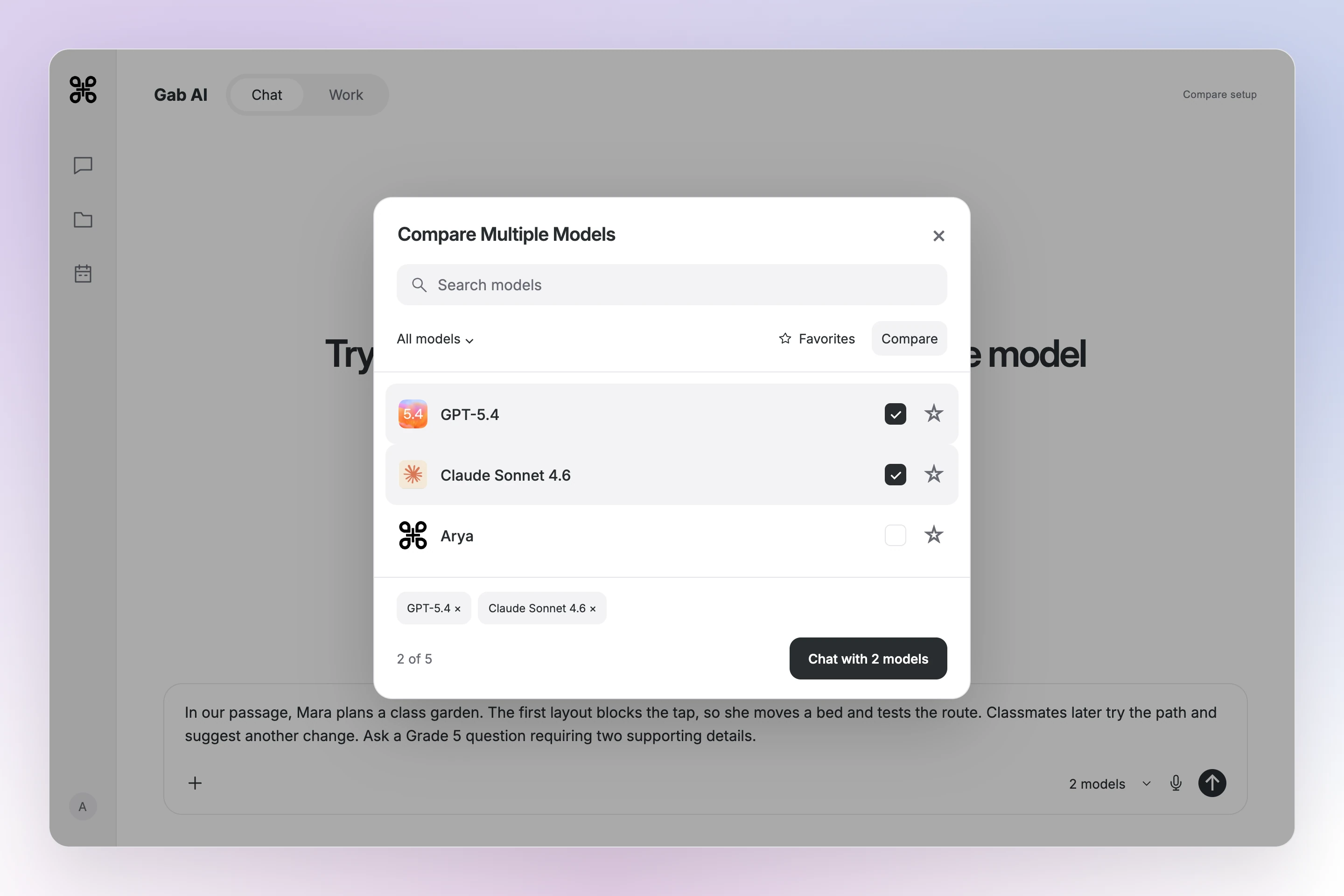
Try the same question with more than one model
Choose compatible models, compare their reasoning and decide which answer helps with your task.
In the model picker, turn on Compare and choose compatible models before sending the same prompt. Compare requires Plus; model access and credit use depend on the selection. Check facts and omissions rather than assuming a winner.
Build a lesson pack and adapt it for different learners
Plan from your learning goal, adapt the materials and inspect the teacher guide—from early-years patterns to secondary evidence and career-linked documentation.
Prepare the text-evidence lesson plan
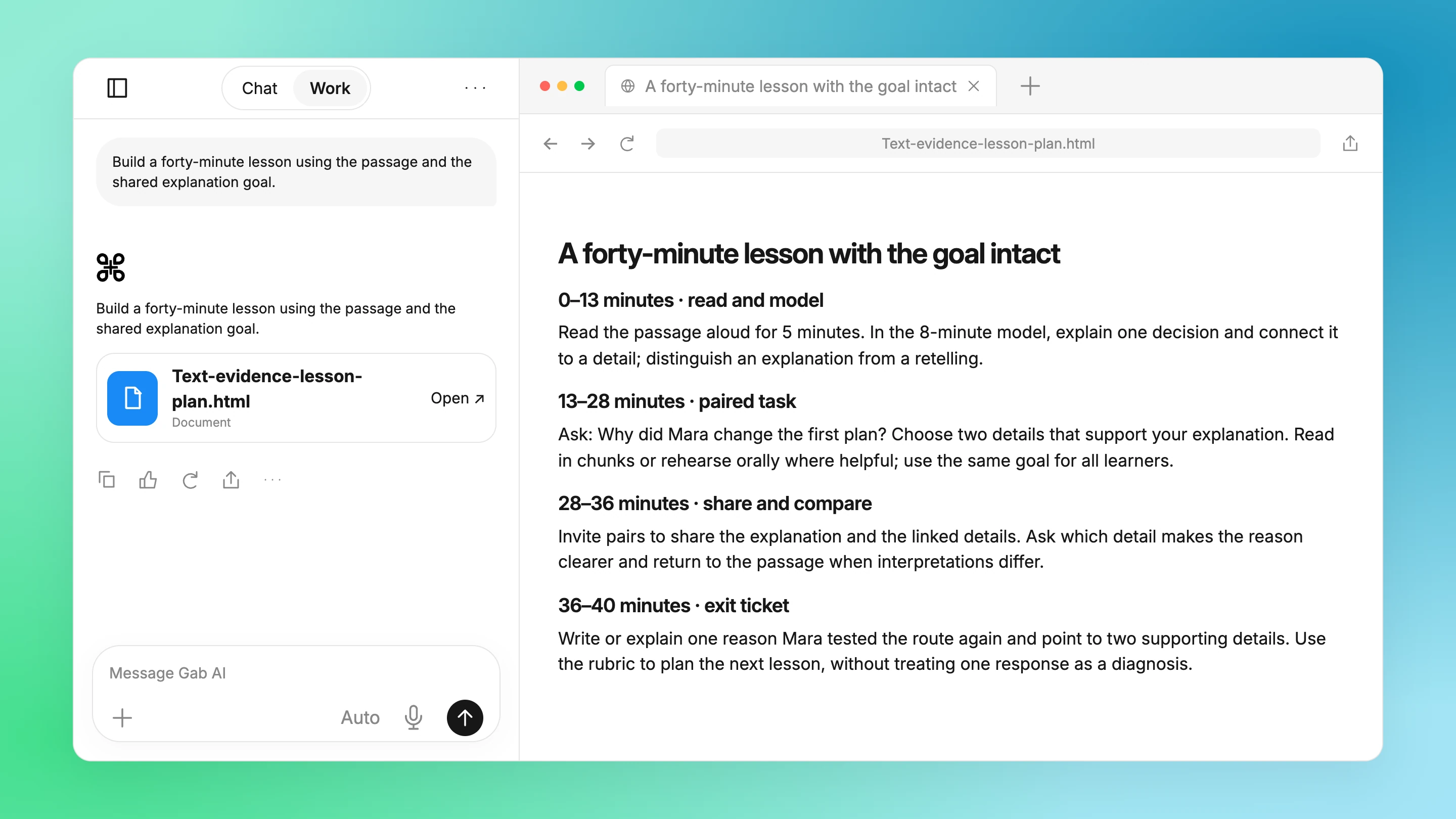
Build a forty-minute lesson using the passage and the shared explanation goal.
Build a forty-minute lesson using the passage and the shared explanation goal.
Loading…
This content could not load.
Your source material stays available.
A forty-minute lesson with the goal intact
0–13 minutes · read and model
Read the passage aloud for 5 minutes. In the 8-minute model, explain one decision and connect it to a detail; distinguish an explanation from a retelling.
Evidence-reading-lesson.txt
View full example
13–28 minutes · paired task
Ask: Why did Mara change the first plan? Choose two details that support your explanation. Read in chunks or rehearse orally where helpful; use the same goal for all learners.
Evidence-reading-lesson.txt
28–36 minutes · share and compare
Invite pairs to share the explanation and the linked details. Ask which detail makes the reason clearer and return to the passage when interpretations differ.
Evidence-reading-lesson.txt
36–40 minutes · exit ticket
Write or explain one reason Mara tested the route again and point to two supporting details. Use the rubric to plan the next lesson, without treating one response as a diagnosis.
Evidence-reading-lesson.txt
The completed plan uses the actual passage, timing and supported access options.
Mara wanted the class garden to be easier to water. She drew the beds, measured the path and asked classmates which corners they could not reach. The first plan looked tidy, but it blocked the tap. Mara moved one bed and tested the route again. On Friday, classmates carried empty watering cans along the path and suggested one more change.
Learning goal and timing
Grade 5: explain a character’s decision using two details from the passage. Forty minutes: 5-minute read-aloud, 8-minute model, 15-minute paired work, 8-minute sharing, 4-minute exit ticket. No district standard or student diagnosis is supplied.
Access and extension
Support: read aloud, chunk the passage, offer a sentence frame and permit oral rehearsal. Extension: explain why the first plan changed using two details and consider the role of feedback. Preserve the same goal; do not lower expectations based on a label.
Create two text-evidence worksheet entry points
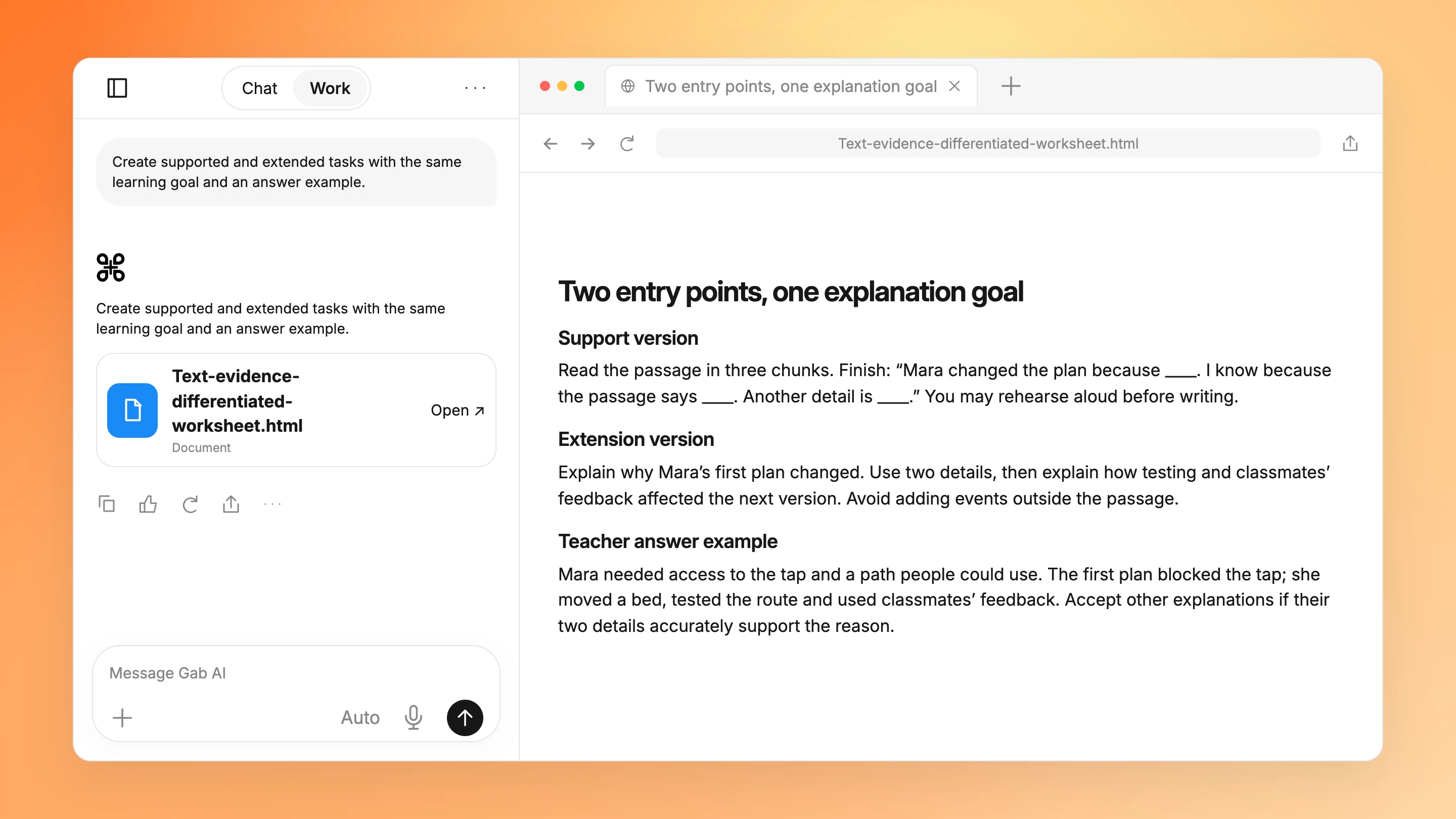
Create supported and extended tasks with the same learning goal and an answer example.
Create supported and extended tasks with the same learning goal and an answer example.
Loading…
This content could not load.
Your source material stays available.
Two entry points, one explanation goal
Support version
Read the passage in three chunks. Finish: “Mara changed the plan because ____. I know because the passage says ____. Another detail is ____.” You may rehearse aloud before writing.
Evidence-reading-lesson.txt
View full example
Extension version
Explain why Mara’s first plan changed. Use two details, then explain how testing and classmates’ feedback affected the next version. Avoid adding events outside the passage.
Evidence-reading-lesson.txt
Teacher answer example
Mara needed access to the tap and a path people could use. The first plan blocked the tap; she moved a bed, tested the route and used classmates’ feedback. Accept other explanations if their two details accurately support the reason.
Evidence-response-rubric.txt
Evidence-reading-lesson.txt
The support and extension versions assess the same supplied learning goal.
Mara wanted the class garden to be easier to water. She drew the beds, measured the path and asked classmates which corners they could not reach. The first plan looked tidy, but it blocked the tap. Mara moved one bed and tested the route again. On Friday, classmates carried empty watering cans along the path and suggested one more change.
Learning goal and timing
Grade 5: explain a character’s decision using two details from the passage. Forty minutes: 5-minute read-aloud, 8-minute model, 15-minute paired work, 8-minute sharing, 4-minute exit ticket. No district standard or student diagnosis is supplied.
Access and extension
Support: read aloud, chunk the passage, offer a sentence frame and permit oral rehearsal. Extension: explain why the first plan changed using two details and consider the role of feedback. Preserve the same goal; do not lower expectations based on a label.
Evidence-response-rubric.txt
Three-level criteria
Ready: explains the decision and connects two accurate details to the explanation. Developing: offers a plausible explanation with one accurate linked detail. Revisit: retells or gives an unsupported explanation. Assess only what the response shows.
Sample response
Mara changed the plan because the first layout blocked the tap and classmates needed a workable path. She moved a bed and tested the route, then used classmates’ suggestions to improve it. Details: blocked tap; route test and class feedback.
Material review
Instructional coordinator check: task, support version, extension and rubric all assess explanation with text evidence. For another grade or technical subject, supply its own passage and goal rather than assigning this grade-5 task unchanged.
Build lesson materials for distinct teaching contexts
Switch the learning context and inspect its materials, timing and teacher guide.
Five contexts. Different materials. A clear learning goal.
About this example
Preschool & kindergarten
Continue an AB shape pattern and explain what repeats. The next shape is a circle. The repeating pair is circle then triangle. A correct next shape alone does not show whether the learner can explain the repeating pair.
Teaching-context-briefs.txt
Elementary & supported reading
Explain Mara’s decision using two accurate details from the passage. The first plan blocked the tap. Mara moved a bed and tested the route, then used classmates’ feedback. Other explanations are acceptable when two accurate details support the reason.
Teaching-context-briefs.txt
Middle & high school
Support a quantitative claim with two recorded values and distinguish recorded totals from missing days. The three recorded days total 45 loans. Wednesday has six more than Monday. This is not an established five-day weekly total; the two missing days are unknown, not zero.
Teaching-context-briefs.txt
Secondary & postsecondary CTE
Convert supplied pack quantities into an accurate work-order note and identify what remains unquoted. Four packs provide 24 items, leaving four beyond the requested 20. The quoted materials subtotal is USD 48. Labor, freight and tax are not supplied; do not call USD 48 the full project cost.
Teaching-context-briefs.txt
Postsecondary health-specialties education
Separate recorded observations, interpretations and missing evidence in a classroom simulation debrief. The request, reading and clarification are recorded observations. “The activity was completed successfully” is unsupported: no completion or assessment outcome is supplied. Ask for the missing outcome rather than inventing it.
Teaching-context-briefs.txt
Review across the materials
These five purpose-created lesson models have different goals, materials and response evidence. Early years: pattern continuation and explanation. Grade 5: explanation with two text details. Secondary: quantitative claim with two recorded values and a missing-data boundary. Career and technical: pack units, work-order quantity and quoted-cost exclusions. Health teaching: observed versus unsupported statements in a training log. Review goal, task, access options and assessment together. No adopted standards, curriculum edition or individual accommodation plan is supplied; do not claim formal alignment or universal readiness.
Teaching-context-briefs.txt
Explore the learning task and teacher guide for each context. Adapt the materials to your adopted curriculum and learners.
Read the prompt and inspect the full example
Switch the learning context and inspect its materials, timing and teacher guide.
Mara wanted the class garden to be easier to water. She drew the beds, measured the path and asked classmates which corners they could not reach. The first plan looked tidy, but it blocked the tap. Mara moved one bed and tested the route again. On Friday, classmates carried empty watering cans along the path and suggested one more change.
Learning goal and timing
Grade 5: explain a character’s decision using two details from the passage. Forty minutes: 5-minute read-aloud, 8-minute model, 15-minute paired work, 8-minute sharing, 4-minute exit ticket. No district standard or student diagnosis is supplied.
Access and extension
Support: read aloud, chunk the passage, offer a sentence frame and permit oral rehearsal. Extension: explain why the first plan changed using two details and consider the role of feedback. Preserve the same goal; do not lower expectations based on a label.
Evidence-response-rubric.txt
Three-level criteria
Ready: explains the decision and connects two accurate details to the explanation. Developing: offers a plausible explanation with one accurate linked detail. Revisit: retells or gives an unsupported explanation. Assess only what the response shows.
Sample response
Mara changed the plan because the first layout blocked the tap and classmates needed a workable path. She moved a bed and tested the route, then used classmates’ suggestions to improve it. Details: blocked tap; route test and class feedback.
Material review
Instructional coordinator check: task, support version, extension and rubric all assess explanation with text evidence. For another grade or technical subject, supply its own passage and goal rather than assigning this grade-5 task unchanged.
Teaching-context-briefs.txt
Preschool & kindergarten learning brief
Context: Preschool & kindergarten. Learning goal: Continue an AB shape pattern and explain what repeats. Lesson time: 20 minutes. Learner task: Arrange circle, triangle, circle, triangle, circle, triangle. Ask what comes next and what repeats. Accept pointing, arranging or a spoken explanation.
Preschool & kindergarten teacher guide
Sequence: 3 minutes: Notice the shapes; 5 minutes: Model the repeating pair; 8 minutes: Build and discuss; 4 minutes: Show the next shape. Teacher answer: The next shape is a circle. The repeating pair is circle then triangle. A correct next shape alone does not show whether the learner can explain the repeating pair. Supplied access options: The brief supplies large printed shapes, an adult model and pointing or oral response options. Select appropriate materials and approved supports for the real class. Review: Observe the next shape and the explanation of the repeating pair; record the response, not a judgment of ability.
Elementary & supported reading learning brief
Context: Elementary & supported reading. Learning goal: Explain Mara’s decision using two accurate details from the passage. Lesson time: 40 minutes. Learner task: Why did Mara change the first garden plan? Explain the reason and connect two details from the original passage.
Elementary & supported reading teacher guide
Sequence: 5 minutes: Read aloud; 8 minutes: Model an explanation; 15 minutes: Work in pairs; 8 minutes: Share and compare; 4 minutes: Exit ticket. Teacher answer: The first plan blocked the tap. Mara moved a bed and tested the route, then used classmates’ feedback. Other explanations are acceptable when two accurate details support the reason. Supplied access options: Read aloud, chunk the passage, offer a sentence frame and permit oral rehearsal. Preserve the explanation goal and the two-detail requirement. Review: Use the supplied Ready / Developing / Revisit rubric to inspect evidence in the response. No diagnosis or district-standard alignment is established.
Middle & high school learning brief
Context: Middle & high school. Learning goal: Support a quantitative claim with two recorded values and distinguish recorded totals from missing days. Lesson time: 25 minutes. Learner task: A library recorded 12 loans on Monday, 18 on Wednesday and 15 on Friday. State the recorded total and compare two days. Tuesday and Thursday were not supplied.
Middle & high school teacher guide
Sequence: 4 minutes: Read the data; 6 minutes: Model a bounded claim; 8 minutes: Compare in pairs; 4 minutes: Explain the evidence; 3 minutes: Exit check. Teacher answer: The three recorded days total 45 loans. Wednesday has six more than Monday. This is not an established five-day weekly total; the two missing days are unknown, not zero. Supplied access options: The brief permits reading labels aloud and using a text list beside the bars. Extend by comparing a difference and ratio while keeping the same evidence requirement. Review: Check the arithmetic, units, two cited values and wording of the conclusion. Do not infer the cause of the difference.
Secondary & postsecondary CTE learning brief
Context: Secondary & postsecondary CTE. Learning goal: Convert supplied pack quantities into an accurate work-order note and identify what remains unquoted. Lesson time: 35 minutes. Learner task: A classroom work order needs 20 items. The supplied quote lists four packs, six items per pack and USD 12 per pack. Document the quantity, surplus and quoted materials subtotal.
Secondary & postsecondary CTE teacher guide
Sequence: 5 minutes: Read the order; 7 minutes: Model the units; 10 minutes: Prepare the note; 8 minutes: Review the evidence; 5 minutes: Exit check. Teacher answer: Four packs provide 24 items, leaving four beyond the requested 20. The quoted materials subtotal is USD 48. Labor, freight and tax are not supplied; do not call USD 48 the full project cost. Supplied access options: The brief provides a labeled quantity table and an oral review before the written note. It contains no approved technical or safety procedure. Review: Verify pack-to-item conversion, currency and exclusions. This teaches documentation; technical or safety instruction requires the approved procedure.
Context: Postsecondary health-specialties education. Learning goal: Separate recorded observations, interpretations and missing evidence in a classroom simulation debrief. Lesson time: 30 minutes. Learner task: The purpose-created skills-lab log records a checklist request at 10:00, a peer reading the supplied instruction at 10:02 and a supervisor requesting clarification at 10:04. Classify what the log supports and what still needs checking.
Sequence: 5 minutes: Read the training log; 8 minutes: Model the categories; 10 minutes: Discuss in triads; 5 minutes: Debrief; 2 minutes: Exit check. Teacher answer: The request, reading and clarification are recorded observations. “The activity was completed successfully” is unsupported: no completion or assessment outcome is supplied. Ask for the missing outcome rather than inventing it. Supplied access options: The brief permits category cards, paired oral discussion and a written summary. There are no patient details, clinical findings or technical procedures in this exercise. Review: Check each statement against the training log. This is a documentation and evidence exercise, not a clinical protocol, learner competency certification or patient-care recommendation.
Instructional coordinator review
These five purpose-created lesson models have different goals, materials and response evidence. Early years: pattern continuation and explanation. Grade 5: explanation with two text details. Secondary: quantitative claim with two recorded values and a missing-data boundary. Career and technical: pack units, work-order quantity and quoted-cost exclusions. Health teaching: observed versus unsupported statements in a training log. Review goal, task, access options and assessment together. No adopted standards, curriculum edition or individual accommodation plan is supplied; do not claim formal alignment or universal readiness.
Shared access boundary
Access options in these briefs support the stated task rather than replacing its learning goal. Real use requires the teacher to choose appropriate materials, verify answers and follow the documented supports approved for that class. Do not infer a diagnosis, lower expectations from a label, create an accommodation plan or award a competency result from this sample.
About these examples
Create lesson plans, worksheets and learning activities
Explore the sample deliverables, then open the workflow to inspect their inputs and evidence.
From the first question to useful work
Prepare the text-evidence lesson plan
Build a forty-minute lesson using the passage and the shared explanation goal.
Add the learning goal, source passage, lesson duration and appropriate class supports before sending.
Read all source material
Evidence-reading-lesson.txt
Original classroom passage
Mara wanted the class garden to be easier to water. She drew the beds, measured the path and asked classmates which corners they could not reach. The first plan looked tidy, but it blocked the tap. Mara moved one bed and tested the route again. On Friday, classmates carried empty watering cans along the path and suggested one more change.
Learning goal and timing
Grade 5: explain a character’s decision using two details from the passage. Forty minutes: 5-minute read-aloud, 8-minute model, 15-minute paired work, 8-minute sharing, 4-minute exit ticket. No district standard or student diagnosis is supplied.
Access and extension
Support: read aloud, chunk the passage, offer a sentence frame and permit oral rehearsal. Extension: explain why the first plan changed using two details and consider the role of feedback. Preserve the same goal; do not lower expectations based on a label.
Evidence-response-rubric.txt
Three-level criteria
Ready: explains the decision and connects two accurate details to the explanation. Developing: offers a plausible explanation with one accurate linked detail. Revisit: retells or gives an unsupported explanation. Assess only what the response shows.
Sample response
Mara changed the plan because the first layout blocked the tap and classmates needed a workable path. She moved a bed and tested the route, then used classmates’ suggestions to improve it. Details: blocked tap; route test and class feedback.
Material review
Instructional coordinator check: task, support version, extension and rubric all assess explanation with text evidence. For another grade or technical subject, supply its own passage and goal rather than assigning this grade-5 task unchanged.
Teaching-context-briefs.txt
Preschool & kindergarten learning brief
Context: Preschool & kindergarten. Learning goal: Continue an AB shape pattern and explain what repeats. Lesson time: 20 minutes. Learner task: Arrange circle, triangle, circle, triangle, circle, triangle. Ask what comes next and what repeats. Accept pointing, arranging or a spoken explanation.
Preschool & kindergarten teacher guide
Sequence: 3 minutes: Notice the shapes; 5 minutes: Model the repeating pair; 8 minutes: Build and discuss; 4 minutes: Show the next shape. Teacher answer: The next shape is a circle. The repeating pair is circle then triangle. A correct next shape alone does not show whether the learner can explain the repeating pair. Supplied access options: The brief supplies large printed shapes, an adult model and pointing or oral response options. Select appropriate materials and approved supports for the real class. Review: Observe the next shape and the explanation of the repeating pair; record the response, not a judgment of ability.
Elementary & supported reading learning brief
Context: Elementary & supported reading. Learning goal: Explain Mara’s decision using two accurate details from the passage. Lesson time: 40 minutes. Learner task: Why did Mara change the first garden plan? Explain the reason and connect two details from the original passage.
Elementary & supported reading teacher guide
Sequence: 5 minutes: Read aloud; 8 minutes: Model an explanation; 15 minutes: Work in pairs; 8 minutes: Share and compare; 4 minutes: Exit ticket. Teacher answer: The first plan blocked the tap. Mara moved a bed and tested the route, then used classmates’ feedback. Other explanations are acceptable when two accurate details support the reason. Supplied access options: Read aloud, chunk the passage, offer a sentence frame and permit oral rehearsal. Preserve the explanation goal and the two-detail requirement. Review: Use the supplied Ready / Developing / Revisit rubric to inspect evidence in the response. No diagnosis or district-standard alignment is established.
Middle & high school learning brief
Context: Middle & high school. Learning goal: Support a quantitative claim with two recorded values and distinguish recorded totals from missing days. Lesson time: 25 minutes. Learner task: A library recorded 12 loans on Monday, 18 on Wednesday and 15 on Friday. State the recorded total and compare two days. Tuesday and Thursday were not supplied.
Middle & high school teacher guide
Sequence: 4 minutes: Read the data; 6 minutes: Model a bounded claim; 8 minutes: Compare in pairs; 4 minutes: Explain the evidence; 3 minutes: Exit check. Teacher answer: The three recorded days total 45 loans. Wednesday has six more than Monday. This is not an established five-day weekly total; the two missing days are unknown, not zero. Supplied access options: The brief permits reading labels aloud and using a text list beside the bars. Extend by comparing a difference and ratio while keeping the same evidence requirement. Review: Check the arithmetic, units, two cited values and wording of the conclusion. Do not infer the cause of the difference.
Secondary & postsecondary CTE learning brief
Context: Secondary & postsecondary CTE. Learning goal: Convert supplied pack quantities into an accurate work-order note and identify what remains unquoted. Lesson time: 35 minutes. Learner task: A classroom work order needs 20 items. The supplied quote lists four packs, six items per pack and USD 12 per pack. Document the quantity, surplus and quoted materials subtotal.
Secondary & postsecondary CTE teacher guide
Sequence: 5 minutes: Read the order; 7 minutes: Model the units; 10 minutes: Prepare the note; 8 minutes: Review the evidence; 5 minutes: Exit check. Teacher answer: Four packs provide 24 items, leaving four beyond the requested 20. The quoted materials subtotal is USD 48. Labor, freight and tax are not supplied; do not call USD 48 the full project cost. Supplied access options: The brief provides a labeled quantity table and an oral review before the written note. It contains no approved technical or safety procedure. Review: Verify pack-to-item conversion, currency and exclusions. This teaches documentation; technical or safety instruction requires the approved procedure.
Context: Postsecondary health-specialties education. Learning goal: Separate recorded observations, interpretations and missing evidence in a classroom simulation debrief. Lesson time: 30 minutes. Learner task: The purpose-created skills-lab log records a checklist request at 10:00, a peer reading the supplied instruction at 10:02 and a supervisor requesting clarification at 10:04. Classify what the log supports and what still needs checking.
Sequence: 5 minutes: Read the training log; 8 minutes: Model the categories; 10 minutes: Discuss in triads; 5 minutes: Debrief; 2 minutes: Exit check. Teacher answer: The request, reading and clarification are recorded observations. “The activity was completed successfully” is unsupported: no completion or assessment outcome is supplied. Ask for the missing outcome rather than inventing it. Supplied access options: The brief permits category cards, paired oral discussion and a written summary. There are no patient details, clinical findings or technical procedures in this exercise. Review: Check each statement against the training log. This is a documentation and evidence exercise, not a clinical protocol, learner competency certification or patient-care recommendation.
Instructional coordinator review
These five purpose-created lesson models have different goals, materials and response evidence. Early years: pattern continuation and explanation. Grade 5: explanation with two text details. Secondary: quantitative claim with two recorded values and a missing-data boundary. Career and technical: pack units, work-order quantity and quoted-cost exclusions. Health teaching: observed versus unsupported statements in a training log. Review goal, task, access options and assessment together. No adopted standards, curriculum edition or individual accommodation plan is supplied; do not claim formal alignment or universal readiness.
Shared access boundary
Access options in these briefs support the stated task rather than replacing its learning goal. Real use requires the teacher to choose appropriate materials, verify answers and follow the documented supports approved for that class. Do not infer a diagnosis, lower expectations from a label, create an accommodation plan or award a competency result from this sample.
Prepare a lesson plan
Build a forty-minute lesson using the passage and the shared explanation goal.
Refine lesson activities around the learning goal
Compare the draft with a focused revision, keeping the source facts in view.
Try one focused revision
Suggested follow-up using the same source facts.
Focused follow-up
What change should I ask for?
Make this a concise facilitator instruction for the opening 13 minutes. Retain the five-minute reading and eight-minute model, and the explanation-versus-retelling goal.
Original excerpt
What does the existing example say?
Read the passage aloud for 5 minutes. In the 8-minute model, explain one decision and connect it to a detail; distinguish an explanation from a retelling.
Suggested revision
What could that revision look like?
Read the passage aloud for 5 minutes, then spend 8 minutes modeling how a detail supports one explained decision. Contrast that explanation with simply retelling what happened.
Inspect what changes between a pattern lesson and a quantitative claim.
Does choosing the next shape prove the explanation goal is met?
Early-years evidence No. The next shape is a circle, but the brief also asks the learner to explain the repeating circle–triangle pair. Pointing, arranging or oral responses can show the supplied task; inspect both pieces of evidence.
Can the three recorded days be reported as the weekly total?
Secondary evidence No. Monday 12, Wednesday 18 and Friday 15 sum to 45 recorded loans. Tuesday and Thursday are not supplied. The coordinator review asks for a quantitative claim with a missing-data boundary, rather than assigning the grade-5 passage unchanged.
Use Chat to discuss the request and refine the result with follow-up questions.
Deliverable: Adapted activity
What to provide
Learning objective, source activity and approved accommodations
Example prompt
Adapt this activity to the supplied learning objective, class time and documented supports. Preserve the intended skill, give accessible directions and explain what each change addresses. Do not infer a student's diagnosis or ability from limited notes.
What to check
Check against approved sources
Match the learning objective
Verify teacher answers and supports
Work
Prepare the text-evidence lesson plan
The completed plan uses the actual passage, timing and supported access options.
Use Work to create and revise the editable Text-evidence-lesson-plan.html with the supplied source files.
Deliverable: Text-evidence-lesson-plan.html
What to provide
Evidence-reading-lesson.txt: Purpose-created original passage and a forty-minute lesson brief.
Example prompt
Create Text-evidence-lesson-plan.html from Evidence-reading-lesson.txt. Preserve all timing and use the original passage. Include teacher modeling, paired work, sharing and an exit ticket. Keep text evidence central; do not invent a district standard or a learner diagnosis.
What to check
Inspect the original inputs
Verify facts, totals and assumptions
Review before sharing or publishing
Work
Create two text-evidence worksheet entry points
The support and extension versions assess the same supplied learning goal.
Evidence-reading-lesson.txt: Purpose-created original passage and a forty-minute lesson brief.
Evidence-response-rubric.txt: Purpose-created assessment criteria with an answer example.
Example prompt
Create Text-evidence-differentiated-worksheet.html from Evidence-reading-lesson.txt and Evidence-response-rubric.txt. Include a chunked support version, sentence frame, oral rehearsal option, extension and teacher answer example. Preserve the explanation-with-two-details goal and accept evidence-supported alternatives.
What to check
Inspect the original inputs
Verify facts, totals and assumptions
Review before sharing or publishing
Work
Build lesson materials for distinct teaching contexts
Five distinct lesson models include timed sequences, learner tasks, teacher guides and source-linked review requirements.
Use Work to build and revise a completed HTML lesson pack from the supplied teaching briefs.
Deliverable: Teaching-context-lesson-models.html
What to provide
Evidence-reading-lesson.txt: Purpose-created original passage and a forty-minute lesson brief.
Evidence-response-rubric.txt: Purpose-created assessment criteria with an answer example.
Teaching-context-briefs.txt: Purpose-created early-years, elementary, secondary, career and health-teaching materials with exact goals, timing and teacher checks.
Example prompt
Create Teaching-context-lesson-models.html from Teaching-context-briefs.txt, Evidence-reading-lesson.txt and Evidence-response-rubric.txt. Build a self-contained interactive lesson pack with five context views: early years, grade 5, secondary, career and technical, and postsecondary health teaching. Preserve each distinct learning goal, source facts, timing and access options. Include learner materials, separate teacher answers and an instructional-coordinator review of goal, task and assessment. Verify 45 loans across only three recorded days; four packs of six provide 24 items, four beyond the requested 20, with a USD 48 quoted materials subtotal. Keep missing days, costs, activity outcomes, adopted standards and technical procedures unfilled. Do not infer learner diagnoses or certify competency. Use purpose-created material, without private student or patient information.
What to check
Check the actual class goal and source material
Verify teacher answers, timing and approved supports
Resolve curriculum and technical requirements before classroom use
More prompts
Chat
Improve a rubric
A rubric revision with clearer criteria, alignment questions and labeled examples.
Use Chat to discuss the request and refine the result with follow-up questions.
Deliverable: Rubric revision
What to provide
Assignment, existing rubric and examples cleared for use
Example prompt
Review this rubric for criteria students can observe and demonstrate. Flag vague or overlapping levels, propose clearer wording and check alignment with the assignment. Use examples rather than identifiable student work.
What to check
Check against approved sources
Match the learning objective
Verify teacher answers and supports
Work
Create an editable lesson pack
A lesson document containing source-linked activities and a separate teacher answer guide.
Use Work to build and revise Lesson pack.docx from your source material.
Deliverable: Lesson pack.docx
What to provide
Approved objectives, readings, materials and lesson duration
Example prompt
Create an editable lesson pack with a timed sequence, activity instructions, exit ticket and separate teacher answers. Link questions to the supplied readings and flag missing evidence; do not invent standards or grading requirements. Deliver "Lesson pack.docx" as the requested editable artifact. Ask for missing source material rather than inventing facts.
What to check
Check against approved sources
Match the learning objective
Verify teacher answers and supports
Work
Build a curriculum alignment workbook
A curriculum workbook linking objectives to lessons and evidence of assessment coverage.
Use Work to build and revise Curriculum alignment.xlsx from your source material.
Deliverable: Curriculum alignment.xlsx
What to provide
Standards excerpts, unit list and approved assessment criteria
Example prompt
Build a workbook mapping each learning objective to lessons, source materials and assessment evidence. Flag unsupported alignment, gaps and unnecessary repetition, and preserve the source edition of every standard. Deliver "Curriculum alignment.xlsx" as the requested editable artifact. Ask for missing source material rather than inventing facts.
What to check
Check against approved sources
Match the learning objective
Verify teacher answers and supports
Work
Build the text-evidence rubric
Three levels use observable evidence; the coordinator check ties materials to the goal.
Use Work to create and revise the editable Text evidence rubric.csv with the supplied source files.
Deliverable: Text evidence rubric.csv
What to provide
Evidence-response-rubric.txt: Purpose-created assessment criteria with an answer example.
Evidence-reading-lesson.txt: Purpose-created original passage and a forty-minute lesson brief.
Example prompt
Create Text evidence rubric.csv from Evidence-response-rubric.txt and Evidence-reading-lesson.txt. Show the three supplied levels, observable evidence and next teaching steps. Check task, support version, extension and rubric against the shared goal. Assess the response, not an inferred student trait.
What to check
Inspect the original inputs
Verify facts, totals and assumptions
Review before sharing or publishing
Chat
Build an elementary lesson
A 40-minute third-grade fraction lesson with visual modeling, practice and an exit ticket.
Use Chat to question the source material and revise the response before preparing a file.
Deliverable: Response in Chat
What to provide
Grade, objective, lesson time and class constraints
Example prompt
Plan a 40-minute third-grade lesson on comparing fractions with the same denominator. Include a concrete visual model, guided practice, independent practice and an exit ticket. Use classroom materials I list and flag prerequisite knowledge.
What to check
Check learning target
Verify teacher key
Adapt for class
Chat
Adapt an elementary learning activity
Accessible reading activity options preserving the approved learning goal and documented response supports.
Use Chat to question the source material and revise the response before preparing a file.
Deliverable: Response in Chat
What to provide
Approved objective, assignment and documented supports
Example prompt
Adapt this elementary reading activity to the approved learning goal and supports I provide. Offer visual, oral and written response options, keep the target unchanged, and flag changes that require team review. Do not infer a disability or add accommodations.
What to check
Check approved goals
Verify recorded supports
Education team review
Chat
Map curriculum alignment
A unit-to-standard map showing learning activities, assessment evidence and partial or unresolved matches.
Use Chat to question the source material and revise the response before preparing a file.
Deliverable: Response in Chat
What to provide
Grade, subject, standards excerpts and curriculum scope
Example prompt
Map these unit objectives to the adopted standards I provide. Include standard reference, learning activity, evidence of assessment and gaps. Mark partial or unclear matches rather than declaring full alignment from similar wording.
What to check
Check adopted standards
Inspect task evidence
Curriculum review
Work
Create a workplace documentation lesson
An editable work-order exercise, learner instructions, assessment rubric and separate teacher answer key.
Use Work to create and revise Workplace documentation lesson.docx alongside the conversation.
Deliverable: Workplace documentation lesson.docx
What to provide
Career-linked objective, class level and approved standards
work orders and target documentation skills
Example prompt
Create an editable work-order exercise, learner instructions, assessment rubric and separate teacher answer key. Label records, make calculations and units explicit and flag safety steps requiring the approved technical procedure. Deliver an editable artifact named "Workplace documentation lesson.docx". If source material is missing, ask for it instead of filling factual gaps.
What to check
Match work-order tasks to the career-linked learning objective
Verify the teacher key against approved technical sources
Check the rubric measures the stated documentation skills
Questions about lesson planning and classroom materials
How can Gab AI help with lesson planning?
Provide the learning goal, reading or data, lesson duration and approved class supports. Use Chat to refine the activity and Work to create lesson materials and teacher guides. The sample packs show the task, timing, sources and answer checks together.
Do these examples cover more than one teaching level?
Yes. Inspect early-years pattern materials, a grade-5 evidence lesson, secondary quantitative reasoning, career-linked work-order documentation and a postsecondary health-teaching debrief. Each uses its own goal and materials. Choose and adapt the example to the real class rather than assigning every version unchanged.
Can I prepare differentiated materials without changing the learning goal?
Keep the goal: explain a decision using two accurate passage details. Adapt read-aloud support, chunking, sentence frames or oral rehearsal using your class’s documented needs. Check the answer key yourself. The sample does not diagnose learners, create individual accommodation plans or establish classroom-tested results.
Can instructional coordinators review alignment?
The lesson pack makes goals, tasks, access options and assessment evidence visible for review. Supply the adopted standards and their edition for formal curriculum mapping. These briefs do not establish district approval, full standards alignment or learner competency.
Can I create an editable lesson pack?
Give Work the learning goal, source passage, lesson length and supports your class uses. Ask for the teaching sequence, activities and a separate answer key. Review the materials and adapt them before using them with your class.
Can I start in Chat, or do I need Work?
Use Chat for questions and text drafts. Choose Work when you want a project with tools and editable files. Work requires Plus and uses credits; see Pricing for plans and allowances. Opening a draft does not send it or attach the example files.
Bring the source material, lesson length and class supports. Prepare the activities and answer checks, then adapt them for the learners in front of you.