AI for product managers: turn feedback into testable requirements.
Synthesize user feedback, write product requirements and turn proposed behavior into acceptance criteria. Try a comment-review prototype while keeping conflicting requests and open decisions visible.
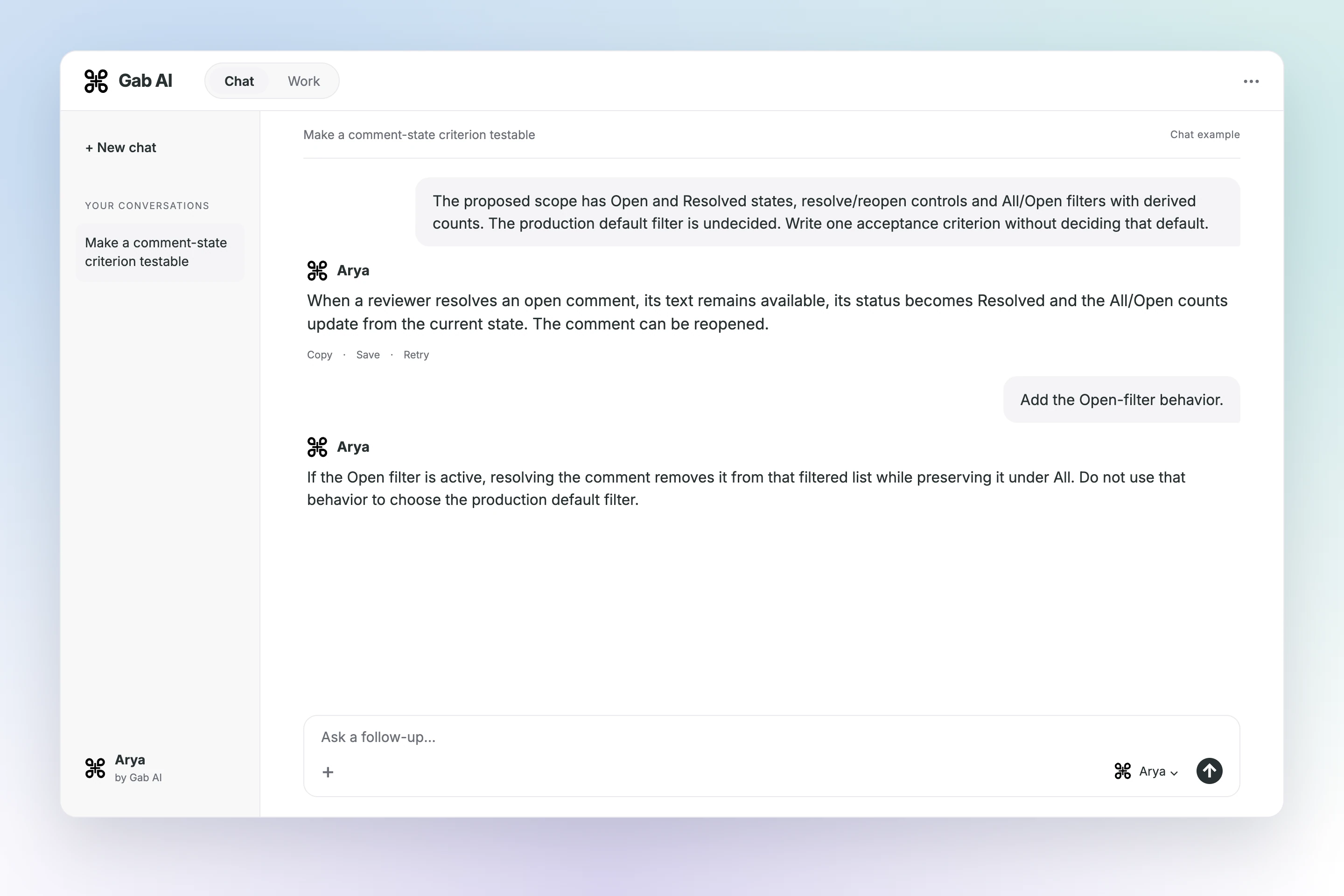
How do reviewers decide which comments still need action, and what do they expect “resolved” to mean? Ask them to walk through a recent review so the question stays tied to an observable task.
Your follow-up
What should I observe during that walkthrough?
Arya
Watch how they find the next unresolved comment, decide it has been addressed and return to it if the change needs more work. Separate finding comments from slower file-loading complaints.
Make a comment-state criterion testable
When a reviewer resolves an open comment, its text remains available, its status becomes Resolved and the All/Open counts update from the current state.
When a reviewer resolves an open comment, its text remains available, its status becomes Resolved and the All/Open counts update from the current state. The comment can be reopened.
Your follow-up
Add the Open-filter behavior.
Arya
If the Open filter is active, resolving the comment removes it from that filtered list while preserving it under All. Do not use that behavior to choose the production default filter.
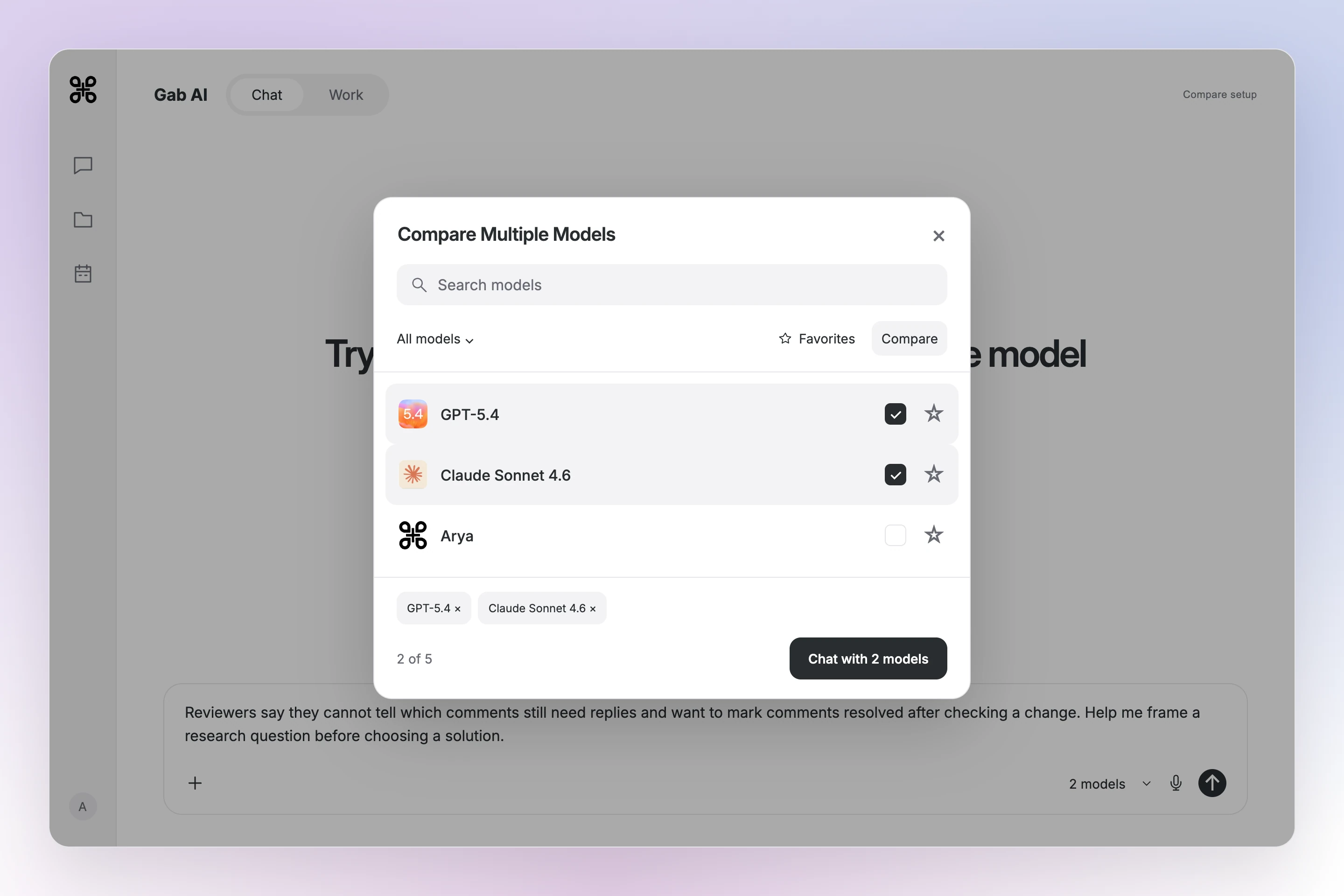
Try the same question with more than one model
Choose compatible models, compare their reasoning and decide which answer helps with your task.
In the model picker, turn on Compare and choose compatible models before sending the same prompt. Compare requires Plus; model access and credit use depend on the selection. Check facts and omissions rather than assuming a winner.
Build a feedback summary, acceptance criteria or prototype
Keep user feedback traceable, turn proposed behavior into acceptance checks and inspect a working prototype before making a product commitment.
Synthesize feedback without smoothing over disagreement
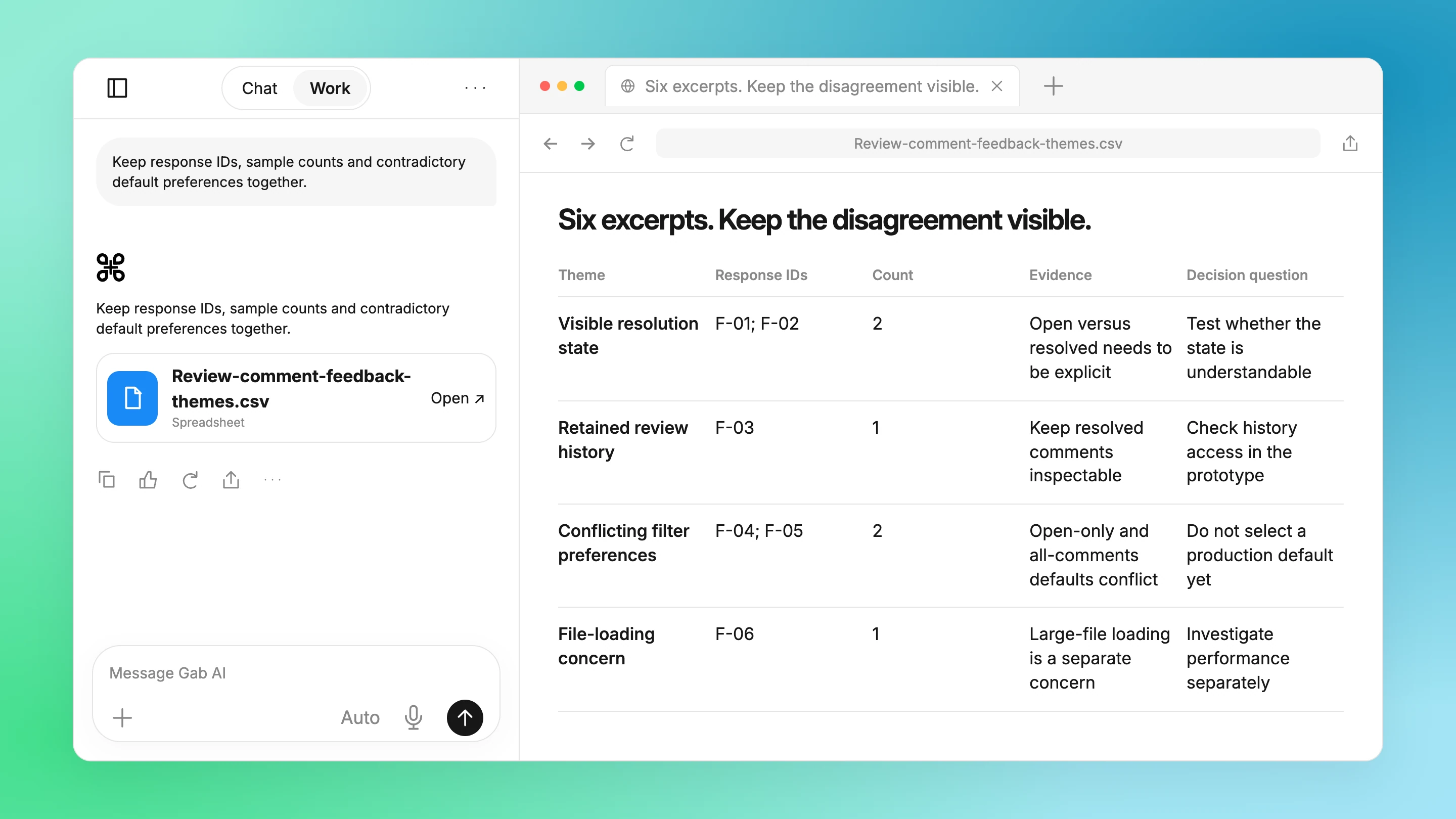
Keep response IDs, sample counts and contradictory default preferences together.
F-01: I cannot tell which comments still need a reply.
F-02
F-02: I need a way to mark a comment resolved after the change is checked.
F-03
F-03: Keep resolved comments so I can inspect the review history.
F-04
F-04: I would prefer to start with only open comments.
F-05
F-05: I would prefer to see every comment when I open a document.
F-06
F-06: Large files take too long to load.
Study limits
Six illustrative excerpts, one per response ID. Sampling and population size are not supplied. Counts describe this set only; they do not establish prevalence or impact. The filter-default preferences conflict and require a product decision.
Write acceptance criteria from the evidence and proposed scope
Turn comment states and filters into observable checks, with unresolved decisions explicit.
Turn comment states and filters into observable checks, with unresolved decisions explicit.
Loading…
This content could not load.
Your source material stays available.
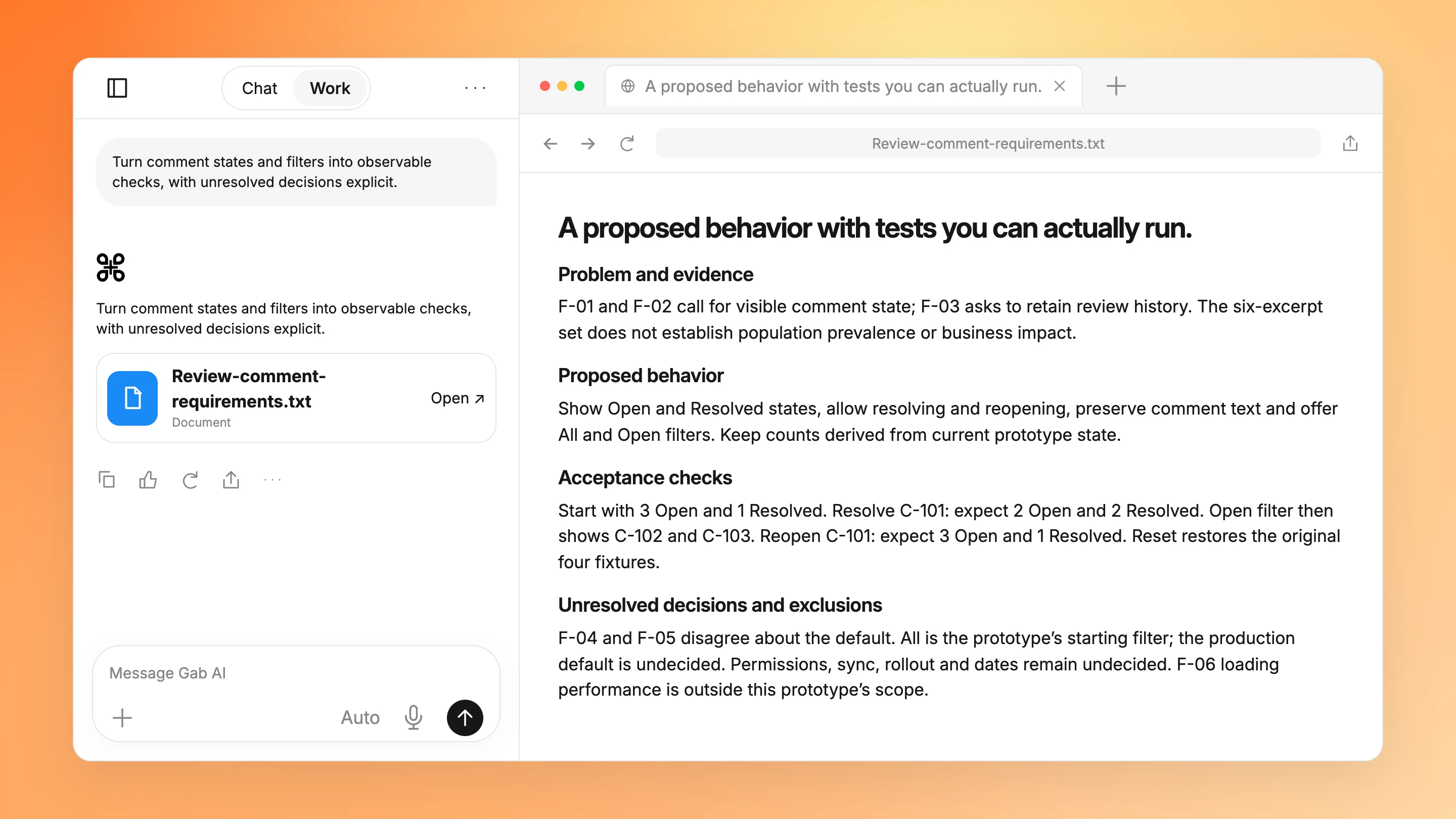
A proposed behavior with tests you can actually run.
Problem and evidence
F-01 and F-02 call for visible comment state; F-03 asks to retain review history. The six-excerpt set does not establish population prevalence or business impact.
Review-comment-feedback.csv
View full example
Proposed behavior
Show Open and Resolved states, allow resolving and reopening, preserve comment text and offer All and Open filters. Keep counts derived from current prototype state.
Review-comment-prototype-brief.txt
Acceptance checks
Start with 3 Open and 1 Resolved. Resolve C-101: expect 2 Open and 2 Resolved. Open filter then shows C-102 and C-103. Reopen C-101: expect 3 Open and 1 Resolved. Reset restores the original four fixtures.
Review-comment-prototype-brief.txt
Unresolved decisions and exclusions
F-04 and F-05 disagree about the default. All is the prototype’s starting filter; the production default is undecided. Permissions, sync, rollout and dates remain undecided. F-06 loading performance is outside this prototype’s scope.
Review-comment-prototype-brief.txt
Review-comment-feedback.csv
A product requirements draft linked to source IDs. Scope and delivery remain proposals.
F-01: I cannot tell which comments still need a reply.
F-02
F-02: I need a way to mark a comment resolved after the change is checked.
F-03
F-03: Keep resolved comments so I can inspect the review history.
F-04
F-04: I would prefer to start with only open comments.
F-05
F-05: I would prefer to see every comment when I open a document.
F-06
F-06: Large files take too long to load.
Study limits
Six illustrative excerpts, one per response ID. Sampling and population size are not supplied. Counts describe this set only; they do not establish prevalence or impact. The filter-default preferences conflict and require a product decision.
Review-comment-prototype-brief.txt
Proposed scope
Show each review comment with an explicit Open or Resolved status. Let a reviewer resolve and reopen comments; retain the text. Provide All and Open filters with counts derived from the current state. Do not claim to improve file-loading performance. Permissions, sync, rollout and delivery dates are not decided.
Default decision
The production default filter remains undecided because F-04 and F-05 conflict. The demonstration starts on All only so visitors can inspect every sample comment; that is a prototype fixture, not an approved product decision.
Four sample comments
C-101, Open: Clarify who reviews the draft. C-102, Open: Link the source for the attendance count. C-103, Open: Replace the unconfirmed launch date. C-104, Resolved: Correct the program name. The four comments are prototype fixtures, not the six research responses.
Acceptance and prototype limits
Initially show 3 Open and 1 Resolved. Resolving an Open comment decrements Open and increments Resolved without deleting its text. Reopening reverses those counts. Open filter hides resolved comments; All shows all four. Reset restores the fixture. State is local to the preview, without saving, sign-in, network calls or a real document update.
Test resolution states in an interactive comment prototype
Resolve, reopen and filter comments, then compare the behavior with the acceptance checks.
Show each review comment with an explicit Open or Resolved status. Let a reviewer resolve and reopen comments; retain the text. Provide All and Open filters with counts derived from the current state. Do not claim to improve file-loading performance. Permissions, sync, rollout and delivery dates are not decided.
Default decision
The production default filter remains undecided because F-04 and F-05 conflict. The demonstration starts on All only so visitors can inspect every sample comment; that is a prototype fixture, not an approved product decision.
Four sample comments
C-101, Open: Clarify who reviews the draft. C-102, Open: Link the source for the attendance count. C-103, Open: Replace the unconfirmed launch date. C-104, Resolved: Correct the program name. The four comments are prototype fixtures, not the six research responses.
Acceptance and prototype limits
Initially show 3 Open and 1 Resolved. Resolving an Open comment decrements Open and increments Resolved without deleting its text. Reopening reverses those counts. Open filter hides resolved comments; All shows all four. Reset restores the fixture. State is local to the preview, without saving, sign-in, network calls or a real document update.
About these examples
Analyze feedback and write product requirements
Open an example to inspect the prompt, sample inputs and completed result.
A useful result, with the details behind it
Synthesize feedback without smoothing over disagreement
Keep response IDs, sample counts and contradictory default preferences together.
Add permitted feedback excerpts, response IDs and the decision you need to make before sending.
Read all source material
Review-comment-feedback.csv
F-01
F-01: I cannot tell which comments still need a reply.
F-02
F-02: I need a way to mark a comment resolved after the change is checked.
F-03
F-03: Keep resolved comments so I can inspect the review history.
F-04
F-04: I would prefer to start with only open comments.
F-05
F-05: I would prefer to see every comment when I open a document.
F-06
F-06: Large files take too long to load.
Study limits
Six illustrative excerpts, one per response ID. Sampling and population size are not supplied. Counts describe this set only; they do not establish prevalence or impact. The filter-default preferences conflict and require a product decision.
Review-comment-prototype-brief.txt
Proposed scope
Show each review comment with an explicit Open or Resolved status. Let a reviewer resolve and reopen comments; retain the text. Provide All and Open filters with counts derived from the current state. Do not claim to improve file-loading performance. Permissions, sync, rollout and delivery dates are not decided.
Default decision
The production default filter remains undecided because F-04 and F-05 conflict. The demonstration starts on All only so visitors can inspect every sample comment; that is a prototype fixture, not an approved product decision.
Four sample comments
C-101, Open: Clarify who reviews the draft. C-102, Open: Link the source for the attendance count. C-103, Open: Replace the unconfirmed launch date. C-104, Resolved: Correct the program name. The four comments are prototype fixtures, not the six research responses.
Acceptance and prototype limits
Initially show 3 Open and 1 Resolved. Resolving an Open comment decrements Open and increments Resolved without deleting its text. Reopening reverses those counts. Open filter hides resolved comments; All shows all four. Reset restores the fixture. State is local to the preview, without saving, sign-in, network calls or a real document update.
Analyze product feedback
Keep response IDs, sample counts and contradictory default preferences together.
Refine product decisions and testable requirements
Compare the draft with a focused revision, keeping the source facts in view.
Try one focused revision
Suggested follow-up using the same source facts.
Focused follow-up
What change should I ask for?
State a product hypothesis and its evidence limit. Retain F-01, F-02 and F-03; do not turn six excerpts into population prevalence.
Original excerpt
What does the existing example say?
F-01 and F-02 call for visible comment state; F-03 asks to retain review history. The six-excerpt set does not establish population prevalence or business impact.
Suggested revision
What could that revision look like?
Hypothesis: visible comment state with retained review history may help this review workflow. F-01 and F-02 request visible state; F-03 requests history. The six supplied excerpts do not establish how common the need is or its business impact.
Use Chat to discuss the request and refine the result with follow-up questions.
Deliverable: Feedback synthesis
What to provide
Anonymized feedback, participant context and research question
Example prompt
Group these anonymized feedback excerpts into themes while preserving response IDs and contrary examples. Distinguish frequency from importance and do not infer a representative population or fabricate user needs.
What to check
Trace conclusions to user evidence
Separate assumptions from commitments
Test the stated behavior
Work
Synthesize feedback without smoothing over disagreement
Keep response IDs, sample counts and contradictory default preferences together.
Use Work to create and revise the named file from the supplied sources.
Deliverable: Review-comment-feedback-themes.csv
What to provide
Review-comment-feedback.csv
Example prompt
Create Review-comment-feedback-themes.csv from Review-comment-feedback.csv. Group the six supplied excerpts into resolution state, retained history, conflicting filter preferences and file-loading concerns. Keep every response ID traceable, count only this sample, and preserve contrary preferences. Do not invent population prevalence, impact scores or a roadmap commitment.
What to check
Inspect the supplied sample files
Check the result against your own sources
Review before sharing or acting
Work
Write acceptance criteria from the evidence and proposed scope
Turn comment states and filters into observable checks, with unresolved decisions explicit.
Use Work to create and revise the named file from the supplied sources.
Deliverable: Review-comment-requirements.txt
What to provide
Review-comment-feedback.csv
Review-comment-prototype-brief.txt
Example prompt
Create Review-comment-requirements.txt from Review-comment-feedback.csv and Review-comment-prototype-brief.txt. Link the problem to response IDs, specify resolve/reopen behavior, retained text and derived counts, and write the supplied acceptance checks. Keep the production default unresolved, separate large-file performance, and do not invent permissions, delivery dates or impact.
What to check
Inspect the supplied sample files
Check the result against your own sources
Review before sharing or acting
Work
Test resolution states in an interactive comment prototype
Resolve, reopen and filter comments, then compare the behavior with the acceptance checks.
Use Work to create and revise the named file from the supplied sources.
Deliverable: Review-comment-prototype.html
What to provide
Review-comment-prototype-brief.txt
Example prompt
Create Review-comment-prototype.html from Review-comment-prototype-brief.txt. Build a self-contained prototype with the four supplied comments, explicit Open/Resolved states, resolve/reopen controls, All/Open filters, derived counts and Reset. Start with 3 Open and 1 Resolved. Keep all comment text, make controls keyboard accessible, and use no network calls, saving, authentication or real document updates. Keep the production filter default undecided.
What to check
Inspect the supplied sample files
Check the result against your own sources
Review before sharing or acting
More prompts
Chat
Compare roadmap options
A product option comparison showing evidence, assumptions and unresolved decision questions.
Use Chat to discuss the request and refine the result with follow-up questions.
Deliverable: Option comparison
What to provide
User evidence, constraints and agreed decision criteria
Example prompt
Compare the supplied roadmap options against user evidence, effort assumptions and our decision criteria. Identify dependencies and what we would need to learn before committing. Do not invent impact scores or delivery dates.
What to check
Trace conclusions to user evidence
Separate assumptions from commitments
Test the stated behavior
Work
Build a requirements document
A requirements draft linking product behavior to user evidence and testable acceptance criteria.
Use Work to build and revise Product requirements draft.docx from your source material.
Deliverable: Product requirements draft.docx
What to provide
Approved problem statement, user evidence and product constraints
Example prompt
Create an editable requirements document with source-linked user needs, scope, exclusions, states, acceptance criteria and open questions. Keep proposals separate from approved commitments and include a testability check for every requirement. Deliver "Product requirements draft.docx" as the requested editable artifact. Ask for missing source material rather than inventing facts.
What to check
Trace conclusions to user evidence
Separate assumptions from commitments
Test the stated behavior
Work
Create an interaction prototype
An interactive prototype with source code, test data and recorded interaction checks.
Use Work to build and revise Interaction prototype.html from your source material.
Deliverable: Interaction prototype.html
What to provide
Approved flow, state behavior, microcopy and accessibility needs
Example prompt
Build a standalone HTML prototype of the supplied flow with working states, keyboard navigation and data. Test the specified interactions where possible and document untested behavior. Do not connect real accounts or imply production readiness. Deliver "Interaction prototype.html" as the requested editable artifact. Ask for missing source material rather than inventing facts.
Supply the feedback, problem statement, proposed scope and constraints. Ask Work for requirements linked to response IDs and acceptance checks. Keep assumptions, contradictions and unresolved decisions visible.
How does the sample handle contradictory feedback?
Keep both requests: F-04 wants Open-only by default; F-05 wants all comments. The prototype’s All view is an exploration choice, not a resolved disagreement or a production decision. Six excerpts do not establish population preference or business impact.
Can I test the prototype instead of just reading it?
Yes. Resolve or reopen a sample comment, switch All and Open filters, inspect the counts and use Reset. The HTML prototype runs locally with fixtures and does not update a real document.
How do I turn acceptance criteria into a product decision?
Use the criteria to review observable behavior, unresolved cases and the evidence for the proposed scope. Compare the prototype with those checks and record the team’s decision separately. Creating a requirements draft does not commit the roadmap.
Can I start in Chat, or do I need Work?
Use Chat for questions and text drafts. Choose Work when you want a project with tools and editable files. Work requires Plus and uses credits; see Pricing for plans and allowances. Opening a draft does not send it or attach the example files.