AI for sales: proposals and pipeline questions from your records.
Prepare a technical sales proposal, review pipeline records and explain approved application requirements. Keep quoted options and missing next steps clear when preparing the buyer conversation.
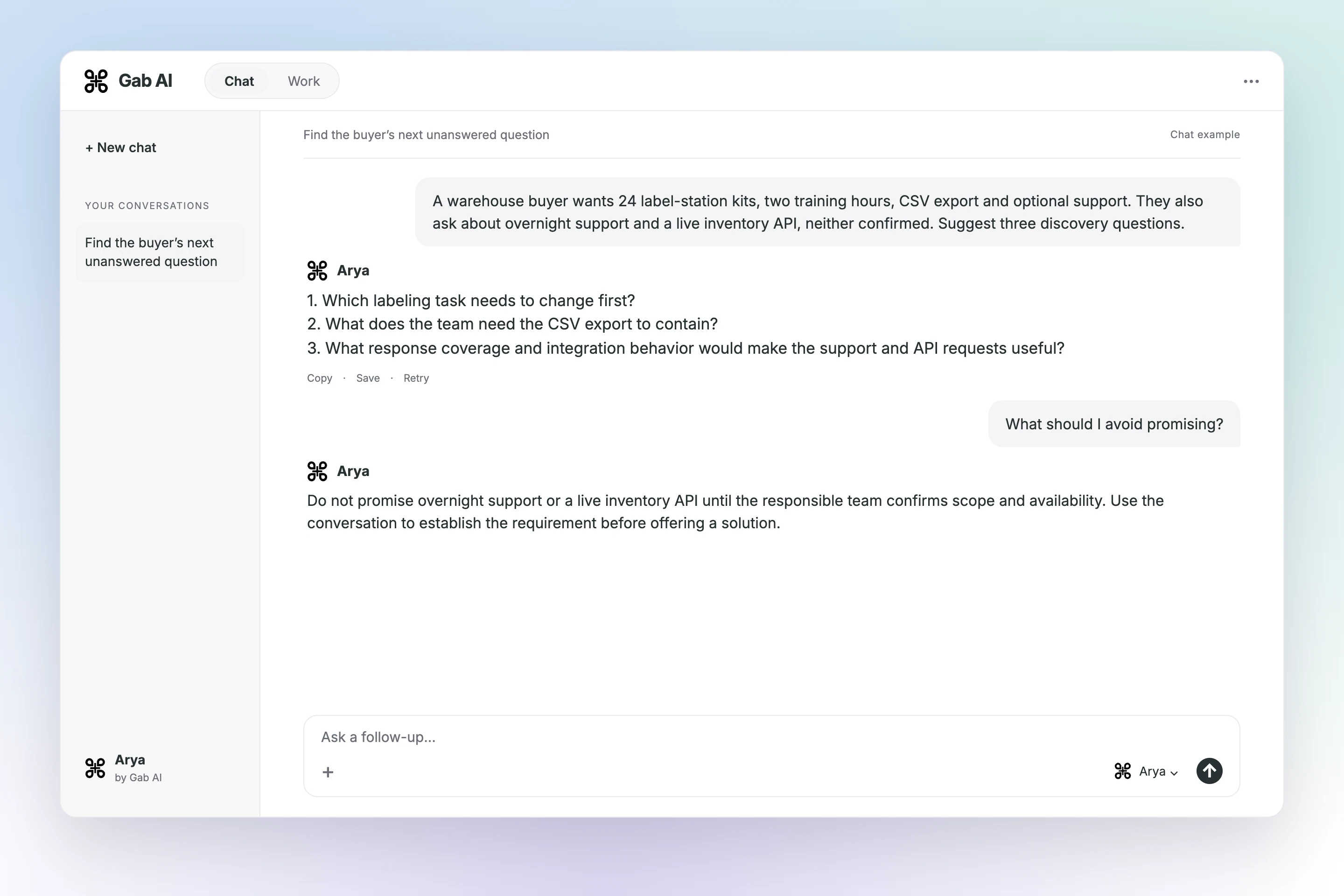
1. Which labeling task needs to change first?
2. What does the team need the CSV export to contain?
3. What response coverage and integration behavior would make the support and API requests useful?
Your follow-up
What should I avoid promising?
Arya
Do not promise overnight support or a live inventory API until the responsible team confirms scope and availability. Use the conversation to establish the requirement before offering a solution.
Ask for a decision without inventing a delivery date
Thanks for reviewing the label-station proposal. The base quoted subtotal is USD 2,100 before tax and delivery. Could we confirm your remaining questions and who will make the next decision?
Your follow-up
Include the two open capability questions.
Arya
We are also checking your overnight-support and live-inventory-API requests. Before we revise the proposal, could you confirm the coverage and integration behavior your team needs?
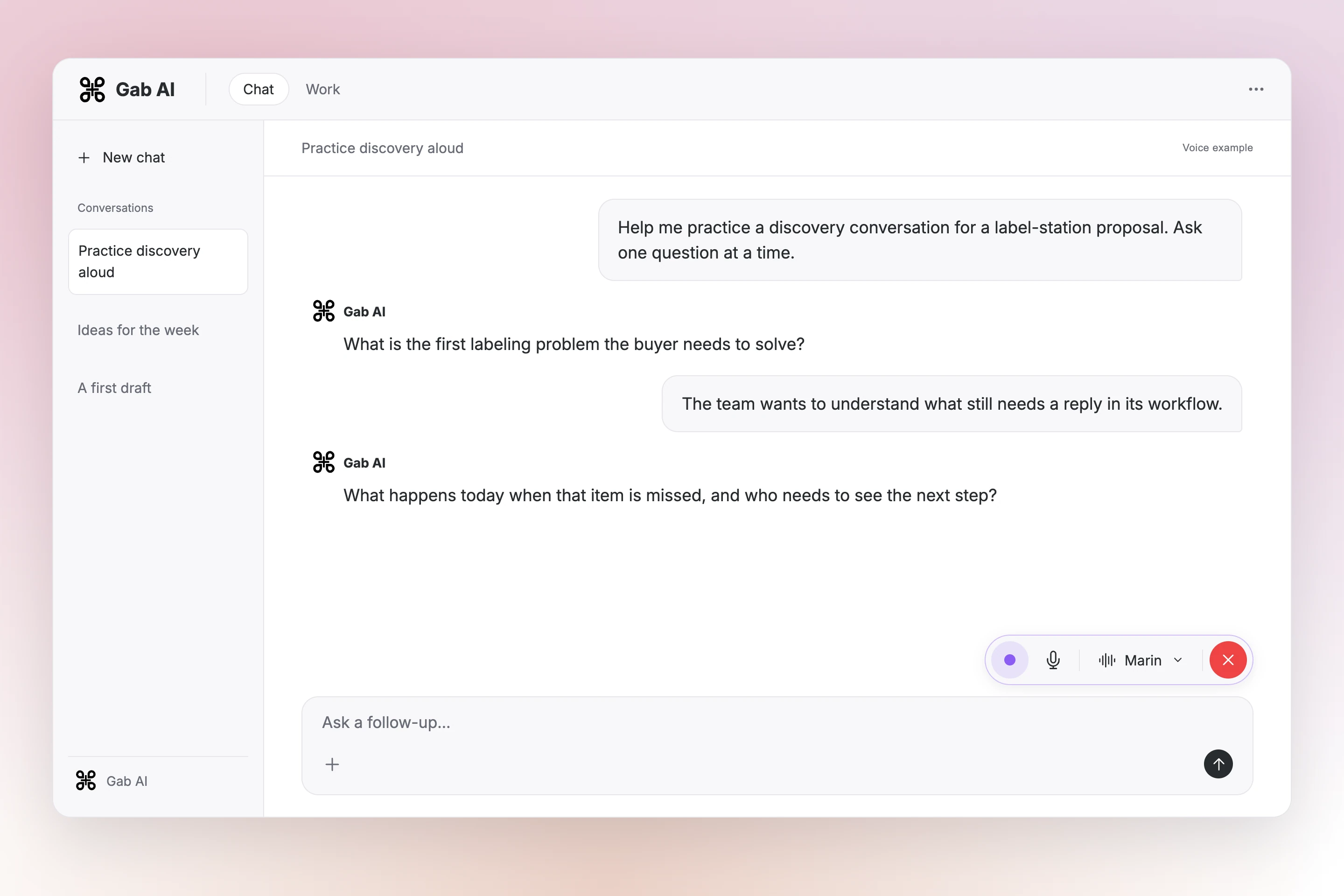
Practice discovery aloud
Use Voice in Chat to work through the conversation one question at a time.
24 × USD 75 = USD 1,800; 2 × USD 150 = USD 300; base subtotal USD 2,100. Optional first-year support adds USD 900, bringing the quoted subtotal to USD 3,000.
Label-station-approved-offer.txt
Keep the limits beside the offer
Support covers weekdays 08:00–17:00 local time. CSV export is included. Overnight support, a live inventory API, tax, delivery charges and an installation date are not supplied or offered.
Label-station-approved-offer.txt
Ask before promising
Confirm the buyer’s inventory interface, delivery needs and approval process. Both options remain proposals; no purchase decision is recorded.
Label-station-approved-offer.txt
Inspect the quote and its exclusions. Selecting an option does not accept or send it.
Read the prompt and inspect the full example
Compare USD 2,100 and USD 3,000 quoted options, with support limits beside the price.
Buyer: Sample warehouse team. They requested 24 label-station kits, two hours of operator training, CSV export and an option for support. They also asked whether overnight support and a live inventory API are available. Their purchase approval, delivery date and final decision are not supplied.
Base offer
Approved quotation: 24 label-station kits at USD 75 each; two operator-training hours at USD 150 per hour. Base quoted subtotal is USD 2,100. Tax and delivery charges are not supplied. These are quoted costs, not an accepted order.
Support option
Optional support costs USD 900 for the first year and covers Monday–Friday, 08:00–17:00 local time. Overnight support and a guaranteed response time are not offered in this packet. With this option, the first-year quoted subtotal is USD 3,000 before unsupplied tax and delivery.
Technical boundaries
CSV export is included. A live inventory API and installation date are not confirmed. Ask which inventory system and interface the buyer uses; do not promise an integration. Keep the base and support options separate for buyer review.
Review the pipeline without inventing probabilities
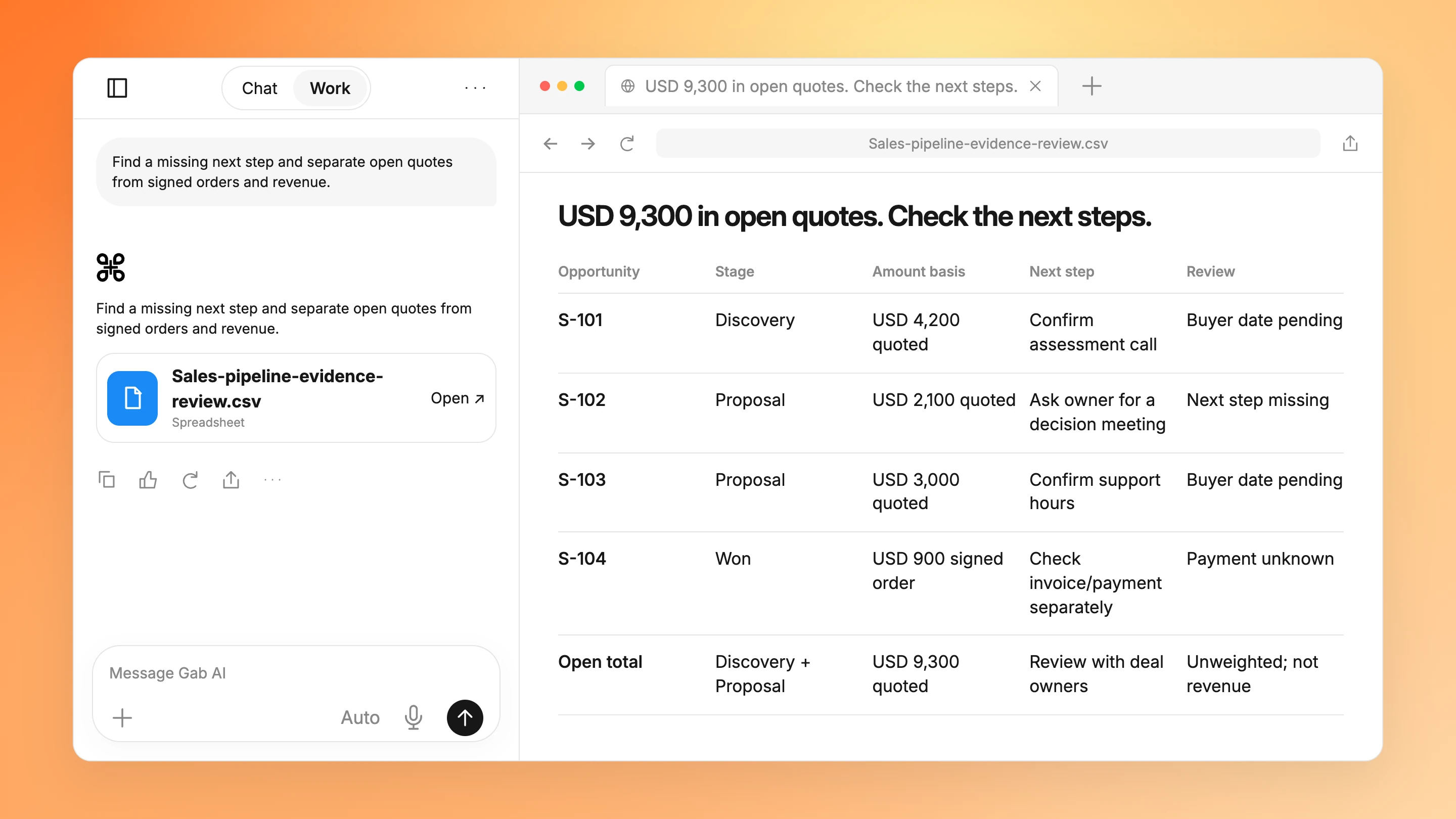
Find a missing next step and separate open quotes from signed orders and revenue.
S-101: Discovery; USD 4,200 quoted amount; October 26 close target; next step is an assessment call proposed by the seller; buyer confirmation of the date is missing.
S-102
S-102: Proposal; USD 2,100 quoted amount; November 2 close target; next step is not supplied; quote sent, with no recorded decision meeting.
S-103
S-103: Proposal; USD 3,000 quoted amount; October 30 close target; next step is confirm support hours with the buyer; support option requested, close date not buyer-confirmed.
S-104
S-104: Won; USD 900 signed order amount; September 30 close date; signed order recorded. Invoice and payment status are not supplied.
Stage definitions
Discovery: a need is recorded, but no approved proposal is agreed. Proposal: a quote is shared, with a buyer decision pending. Won: a signed order is recorded. No probability weights are supplied. Sum open quoted amounts separately from signed orders; neither sum establishes collected revenue.
Keep a borrower checklist tied to approved instructions
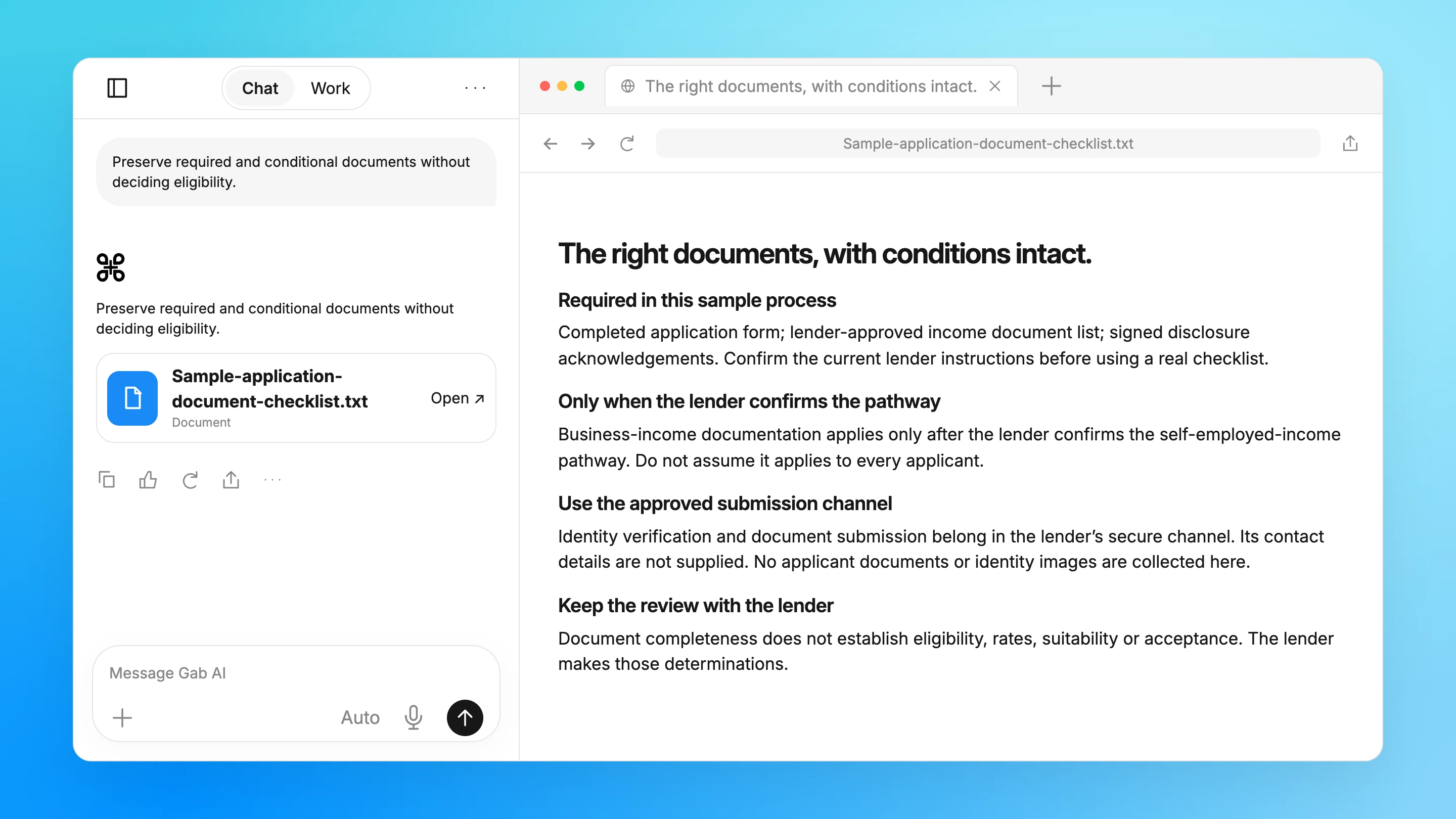
Preserve required and conditional documents without deciding eligibility.
The sample application needs the completed application form, the lender-approved income document list and signed disclosure acknowledgements. Explain the items using the lender wording; do not request additional documents.
Conditional request
Business-income documentation is conditional: request it only when the lender confirms that the self-employed-income pathway applies. Do not assume that it applies to an applicant.
Secure submission
Identity verification and document submission use the lender’s approved secure channel. Do not collect identity images, account numbers or applicant documents in this demonstration. Contact details for that channel are not supplied.
Decision boundary
The lender reviews completeness and eligibility. A checklist does not approve credit, set a rate, establish suitability or confirm that an application will be accepted.
About these examples
Draft proposals, review the pipeline and prepare buyer replies
Open an example to inspect the prompt, sample inputs and completed result.
A useful result, with the details behind it
Build a technical proposal from approved scope
Compare USD 2,100 and USD 3,000 quoted options, with support limits beside the price.
Add the approved offer, buyer requirements, prices and exclusions before sending.
Read all source material
Label-station-approved-offer.txt
Buyer requirements
Buyer: Sample warehouse team. They requested 24 label-station kits, two hours of operator training, CSV export and an option for support. They also asked whether overnight support and a live inventory API are available. Their purchase approval, delivery date and final decision are not supplied.
Base offer
Approved quotation: 24 label-station kits at USD 75 each; two operator-training hours at USD 150 per hour. Base quoted subtotal is USD 2,100. Tax and delivery charges are not supplied. These are quoted costs, not an accepted order.
Support option
Optional support costs USD 900 for the first year and covers Monday–Friday, 08:00–17:00 local time. Overnight support and a guaranteed response time are not offered in this packet. With this option, the first-year quoted subtotal is USD 3,000 before unsupplied tax and delivery.
Technical boundaries
CSV export is included. A live inventory API and installation date are not confirmed. Ask which inventory system and interface the buyer uses; do not promise an integration. Keep the base and support options separate for buyer review.
Sales-opportunity-snapshot.csv
S-101
S-101: Discovery; USD 4,200 quoted amount; October 26 close target; next step is an assessment call proposed by the seller; buyer confirmation of the date is missing.
S-102
S-102: Proposal; USD 2,100 quoted amount; November 2 close target; next step is not supplied; quote sent, with no recorded decision meeting.
S-103
S-103: Proposal; USD 3,000 quoted amount; October 30 close target; next step is confirm support hours with the buyer; support option requested, close date not buyer-confirmed.
S-104
S-104: Won; USD 900 signed order amount; September 30 close date; signed order recorded. Invoice and payment status are not supplied.
Stage definitions
Discovery: a need is recorded, but no approved proposal is agreed. Proposal: a quote is shared, with a buyer decision pending. Won: a signed order is recorded. No probability weights are supplied. Sum open quoted amounts separately from signed orders; neither sum establishes collected revenue.
Sample-lender-document-policy.txt
Required for this sample process
The sample application needs the completed application form, the lender-approved income document list and signed disclosure acknowledgements. Explain the items using the lender wording; do not request additional documents.
Conditional request
Business-income documentation is conditional: request it only when the lender confirms that the self-employed-income pathway applies. Do not assume that it applies to an applicant.
Secure submission
Identity verification and document submission use the lender’s approved secure channel. Do not collect identity images, account numbers or applicant documents in this demonstration. Contact details for that channel are not supplied.
Decision boundary
The lender reviews completeness and eligibility. A checklist does not approve credit, set a rate, establish suitability or confirm that an application will be accepted.
Draft a sales proposal
Compare USD 2,100 and USD 3,000 quoted options, with support limits beside the price.
Refine sales commitments and document requirements
Compare the draft with a focused revision, keeping the source facts in view.
Try one focused revision
Suggested follow-up using the same source facts.
Focused follow-up
What change should I ask for?
Explain base and optional pricing in two sentences. Preserve quantities, rates and subtotals; do not present optional support as accepted.
Original excerpt
What does the existing example say?
24 × USD 75 = USD 1,800; 2 × USD 150 = USD 300; base subtotal USD 2,100. Optional first-year support adds USD 900, bringing the quoted subtotal to USD 3,000.
Suggested revision
What could that revision look like?
The base proposal is USD 2,100: 24 kits at USD 75 plus 2 training hours at USD 150 per hour. Optional first-year support adds USD 900, giving a quoted subtotal of USD 3,000 if selected, before unsupplied tax and delivery.
Check the actual quote before adding a sales commitment.
Does the support option cover the overnight shift?
Support hours No. The approved option covers Monday–Friday, 08:00–17:00 local time. The buyer’s overnight request remains unmet.
Is a live inventory API included?
Integration CSV export is included; a live inventory API is not confirmed. Ask which system and interface the buyer uses before promising an integration.
Preserve the policy’s conditions and submission channel.
Should every applicant provide business-income documents?
Conditional item No. That request is conditional on lender confirmation of the self-employed-income pathway.
Does completing the checklist approve the application?
Approval No. The sample policy leaves completeness and eligibility review with the lender. The checklist does not establish rates, suitability or acceptance.
Use Chat to discuss the request and refine the result with follow-up questions.
Deliverable: Discovery question list
What to provide
Verified buyer context, product scope and meeting objective
Example prompt
Draft discovery questions for this buyer using the verified context and our actual product scope. Separate questions about needs, decision process and implementation constraints. Do not invent buyer pain points or imply unsupported product capabilities.
What to check
Verify buyer and product facts
Confirm commitments and permissions
Review before contacting anyone
Work
Build a technical proposal from approved scope
Compare USD 2,100 and USD 3,000 quoted options, with support limits beside the price.
Use Work to create and revise the named file from the supplied sources.
Deliverable: Label-station-proposal-review.html
What to provide
Label-station-approved-offer.txt
Example prompt
Create Label-station-proposal-review.html from Label-station-approved-offer.txt. Show a base option and optional first-year weekday support, with a selector that updates the quoted subtotal. Preserve unit quantities, hours, currency, exclusions and buyer questions. Tax and delivery are not supplied. Do not promise overnight support, a live API, acceptance or an installation date. Make it a self-contained review artifact with no sending or purchasing controls.
What to check
Inspect the supplied sample files
Check the result against your own sources
Review before sharing or acting
Work
Review the pipeline without inventing probabilities
Find a missing next step and separate open quotes from signed orders and revenue.
Use Work to create and revise the named file from the supplied sources.
Deliverable: Sales-pipeline-evidence-review.csv
What to provide
Sales-opportunity-snapshot.csv
Example prompt
Create Sales-pipeline-evidence-review.csv from Sales-opportunity-snapshot.csv. Preserve the four opportunity IDs, stages, amounts and recorded evidence. Flag missing next steps and unconfirmed buyer dates. Sum the three open quoted amounts separately from the signed order; no probability weights or payment evidence are supplied. Do not forecast revenue, change CRM records or contact anyone.
What to check
Inspect the supplied sample files
Check the result against your own sources
Review before sharing or acting
Chat
Keep a borrower checklist tied to approved instructions
Preserve required and conditional documents without deciding eligibility.
Using Sample-lender-document-policy.txt, draft an applicant-facing checklist. Separate the required items from the conditional business-income request. Keep identity verification in the lender’s secure channel, whose contact details are not supplied. Do not collect documents, invent requirements, set rates or decide eligibility. Ask for the current lender policy before adapting this sample.
What to check
Inspect the supplied sample files
Check the result against your own sources
Review before sharing or acting
More prompts
Chat
Write a meeting follow-up
A follow-up draft preserving the meeting's actual decisions, commitments and unresolved questions.
Use Chat to discuss the request and refine the result with follow-up questions.
Deliverable: Follow-up email draft
What to provide
Approved meeting notes, confirmed decisions and agreed actions
Example prompt
Draft a follow-up email from these meeting notes. Summarize confirmed decisions, distinguish proposals from commitments and list agreed actions with the owners and dates provided. Do not send the email or invent pricing or deadlines.
What to check
Verify buyer and product facts
Confirm commitments and permissions
Review before contacting anyone
Work
Build an account research brief
A sourced account document with verified context and questions for the seller to test in conversation.
Use Work to build and revise Account research brief.docx from your source material.
Deliverable: Account research brief.docx
What to provide
Target account, permitted public sources and approved sales objective
Example prompt
Create an editable account brief from official public sources and supplied notes. Include business context, source dates, relevant questions and uncertainty; do not infer private budgets, purchase intent or personal characteristics. Deliver "Account research brief.docx" as the requested editable artifact. Ask for missing source material rather than inventing facts.
What to check
Verify buyer and product facts
Confirm commitments and permissions
Review before contacting anyone
Work
Create a proposal comparison workbook
A proposal workbook showing requirement coverage, commercial assumptions and unanswered buyer questions.
Use Work to build and revise Proposal comparison.xlsx from your source material.
Deliverable: Proposal comparison.xlsx
What to provide
Buyer requirements, approved offers and confirmed commercial terms
Example prompt
Build a workbook linking buyer requirements to deliverables, prices, assumptions, exclusions and open questions in the supplied offers. Preserve currency and unit basis; do not present proposals as accepted orders. Deliver "Proposal comparison.xlsx" as the requested editable artifact. Ask for missing source material rather than inventing facts.
What to check
Verify buyer and product facts
Confirm commitments and permissions
Review before contacting anyone
Chat
Prepare service discovery questions
Managed IT discovery questions covering support hours, escalation expectations and the buyer's decision criteria.
Use Chat to question the source material and revise the response before preparing a file.
Deliverable: Response in Chat
What to provide
Discovery notes, buyer objectives and permitted services
Example prompt
Prepare discovery questions for a business considering our managed IT support service. Use this service description and buyer background. Cover current pain points, service hours, escalation expectations and decision criteria without assuming a budget or promising coverage.
What to check
Check service scope
Confirm delivery terms
Review proposal
Chat
Prepare a pipeline review
A pipeline review identifying stage evidence gaps, missing next steps and close-date questions for deal owners.
Use Chat to question the source material and revise the response before preparing a file.
Deliverable: Response in Chat
What to provide
Anonymized opportunity stages, dates and amounts
Example prompt
Prepare a pipeline review from these anonymized opportunities. Group by sales stage, identify missing next steps and unsupported close-date assumptions, and list questions for deal owners. Do not invent buyer intent or assign probability without our stage definitions.
What to check
Check deal evidence
Confirm stage definitions
Review with deal owners
Chat
Prepare an application checklist
A borrower checklist preserving the lender's required and conditional documents with plain-language explanations.
Use Chat to question the source material and revise the response before preparing a file.
Deliverable: Response in Chat
What to provide
Approved loan process and applicant-facing instructions
Example prompt
Create a borrower document checklist from these approved application requirements. Group items by purpose, explain them in plain language and flag conditional requirements. Do not invent eligibility rules or request unnecessary personal information.
Supply the buyer requirements, approved offer, prices and exclusions. Ask Work for a comparison or proposal that keeps assumptions and unresolved questions visible. The sample lets you inspect two quoted options.
Can it review a pipeline export?
Yes. Supply an authorized snapshot and your stage definitions. Ask for missing next steps, unsupported close-date assumptions and transparent totals. The sample separates open quotes from a signed order; neither establishes collected revenue.
Can it help explain lending or insurance documents?
Provide your organization’s current approved instructions. Ask for plain-language explanations with required and conditional items kept separate. Have an authorized reviewer check them; a draft does not decide eligibility, coverage, rates or suitability.
Does opening an example update our CRM or send a proposal?
No. The action opens a Chat or Work draft. Attach permitted material, review the result and decide what to do next through your approved process.
How should I separate optional services in a proposal?
List the base scope and subtotal first, then the optional service and its effect on the subtotal. The sample’s base USD 2,100 becomes USD 3,000 only if USD 900 first-year support is selected. A draft proposal does not record acceptance, update a CRM or establish a final invoice.
Can I start in Chat, or do I need Work?
Use Chat for questions and text drafts. Choose Work when you want a project with tools and editable files. Work requires Plus and uses credits; see Pricing for plans and allowances. Opening a draft does not send it or attach the example files.