AI for game development: prototype a mechanic and plan its tests.
Prototype a browser-game mechanic, develop its design rules and prepare a playtest checklist. Try the small grid game, inspect the source and decide what to test before expanding the idea.
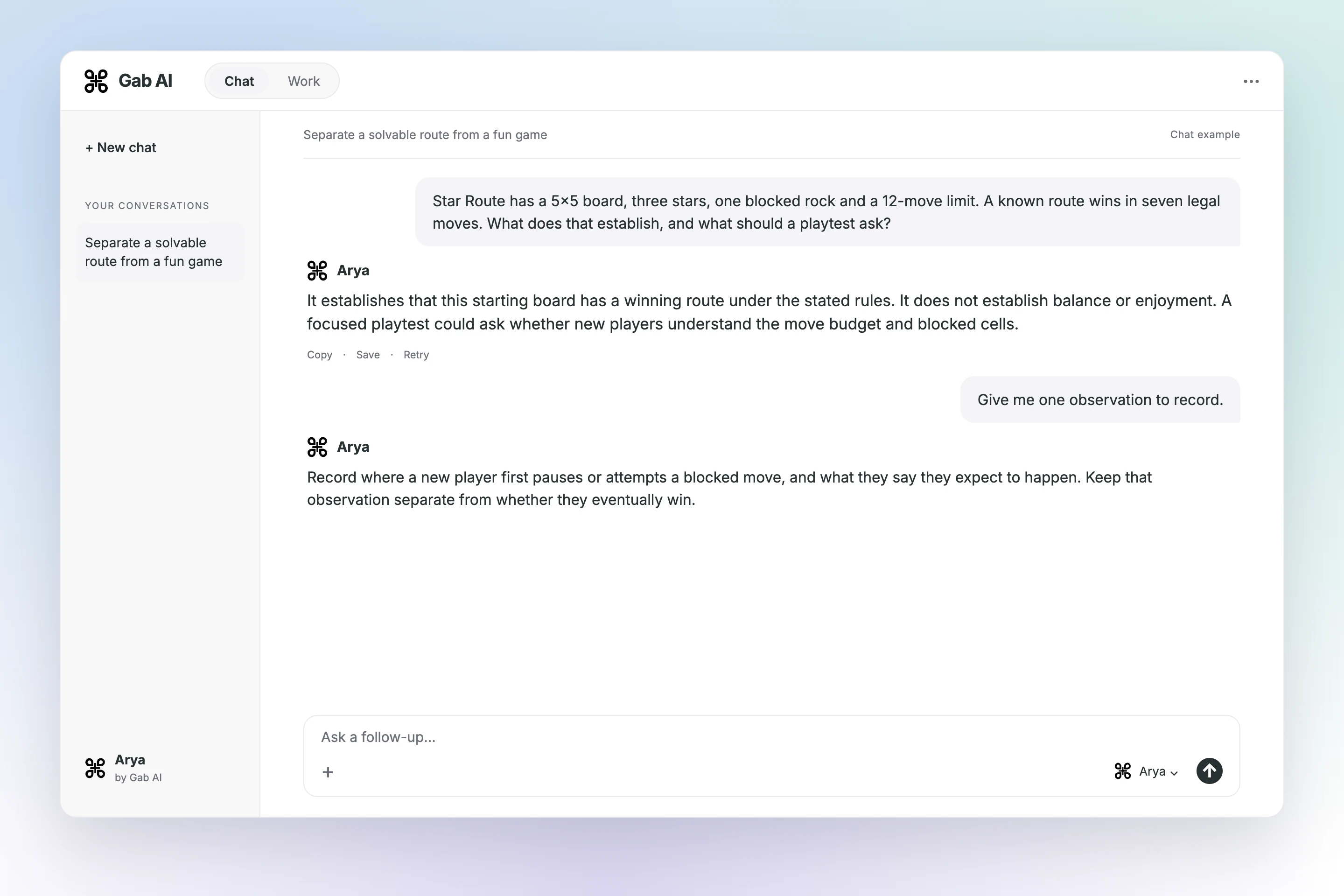
It establishes that this starting board has a winning route under the stated rules. It does not establish balance or enjoyment. A focused playtest could ask whether new players understand the move budget and blocked cells.
Your follow-up
Give me one observation to record.
Arya
Record where a new player first pauses or attempts a blocked move, and what they say they expect to happen. Keep that observation separate from whether they eventually win.
Make a short tutorial fit the actual controls
Collect all three stars before your 12 moves run out.
Collect all three stars before your 12 moves run out. Use the arrow keys or direction buttons to move one cell at a time. The rock blocks your path; blocked moves do not spend a move.
Your follow-up
Make the first instruction focus on the goal.
Arya
Reach all three stars in 12 moves or fewer. Move one square at a time with the arrows or direction buttons, and plan a route around the rock.
Build a browser game and check its rules
Build a small browser prototype, turn its rules into concrete checks and decide what to playtest next.
Build a small game with a complete loop
Play an original grid mechanic with keyboard or direction buttons, a move budget, win/loss and restart.
Move across a 5-by-5 board from (0,2), avoid the rock at (2,2) and collect stars at (1,1), (3,1) and (4,3). Arrow keys and visible direction buttons use the same movement rule.
Star-route-game-rules.txt
Complete the loop
Each legal move costs one move. Collecting the third star wins, including on the last allowed move. Zero moves with fewer than three stars loses. Restart resets the board, score and move budget.
Star-route-game-rules.txt
Check rather than assume
The supplied seven-move path wins with five moves left. A 12-move back-and-forth path loses. Boundary and rock attempts cost no moves. The inline preview includes its readable source; the test matrix is a plan, with execution evidence recorded separately.
Star-route-acceptance-checks.txt
A complete local mechanic prototype: collect three stars in 12 legal moves, then win, lose or restart. Original shapes; no live model calls or publishing.
Read the prompt and inspect the full example
Play an original grid mechanic with keyboard or direction buttons, a move budget, win/loss and restart.
Star Route uses a 5-by-5 board with zero-based (x,y) coordinates. Start at (0,2). A blocked rock occupies (2,2). Three stars are at (1,1), (3,1) and (4,3). Start with 12 moves remaining and zero collected stars.
Input and movement
Move one cell up, down, left or right using arrow keys when the board is focused or the four on-screen direction buttons. Each legal move costs one move. Attempts outside the board or onto the rock do not move the player or consume a move. Stars are collected once on entering their cells.
Win, loss and restart
Collect all three stars to win. If the final allowed move collects the third star, winning takes precedence over running out of moves. Lose when no moves remain and fewer than three stars have been collected. Movement after a win or loss has no effect. Restart restores the complete initial state.
Prototype scope
This is a turn-based single-player mechanic prototype with original CSS shapes, no audio, no timer, no multiplayer and no publishing. It has no account, external service, persistent save or model-powered character. Difficulty and enjoyment have not been established through player research.
Star-route-acceptance-checks.txt
Winning path
From restart, press Right, Up, Right, Right, Right, Down, Down. Expected: position (4,3), three collected stars, five moves remaining and Won. This is seven legal moves.
Boundary and obstacle checks
From restart, press Left. Expected: position (0,2), zero stars and 12 moves remaining. Then press Right twice. The first reaches (1,2) and leaves 11 moves; the second attempts the rock at (2,2) and must leave position and moves unchanged.
Loss and terminal checks
From restart, alternate Right then Left six times. Expected: position (0,2), zero stars, zero moves remaining and Lost. Further direction inputs must have no effect. Restart must restore position (0,2), all three stars and 12 moves.
Last-move win precedence
From restart, use Right, Up, Right, Up, Right, Right, Down, Down, Down, Left, Up, Up. Expected: position (3,1), three stars, zero moves and Won. This route takes exactly 12 legal moves and collects the star at (3,1) last.
Verification boundary
The test matrix names checks and expected outcomes. Execution evidence belongs in a separate dated QA record. A passing fixture does not establish game balance, accessibility on every device or production readiness.
Turn the game rules into reproducible checks
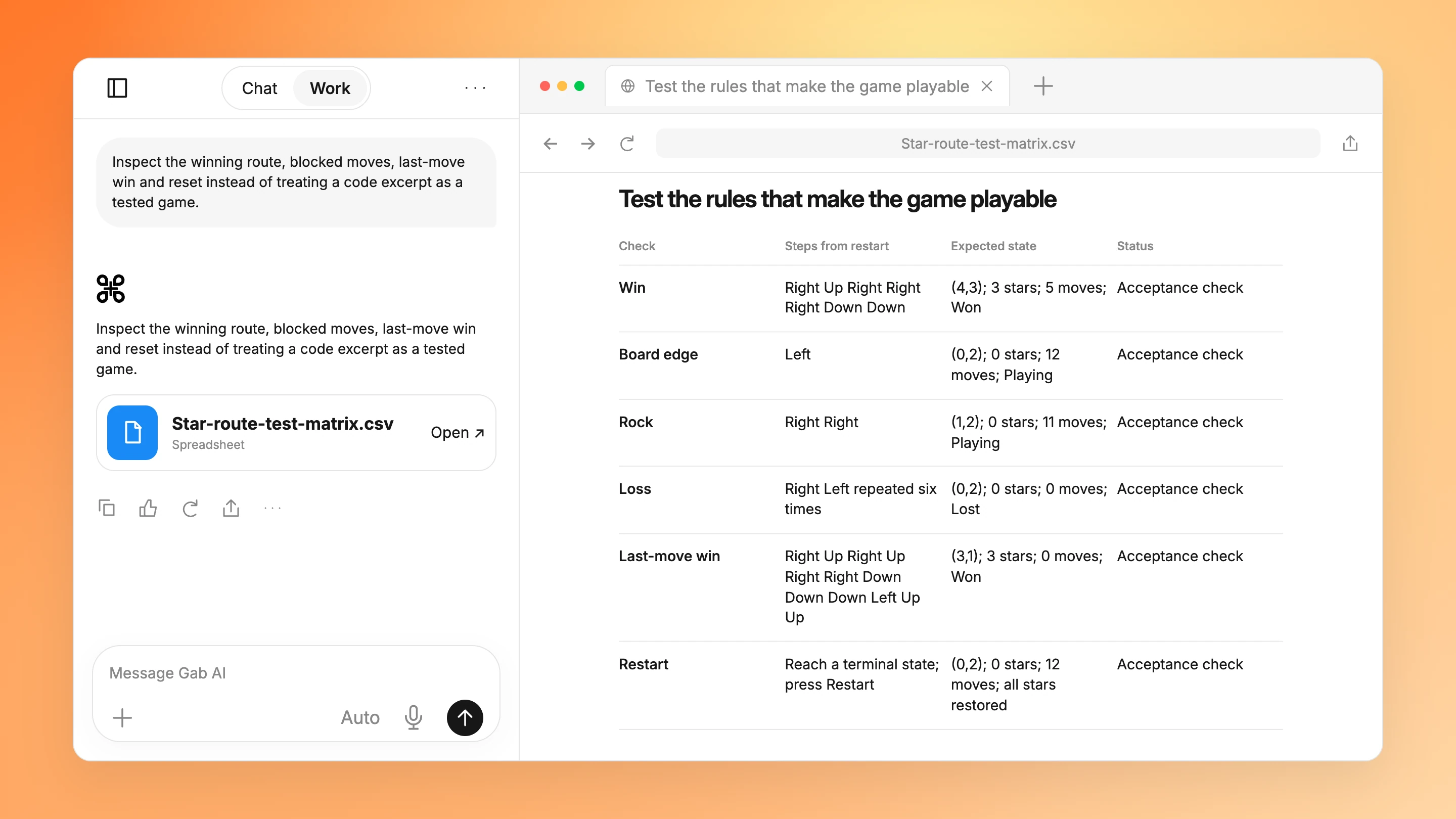
Inspect the winning route, blocked moves, last-move win and reset instead of treating a code excerpt as a tested game.
Star Route uses a 5-by-5 board with zero-based (x,y) coordinates. Start at (0,2). A blocked rock occupies (2,2). Three stars are at (1,1), (3,1) and (4,3). Start with 12 moves remaining and zero collected stars.
Input and movement
Move one cell up, down, left or right using arrow keys when the board is focused or the four on-screen direction buttons. Each legal move costs one move. Attempts outside the board or onto the rock do not move the player or consume a move. Stars are collected once on entering their cells.
Win, loss and restart
Collect all three stars to win. If the final allowed move collects the third star, winning takes precedence over running out of moves. Lose when no moves remain and fewer than three stars have been collected. Movement after a win or loss has no effect. Restart restores the complete initial state.
Prototype scope
This is a turn-based single-player mechanic prototype with original CSS shapes, no audio, no timer, no multiplayer and no publishing. It has no account, external service, persistent save or model-powered character. Difficulty and enjoyment have not been established through player research.
Star-route-acceptance-checks.txt
Winning path
From restart, press Right, Up, Right, Right, Right, Down, Down. Expected: position (4,3), three collected stars, five moves remaining and Won. This is seven legal moves.
Boundary and obstacle checks
From restart, press Left. Expected: position (0,2), zero stars and 12 moves remaining. Then press Right twice. The first reaches (1,2) and leaves 11 moves; the second attempts the rock at (2,2) and must leave position and moves unchanged.
Loss and terminal checks
From restart, alternate Right then Left six times. Expected: position (0,2), zero stars, zero moves remaining and Lost. Further direction inputs must have no effect. Restart must restore position (0,2), all three stars and 12 moves.
Last-move win precedence
From restart, use Right, Up, Right, Up, Right, Right, Down, Down, Down, Left, Up, Up. Expected: position (3,1), three stars, zero moves and Won. This route takes exactly 12 legal moves and collects the star at (3,1) last.
Verification boundary
The test matrix names checks and expected outcomes. Execution evidence belongs in a separate dated QA record. A passing fixture does not establish game balance, accessibility on every device or production readiness.
Choose a playtest question before expanding the game
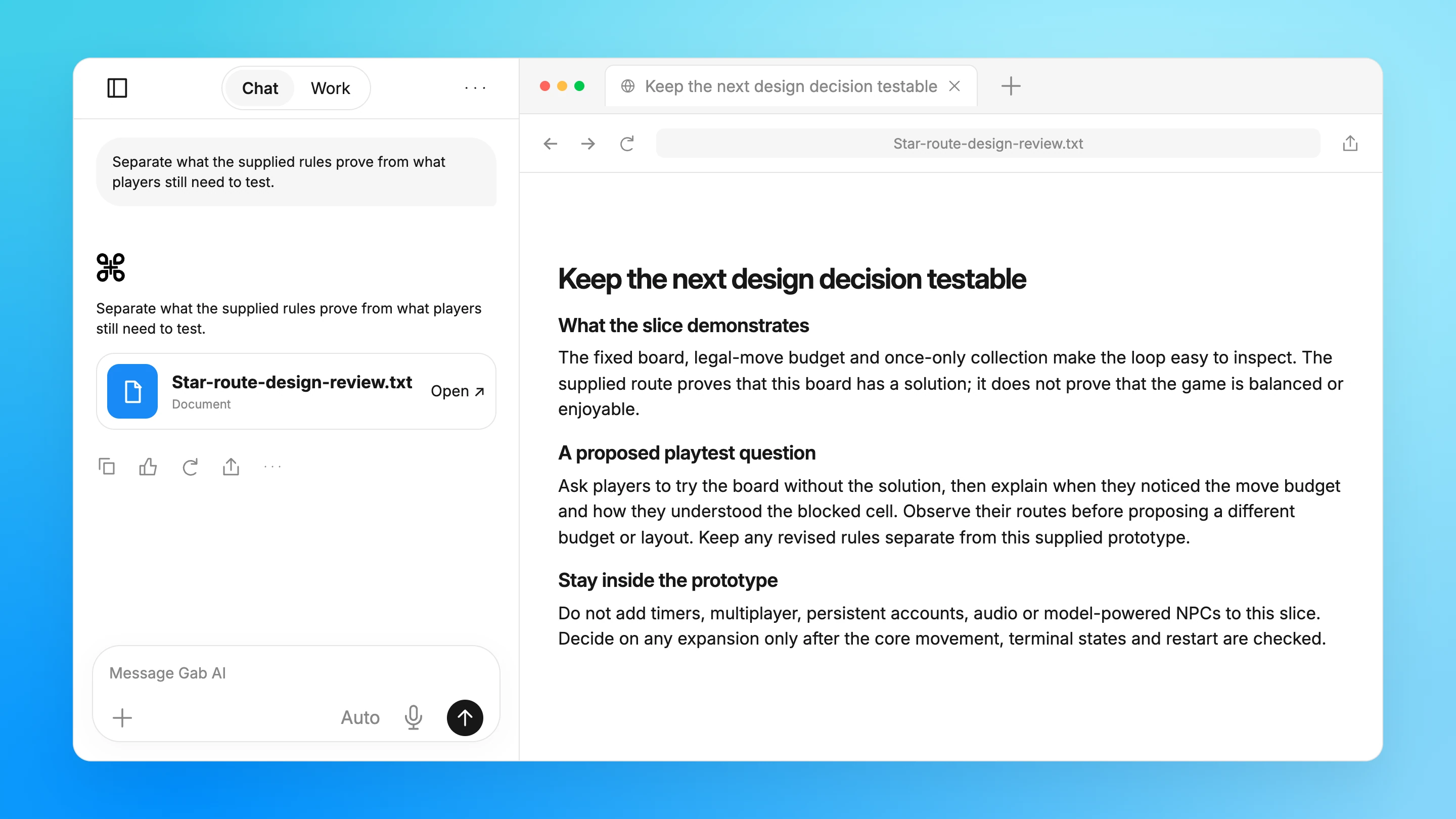
Separate what the supplied rules prove from what players still need to test.
Separate what the supplied rules prove from what players still need to test.
Loading…
This content could not load.
Your source material stays available.
Keep the next design decision testable
What the slice demonstrates
The fixed board, legal-move budget and once-only collection make the loop easy to inspect. The supplied route proves that this board has a solution; it does not prove that the game is balanced or enjoyable.
Star-route-game-rules.txt
Star-route-acceptance-checks.txt
View full example
A proposed playtest question
Ask players to try the board without the solution, then explain when they noticed the move budget and how they understood the blocked cell. Observe their routes before proposing a different budget or layout. Keep any revised rules separate from this supplied prototype.
Star-route-game-rules.txt
Star-route-acceptance-checks.txt
Stay inside the prototype
Do not add timers, multiplayer, persistent accounts, audio or model-powered NPCs to this slice. Decide on any expansion only after the core movement, terminal states and restart are checked.
Star-route-game-rules.txt
A mechanic review based on the brief. No player study or enjoyment claim is invented.
Star Route uses a 5-by-5 board with zero-based (x,y) coordinates. Start at (0,2). A blocked rock occupies (2,2). Three stars are at (1,1), (3,1) and (4,3). Start with 12 moves remaining and zero collected stars.
Input and movement
Move one cell up, down, left or right using arrow keys when the board is focused or the four on-screen direction buttons. Each legal move costs one move. Attempts outside the board or onto the rock do not move the player or consume a move. Stars are collected once on entering their cells.
Win, loss and restart
Collect all three stars to win. If the final allowed move collects the third star, winning takes precedence over running out of moves. Lose when no moves remain and fewer than three stars have been collected. Movement after a win or loss has no effect. Restart restores the complete initial state.
Prototype scope
This is a turn-based single-player mechanic prototype with original CSS shapes, no audio, no timer, no multiplayer and no publishing. It has no account, external service, persistent save or model-powered character. Difficulty and enjoyment have not been established through player research.
Star-route-acceptance-checks.txt
Winning path
From restart, press Right, Up, Right, Right, Right, Down, Down. Expected: position (4,3), three collected stars, five moves remaining and Won. This is seven legal moves.
Boundary and obstacle checks
From restart, press Left. Expected: position (0,2), zero stars and 12 moves remaining. Then press Right twice. The first reaches (1,2) and leaves 11 moves; the second attempts the rock at (2,2) and must leave position and moves unchanged.
Loss and terminal checks
From restart, alternate Right then Left six times. Expected: position (0,2), zero stars, zero moves remaining and Lost. Further direction inputs must have no effect. Restart must restore position (0,2), all three stars and 12 moves.
Last-move win precedence
From restart, use Right, Up, Right, Up, Right, Right, Down, Down, Down, Left, Up, Up. Expected: position (3,1), three stars, zero moves and Won. This route takes exactly 12 legal moves and collects the star at (3,1) last.
Verification boundary
The test matrix names checks and expected outcomes. Execution evidence belongs in a separate dated QA record. A passing fixture does not establish game balance, accessibility on every device or production readiness.
About these examples
Develop game rules, prototypes and playtest plans
Open an example to inspect the prompt, sample inputs and completed result.
A useful result, with the details behind it
Build a small game with a complete loop
Play an original grid mechanic with keyboard or direction buttons, a move budget, win/loss and restart.
Add your game rules, controls and target environment before sending. The existing prototype is available to play here.
Read all source material
Star-route-game-rules.txt
Board and starting state
Star Route uses a 5-by-5 board with zero-based (x,y) coordinates. Start at (0,2). A blocked rock occupies (2,2). Three stars are at (1,1), (3,1) and (4,3). Start with 12 moves remaining and zero collected stars.
Input and movement
Move one cell up, down, left or right using arrow keys when the board is focused or the four on-screen direction buttons. Each legal move costs one move. Attempts outside the board or onto the rock do not move the player or consume a move. Stars are collected once on entering their cells.
Win, loss and restart
Collect all three stars to win. If the final allowed move collects the third star, winning takes precedence over running out of moves. Lose when no moves remain and fewer than three stars have been collected. Movement after a win or loss has no effect. Restart restores the complete initial state.
Prototype scope
This is a turn-based single-player mechanic prototype with original CSS shapes, no audio, no timer, no multiplayer and no publishing. It has no account, external service, persistent save or model-powered character. Difficulty and enjoyment have not been established through player research.
Star-route-acceptance-checks.txt
Winning path
From restart, press Right, Up, Right, Right, Right, Down, Down. Expected: position (4,3), three collected stars, five moves remaining and Won. This is seven legal moves.
Boundary and obstacle checks
From restart, press Left. Expected: position (0,2), zero stars and 12 moves remaining. Then press Right twice. The first reaches (1,2) and leaves 11 moves; the second attempts the rock at (2,2) and must leave position and moves unchanged.
Loss and terminal checks
From restart, alternate Right then Left six times. Expected: position (0,2), zero stars, zero moves remaining and Lost. Further direction inputs must have no effect. Restart must restore position (0,2), all three stars and 12 moves.
Last-move win precedence
From restart, use Right, Up, Right, Up, Right, Right, Down, Down, Down, Left, Up, Up. Expected: position (3,1), three stars, zero moves and Won. This route takes exactly 12 legal moves and collects the star at (3,1) last.
Verification boundary
The test matrix names checks and expected outcomes. Execution evidence belongs in a separate dated QA record. A passing fixture does not establish game balance, accessibility on every device or production readiness.
Draft a game prototype
Play an original grid mechanic with keyboard or direction buttons, a move budget, win/loss and restart.
Refine game rules and playtest questions
Compare the draft with a focused revision, keeping the source facts in view.
Try one focused revision
Suggested follow-up using the same source facts.
Focused follow-up
What change should I ask for?
Write a short playtest instruction. Keep the board size, starting point, rock, three star coordinates and equivalent controls; do not claim a test ran.
Original excerpt
What does the existing example say?
Move across a 5-by-5 board from (0,2), avoid the rock at (2,2) and collect stars at (1,1), (3,1) and (4,3). Arrow keys and visible direction buttons use the same movement rule.
Suggested revision
What could that revision look like?
On the 5-by-5 board, start at (0,2), avoid the rock at (2,2) and collect the stars at (1,1), (3,1) and (4,3). Try arrow keys and visible direction buttons against the same movement rules, recording expected and observed results separately.
Inspect the exact contract behind a move or terminal state.
Does pressing into the rock spend a move?
Blocked moves No. From the start, Right reaches (1,2) with 11 moves left. Another Right attempts the rock at (2,2), so position and remaining moves stay unchanged.
What if the third star is collected on move 12?
Final move The supplied rules give winning precedence. The 12-move acceptance route ends at (3,1) with three stars, zero moves and Won.
Try the game, then review its behavior and limits.
Can the supplied board be completed?
Winning route Yes. The supplied Right, Up, Right, Right, Right, Down, Down route takes seven legal moves and collects three stars, leaving five moves.
Does a working prototype prove the difficulty is right?
Player research No. Difficulty and enjoyment have no player-research evidence in this brief. The matrix describes expected checks; actual runs need a separate dated record.
Use Chat to discuss the request and refine the result with follow-up questions.
Deliverable: Game-loop brief
What to provide
Genre, target device, player actions and scope limits
Example prompt
Help define a small browser-game loop from my constraints. State the player action, feedback, win/loss condition and restart behavior, then flag mechanics that exceed the scope. Do not treat a concept as a playable implementation.
What to check
Play the complete game loop
Verify controls and restart behavior
Review asset rights and code
Work
Build a small game with a complete loop
Play an original grid mechanic with keyboard or direction buttons, a move budget, win/loss and restart.
Use Work to create and revise the named file from the supplied sources.
Deliverable: Star-route-playable-prototype.html
What to provide
Star-route-game-rules.txt
Star-route-acceptance-checks.txt
Example prompt
Create Star-route-playable-prototype.html from Star-route-game-rules.txt and Star-route-acceptance-checks.txt. Implement the exact fixed board, four-direction input, once-only stars, 12 legal moves, blocked attempts, win/loss precedence and complete restart. Include readable source and no external services, timers, accounts or publishing. Run the supplied checks where supported and report actual execution evidence separately from the test plan.
What to check
Inspect the supplied sample files
Check the result against your own sources
Review before sharing or acting
Work
Turn the game rules into reproducible checks
Inspect the winning route, blocked moves, last-move win and reset instead of treating a code excerpt as a tested game.
Use Work to create and revise the named file from the supplied sources.
Deliverable: Star-route-test-matrix.csv
What to provide
Star-route-game-rules.txt
Star-route-acceptance-checks.txt
Example prompt
Create Star-route-test-matrix.csv from Star-route-game-rules.txt and Star-route-acceptance-checks.txt. Preserve each exact route and expected position, star count, remaining moves and terminal state. Label the rows Acceptance check, not Passed. Keep actual execution evidence in a separate dated QA record.
What to check
Inspect the supplied sample files
Check the result against your own sources
Review before sharing or acting
Chat
Choose a playtest question before expanding the game
Separate what the supplied rules prove from what players still need to test.
Use Chat to question the supplied process and refine the response.
Deliverable: Star-route-design-review.txt
What to provide
Star-route-game-rules.txt
Star-route-acceptance-checks.txt
Example prompt
Using Star-route-game-rules.txt and Star-route-acceptance-checks.txt, review the mechanic and propose one focused playtest question. Distinguish solvability from balance or enjoyment. Preserve the prototype rules and avoid inventing player feedback, audio, multiplayer, model-powered characters or production readiness.
What to check
Inspect the supplied sample files
Check the result against your own sources
Review before sharing or acting
More prompts
Chat
Prepare an asset concept prompt
An original asset concept to inspect for style, readability and permitted reference use.
Use Chat to discuss the request and refine the result with follow-up questions.
Deliverable: Generated asset concept
What to provide
Your visual brief, required dimensions and permissioned references
Example prompt
Generate a concept image for the supplied original game asset using my dimensions and visual references. Avoid existing characters and licensed marks, keep it clearly a concept and do not claim that a flat image is a rigged or production-ready asset.
What to check
Play the complete game loop
Verify controls and restart behavior
Review asset rights and code
Work
Build a playable browser prototype
A playable prototype and source file with explicit evidence of checks run and remaining limitations.
Use Work to build and revise Playable game.html from your source material.
Deliverable: Playable game.html
What to provide
Approved game rules, control scheme and acceptance checks
Example prompt
Create a standalone browser game implementing the supplied small game loop, keyboard and touch controls, visible score, win/loss state and restart. Test the listed interactions where supported and report untested behavior. Deliver source and preview without publishing automatically. Deliver "Playable game.html" as the requested editable artifact. Ask for missing source material rather than inventing facts.
What to check
Play the complete game loop
Verify controls and restart behavior
Review asset rights and code
Work
Build a game regression checklist
A game test workbook with concrete expected behavior and separate execution evidence.
Use Work to build and revise Game regression workbook.xlsx from your source material.
Deliverable: Game regression workbook.xlsx
What to provide
Implemented rules, target devices and known bug reports
Example prompt
Create a workbook of test cases for movement, input, scoring, collisions, pause, win/loss and restart using the supplied implementation. Separate proposed tests from executed results and include reproducible bug steps and expected behavior. Deliver "Game regression workbook.xlsx" as the requested editable artifact. Ask for missing source material rather than inventing facts.
Questions about Gab Super Intelligence for game developers
Can Gab AI help build a playable browser game?
Give Work a small game loop, controls and acceptance checks. Ask for a standalone prototype and readable source. The sample uses an original turn-based grid mechanic. Use its source and rules as a starting point for your own prototype.
Can I try the game on this page?
Yes. Use the four direction buttons, or focus the board and use arrow keys. Collect all three stars within 12 legal moves. Try the win/loss state and Restart.
How can Gab AI help with game testing?
Ask Work to turn rules into steps and expected states, then run the checks and record observed results separately. The matrix covers a winning route, edges, the rock, loss, last-move win and reset; its rows do not claim Passed. The supplied seven-move winning path is a case to reproduce, not evidence every test ran.
Does the prototype use live model calls, audio or multiplayer?
No. It is a local deterministic mechanic with original shapes and no external services. The design-review example helps choose a playtest question without inventing player feedback or claiming production readiness.
Can I start in Chat, or do I need Work?
Use Chat for questions and text drafts. Choose Work when you want a project with tools and editable files. Work requires Plus and uses credits; see Pricing for plans and allowances. Opening a draft does not send it or attach the example files.