AI for marketing: connect campaign results, research and copy.
Turn campaign data into a useful report, find themes in customer interviews and write a press release from approved facts. Keep the research, message and next decision connected.
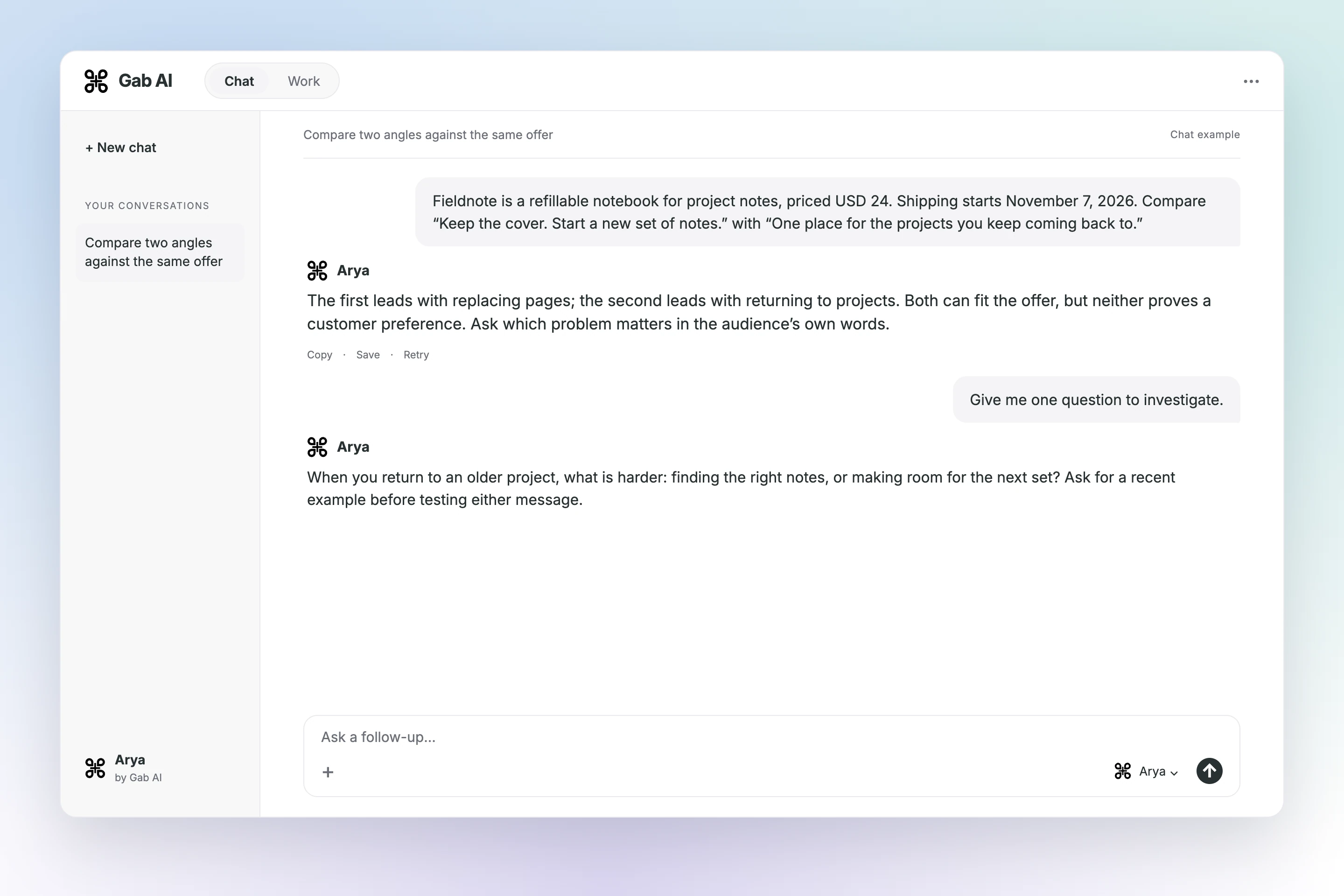
The first leads with replacing pages; the second leads with returning to projects. Both can fit the offer, but neither proves a customer preference. Ask which problem matters in the audience’s own words.
Your follow-up
Give me one question to investigate.
Arya
When you return to an older project, what is harder: finding the right notes, or making room for the next set? Ask for a recent example before testing either message.
Make the offer clear in a short launch email
Subject: A fresh set of notes, a familiar cover
Meet Fieldnote, a refillable notebook for the projects you keep coming back to.
Subject: A fresh set of notes, a familiar cover
Meet Fieldnote, a refillable notebook for the projects you keep coming back to. USD 24. Shipping begins November 7, 2026.
Your follow-up
Make it more straightforward.
Arya
Subject: Meet the Fieldnote refillable notebook
Keep your project notes in a notebook you can refill. Fieldnote is USD 24, with shipping beginning November 7, 2026.
Try the same question with more than one model
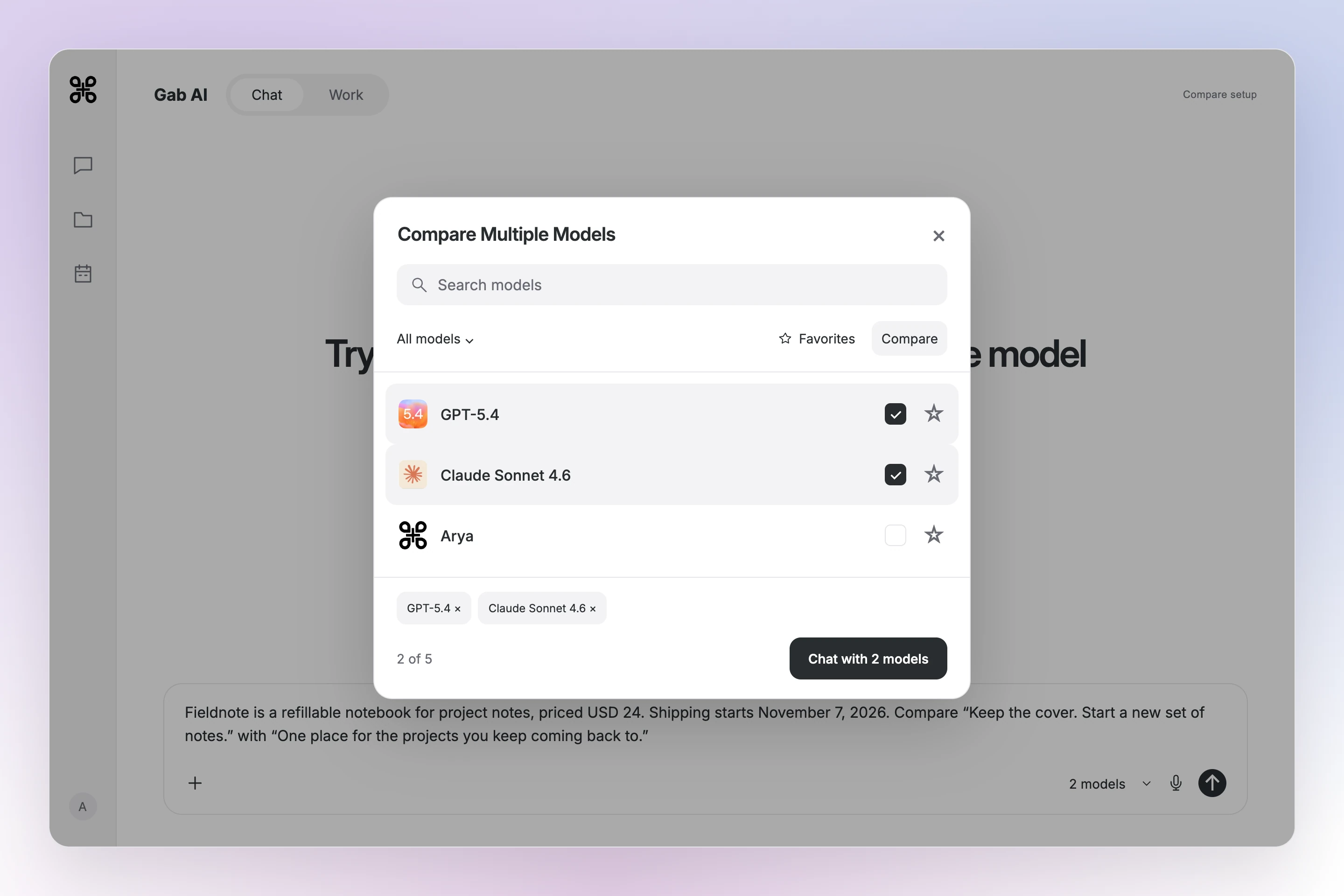
Choose compatible models, compare their reasoning and decide which answer helps with your task.
In the model picker, turn on Compare and choose compatible models before sending the same prompt. Compare requires Plus; model access and credit use depend on the selection. Check facts and omissions rather than assuming a winner.
Turn a campaign idea into a short video
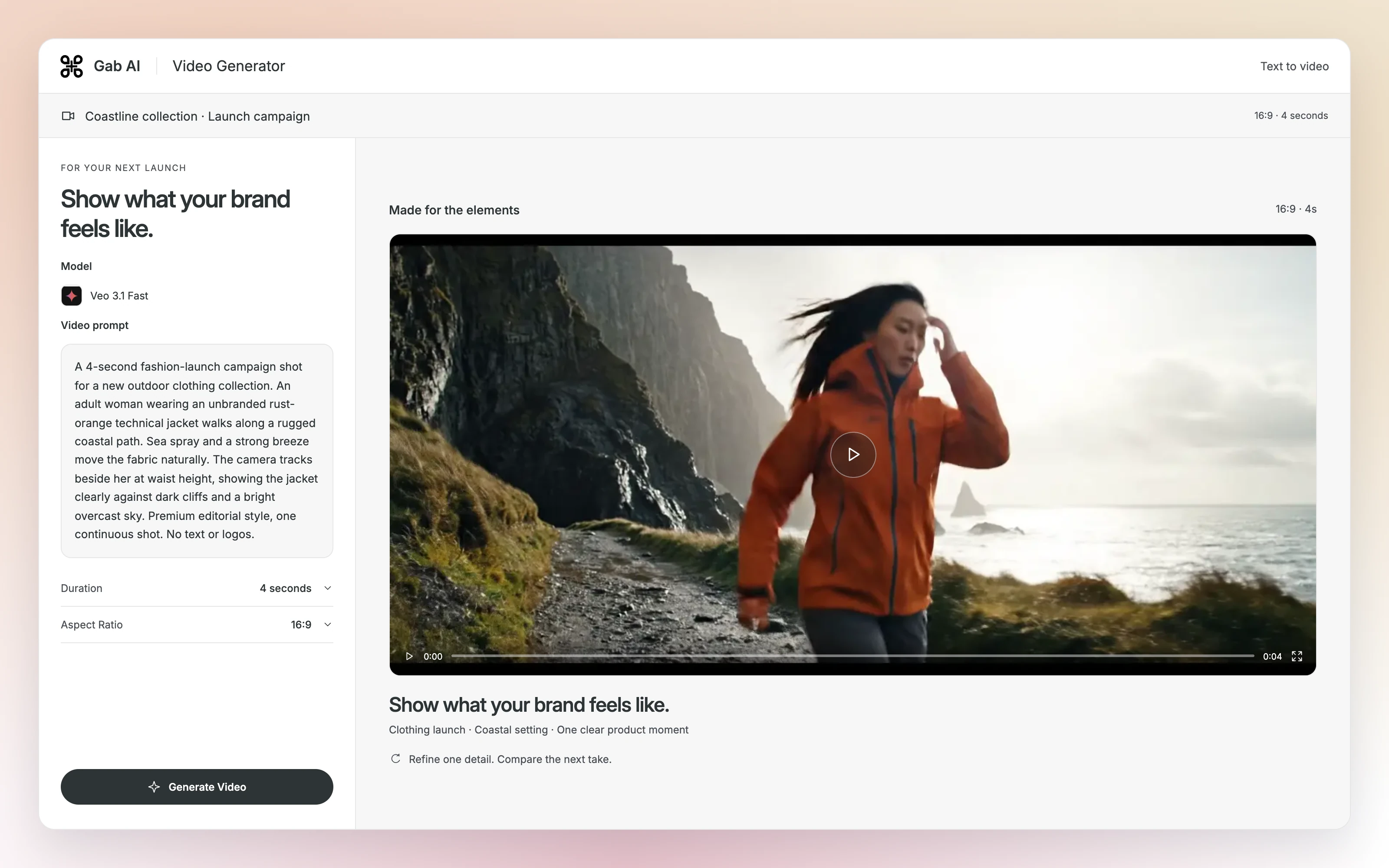
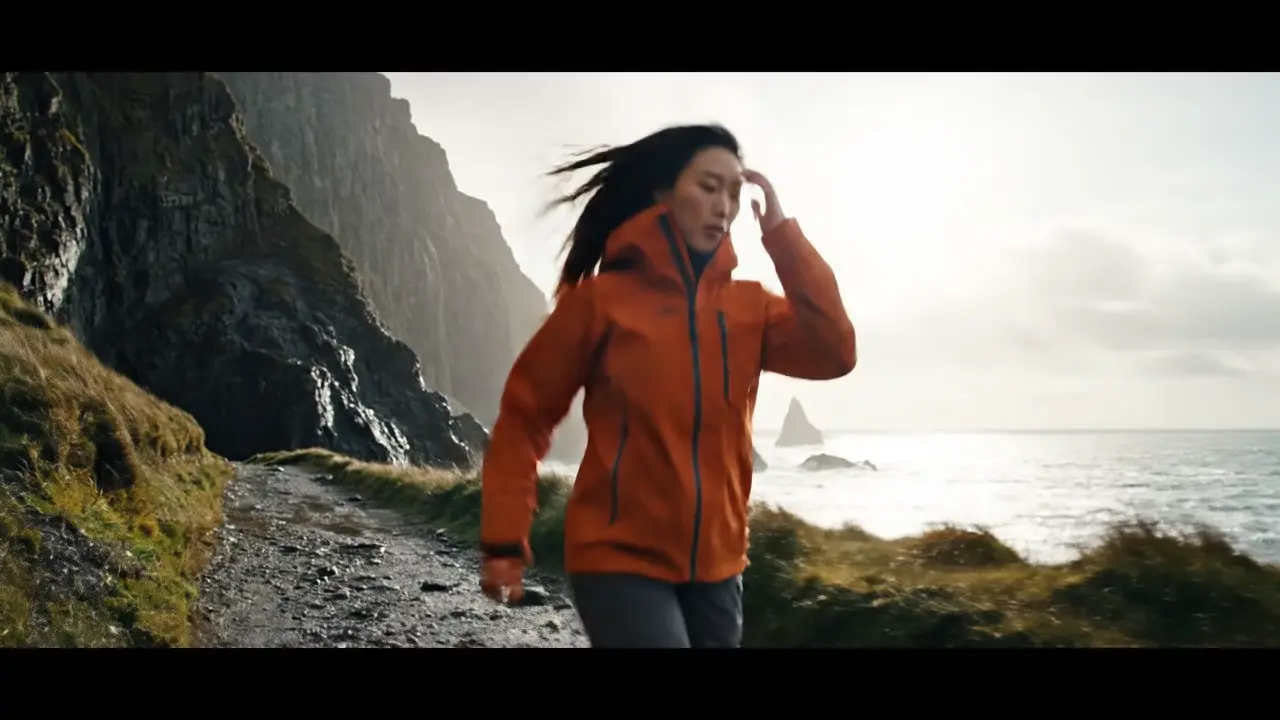
Describe one subject, one action and one camera direction. Watch the returned clip before refining it.
Coastline collection · Launch campaignReady to play.
Ready to try it yourself?
Read and use the promptPrompt
Text
1A 4-second fashion-launch campaign shot for a new outdoor clothing collection. An adult woman wearing an unbranded rust-orange technical jacket walks along a rugged coastal path. Sea spray and a strong breeze move the fabric naturally. The camera tracks beside her at waist height, showing the jacket clearly against dark cliffs and a bright overcast sky. Premium editorial style, one continuous shot. No text or logos.
Choose an available video model and check its duration, frame shape and estimate before generating.
Build a campaign report, research summary or announcement
Separate what the results show from the hypotheses you want to investigate.
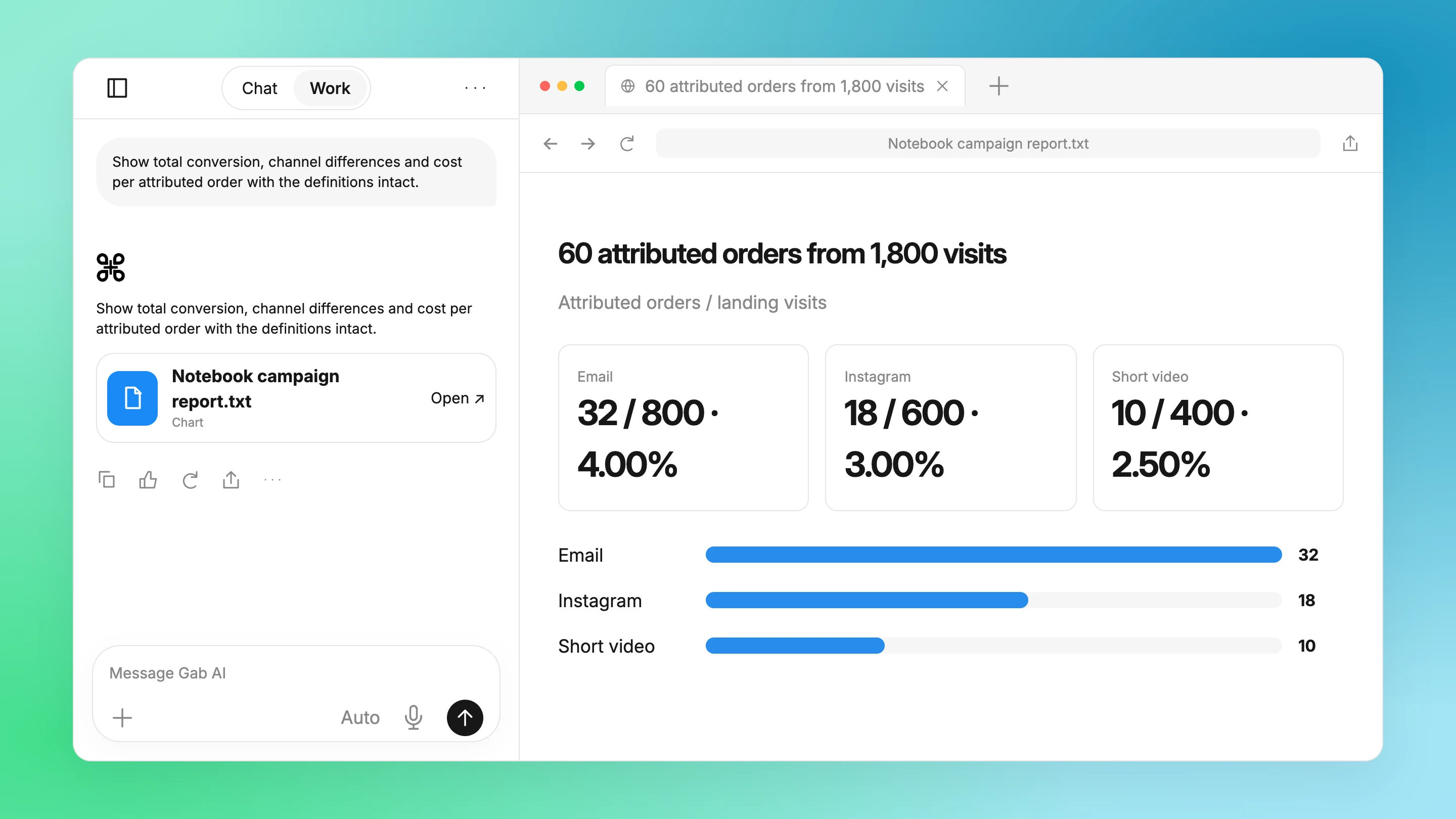
Calculate the notebook campaign report
Show total conversion, channel differences and cost per attributed order with the definitions intact.
Orders are attributed using the sample campaign’s reporting convention. Customer acquisition, profit, returns and repeat purchases are not supplied. Order counts are not verified revenue or new-customer counts.
Page replacement appears in N01, N02 and N05: three coded notes. These are note counts from the sample, not population preferences.
Notebook-research-notes.csv
Notebook-research-brief.txt
Project organization · three notes
Project organization or retrieval appears in N02, N03 and N04: three coded notes. N02 supports both themes, so adding the two counts would double-count it rather than establish six different respondents.
Notebook-research-notes.csv
Notebook-research-brief.txt
A reason to investigate, not a winner
The two themes connect to the two proposed message angles. A five-note sample does not establish preference in the market, causal lift or a winning message.
Notebook-research-brief.txt
Notebook-research-notes.csv
The next research decision
The proposed interview study asks about page replacement and finding earlier notes before counterbalanced message review. Recruitment, sample size, consent, budget and approval remain to be decided. It has not been conducted.
Notebook-research-brief.txt
Curated qualitative coding exercise: five notes, overlapping themes and a proposed study. No representative customer findings.
Read the prompt and inspect the full example
Show which notes support each message hypothesis and what the sample cannot establish.
Fieldnote refillable notebook: USD 24. Shipping begins November 7, 2026. Audience: people who keep project notes. No sustainability certification, discount, shipping price or durability test has been supplied.
Message hypotheses
A: Keep the cover. Start a new set of notes. B: One place for the projects you keep coming back to. Five research notes mention replacing pages and finding old project notes; this is a qualitative sample, not a representative survey.
Channel plan
Monday email, Wednesday Instagram, Friday short video. Campaign owner: marketing lead; review owner: brand editor. Each asset needs approved / changes requested / pending status. Prepare draft copy only; publication and scheduling are separate actions.
Notebook-research-notes.csv
Sample scope
Five purpose-created notes are supplied for a coding exercise. They are not real testimonials or a representative survey. There are no demographic, recruitment, market-size, willingness-to-pay or population-preference findings.
N01
N01: I reuse a good cover, but my pages run out.
N02
N02: I want fresh pages when I start a project.
N03
N03: Finding an old project note takes too long.
N04
N04: I keep separate notes for ongoing projects.
N05
N05: Replacing pages matters more to me than a new cover.
Notebook-research-brief.txt
Coding question
Review the five supplied notes for two themes: replacing or starting fresh pages, and organizing or retrieving project notes. A note may support both themes; count coded notes, not customers or market share. Keep the exact note IDs and wording visible so the analyst can inspect the interpretation.
Messages to investigate
Compare the campaign hypotheses A: Keep the cover. Start a new set of notes. and B: One place for the projects you keep coming back to. Theme frequencies may suggest what to investigate; they do not establish a winning message, causal lift, willingness to pay or what most buyers want.
Proposed next study
Propose interviews with people who actually keep project notes, asking how they replace pages and find earlier notes before showing messages A and B in counterbalanced order. Record recruitment and sample limitations, reasons for preference, unclear wording and unanswered questions. Sample size, recruitment criteria, consent process, budget and approval are not yet supplied; do not claim a study has been conducted.
Prepare an announcement from approved facts
Create a reviewable announcement and answer media questions without inventing claims.
Fieldnote refillable notebook is priced at USD 24, with shipping beginning November 7, 2026. It is intended for people who keep project notes. The draft introduces no discount, certification, shipping price or customer-preference claim.
Notebook-announcement-brief.txt
Notebook-campaign-brief.txt
Media questions with sources
The Q&A distinguishes a supplied shipping date from an unknown shipping price, and an unsupported certification from an approved product fact. research notes are not testimonials.
Notebook-announcement-brief.txt
Review before distribution
The brand editor must verify the product facts and claims. Obtain contact and purchase details separately if needed. Approval, outreach, publishing and scheduling have not occurred.
Notebook-announcement-brief.txt
Curated press draft and media Q&A. Brand-editor approval is pending; no outreach or publication occurred.
Read the prompt and inspect the full example
Draft the announcement and a source-backed media Q&A from the approved product facts.
Fieldnote refillable notebook: USD 24. Shipping begins November 7, 2026. Audience: people who keep project notes. No sustainability certification, discount, shipping price or durability test has been supplied.
Message hypotheses
A: Keep the cover. Start a new set of notes. B: One place for the projects you keep coming back to. Five research notes mention replacing pages and finding old project notes; this is a qualitative sample, not a representative survey.
Channel plan
Monday email, Wednesday Instagram, Friday short video. Campaign owner: marketing lead; review owner: brand editor. Each asset needs approved / changes requested / pending status. Prepare draft copy only; publication and scheduling are separate actions.
Notebook-announcement-brief.txt
Approved product facts
Prepare a press announcement draft for the Fieldnote refillable notebook. Approved facts: product name Fieldnote refillable notebook; price USD 24; shipping begins November 7, 2026; intended audience people who keep project notes. The announcement is a draft for brand-editor review, not approved for release.
Claims and missing information
No free-shipping offer, sustainability certification, durability test, discount, spokesperson quote, media contact, purchase URL or company-location information is supplied. Omit unsupported claims and invented contact details. The five research notes must not appear as customer testimonials or public market-preference statistics.
PR approval and next steps
Before distributing, the brand editor checks the product name, price, shipping date and every claim. Obtain approved media-contact and purchase information separately if needed. Keep the announcement, media questions and source facts distinct. Do not send outreach, publish content, create scheduled jobs or mark the release approved.
About these examples
Plan campaigns, research customers and report results
Turn research into a clear brief and a public-facing draft.
Give the next marketing decision its evidence
Check the campaign denominator
Calculate conversion and cost per attributed order from the sample rows.
Add the campaign export and metric definitions before sending.
Read all source material
Notebook-campaign-brief.txt
Approved offer
Fieldnote refillable notebook: USD 24. Shipping begins November 7, 2026. Audience: people who keep project notes. No sustainability certification, discount, shipping price or durability test has been supplied.
Message hypotheses
A: Keep the cover. Start a new set of notes. B: One place for the projects you keep coming back to. Five research notes mention replacing pages and finding old project notes; this is a qualitative sample, not a representative survey.
Channel plan
Monday email, Wednesday Instagram, Friday short video. Campaign owner: marketing lead; review owner: brand editor. Each asset needs approved / changes requested / pending status. Prepare draft copy only; publication and scheduling are separate actions.
Orders are attributed using the sample campaign’s reporting convention. Customer acquisition, profit, returns and repeat purchases are not supplied. Order counts are not verified revenue or new-customer counts.
Five purpose-created notes are supplied for a coding exercise. They are not real testimonials or a representative survey. There are no demographic, recruitment, market-size, willingness-to-pay or population-preference findings.
N01
N01: I reuse a good cover, but my pages run out.
N02
N02: I want fresh pages when I start a project.
N03
N03: Finding an old project note takes too long.
N04
N04: I keep separate notes for ongoing projects.
N05
N05: Replacing pages matters more to me than a new cover.
Notebook-research-brief.txt
Coding question
Review the five supplied notes for two themes: replacing or starting fresh pages, and organizing or retrieving project notes. A note may support both themes; count coded notes, not customers or market share. Keep the exact note IDs and wording visible so the analyst can inspect the interpretation.
Messages to investigate
Compare the campaign hypotheses A: Keep the cover. Start a new set of notes. and B: One place for the projects you keep coming back to. Theme frequencies may suggest what to investigate; they do not establish a winning message, causal lift, willingness to pay or what most buyers want.
Proposed next study
Propose interviews with people who actually keep project notes, asking how they replace pages and find earlier notes before showing messages A and B in counterbalanced order. Record recruitment and sample limitations, reasons for preference, unclear wording and unanswered questions. Sample size, recruitment criteria, consent process, budget and approval are not yet supplied; do not claim a study has been conducted.
Notebook-announcement-brief.txt
Approved product facts
Prepare a press announcement draft for the Fieldnote refillable notebook. Approved facts: product name Fieldnote refillable notebook; price USD 24; shipping begins November 7, 2026; intended audience people who keep project notes. The announcement is a draft for brand-editor review, not approved for release.
Claims and missing information
No free-shipping offer, sustainability certification, durability test, discount, spokesperson quote, media contact, purchase URL or company-location information is supplied. Omit unsupported claims and invented contact details. The five research notes must not appear as customer testimonials or public market-preference statistics.
PR approval and next steps
Before distributing, the brand editor checks the product name, price, shipping date and every claim. Obtain approved media-contact and purchase information separately if needed. Keep the announcement, media questions and source facts distinct. Do not send outreach, publish content, create scheduled jobs or mark the release approved.
Build a campaign report
Show total conversion, channel differences and cost per attributed order with the definitions intact.
Refine campaign claims against the evidence
Compare the draft with a focused revision, keeping the source facts in view.
Try one focused revision
Suggested follow-up using the same source facts.
Focused follow-up
What change should I ask for?
Turn this finding into a follow-up research question. Preserve the three note IDs and explain what the count cannot show.
Original excerpt
What does the existing example say?
Page replacement appears in N01, N02 and N05: three coded notes. These are note counts from the sample, not population preferences.
Suggested revision
What could that revision look like?
N01, N02 and N05 mention replacing or starting fresh pages. How do people who keep project notes handle page replacement, and why? Three coded notes suggest a question to investigate; they do not measure customer preference or establish a winning message.
Read the source note and the sample limits together.
Why can the theme counts add up to six when there are five notes?
Overlapping themes N02 mentions fresh pages and starting a project, so it supports both themes. Adding the two theme totals would count that note twice. The coding rule counts notes within each theme; these are not population preferences.
Does this establish which campaign message will win?
A winning message? No. The notes suggest themes to investigate. They are qualitative and not representative; the brief explicitly excludes claims about a winning message or causal lift.
What should the analyst investigate next?
Next study Ask people who keep project notes how they replace pages and retrieve earlier notes before counterbalanced review of messages A and B. Recruitment, sample size, consent, budget and approval still need decisions.
Keep the announcement separate from missing product or media information.
Can the announcement promise free shipping?
Shipping No shipping price or free-shipping offer is supplied. The approved fact is that shipping begins November 7, 2026.
Can we quote the five notes as customer testimonials?
Testimonials No. They are purpose-created research material. The announcement brief explicitly excludes using them as testimonials or public market-preference statistics.
Is this announcement ready to distribute automatically?
Release status It remains a draft for brand-editor review. Product facts, claims and any contact or purchase details need approval before distribution. The example sends and publishes nothing.
Use Chat to discuss the request and refine the result with follow-up questions.
Deliverable: Message comparison
What to provide
Approved product facts, audience and positioning brief
Example prompt
Compare three campaign messages using my approved product facts and audience brief. Explain the customer problem each addresses, flag claims needing evidence and keep suggested copy separate from approved wording.
What to check
Substantiate product claims
Confirm audience and dates
Approve before publishing
Work
Calculate the notebook campaign report
The report uses the total denominator and USD 500 spend; attribution does not establish profit or new customers.
Use Work to create and revise the editable Notebook campaign report.txt with the supplied source files.
Deliverable: Notebook campaign report.txt
What to provide
Notebook-campaign-results.csv: results; attribution is the supplied campaign convention.
Example prompt
Create Notebook campaign report.txt from Notebook-campaign-results.csv. Calculate visits, attributed orders, spend, conversion and cost per attributed order for each channel and total. Use 60 / 1800 for total conversion and 500 / 60 for total cost. Preserve attribution limits; do not label orders new customers, profit or verified revenue.
What to check
Verify the offer and research limitations
Approve each channel asset before publishing
Recalculate metrics from the original export
Work
Trace qualitative themes to the actual notes
Inspect the five notes behind a message hypothesis, then plan what to investigate next.
Use Work to create and inspect the self-contained HTML example before any publication decision.
Deliverable: Notebook-research-evidence.html
What to provide
Notebook-campaign-brief.txt
Notebook-research-notes.csv
Notebook-research-brief.txt
Example prompt
Using Notebook-research-notes.csv, Notebook-research-brief.txt and Notebook-campaign-brief.txt, create Notebook-research-evidence.html. Show the exact five notes, code page-replacement and project-organization themes, count overlapping coded notes and link each interpretation to its note ID. Compare the two message hypotheses and propose the follow-up study with recruitment, sample and approval gaps explicit. Make theme filters work. Do not claim a representative survey, a winning message, real testimonials or a completed study. Deliver a self-contained HTML evidence board.
What to check
Inspect every source and assumption
Review claims and limitations with the responsible editor
Approve any separate publication or research activity yourself
Work
Prepare an announcement from approved facts
Create a reviewable announcement and answer media questions without inventing claims.
Use Work to create and inspect the self-contained HTML example before any publication decision.
Deliverable: Notebook-press-announcement.html
What to provide
Notebook-campaign-brief.txt
Notebook-announcement-brief.txt
Example prompt
Using Notebook-campaign-brief.txt and Notebook-announcement-brief.txt, create Notebook-press-announcement.html. Prepare a polished product-announcement draft and a separate media Q&A with selectable questions and exact source excerpts. Preserve Fieldnote refillable notebook, USD 24 and shipping beginning November 7, 2026. Omit unsupported quotes, contact details, certifications, discounts, free shipping and customer statistics. Keep brand-editor review pending. Do not send outreach, publish or schedule anything. Deliver the self-contained HTML file.
What to check
Inspect every source and assumption
Review claims and limitations with the responsible editor
Approve any separate publication or research activity yourself
More prompts
Chat
Draft a launch email sequence
Three editable launch email drafts with consistent facts and claims marked for review.
Use Chat to discuss the request and refine the result with follow-up questions.
Deliverable: Email drafts
What to provide
Verified launch details, audience consent rules and brand voice
Example prompt
Draft three launch emails: introduction, use-case explanation and final reminder. Use only the supplied product facts and confirmed dates, avoid invented urgency and identify any claim requiring substantiation. Return drafts; do not send them.
What to check
Substantiate product claims
Confirm audience and dates
Approve before publishing
Work
Build a campaign calendar
A campaign workbook linking each planned asset to its brief, dates, budget assumptions and approval owner.
Use Work to build and revise Campaign calendar.xlsx from your source material.
Deliverable: Campaign calendar.xlsx
What to provide
Approved channels, content briefs, dates and review owners
Example prompt
Create a campaign workbook with channel, audience, creative brief, confirmed date, owner, review state and budget assumption. Include a summary of pending approvals and dependencies. Do not schedule posts or purchase ads. Deliver "Campaign calendar.xlsx" as the requested editable artifact. Ask for missing source material rather than inventing facts.
What to check
Substantiate product claims
Confirm audience and dates
Approve before publishing
Work
Create an editable campaign presentation
An editable campaign deck with source notes, measurement definitions and decisions still awaiting approval.
Use Work to build and revise Campaign presentation.pptx from your source material.
Deliverable: Campaign presentation.pptx
What to provide
Approved positioning, research findings and asset permissions
Example prompt
Build a presentation of the campaign objective, audience evidence, message directions, channel plan and measures of success. Use supplied research and approved assets; add source notes and separate proposals from authorized spend. Deliver "Campaign presentation.pptx" as the requested editable artifact. Ask for missing source material rather than inventing facts.
What to check
Substantiate product claims
Confirm audience and dates
Approve before publishing
Chat
Compare two notebook campaign messages
A comparison explains the angle each message tests, without inventing proof from a five-note qualitative sample.
Use Chat to inspect the supplied evidence, question the draft and revise its wording before using it.
Deliverable: Response in Chat
What to provide
Notebook-campaign-brief.txt: Purpose-created offer and message research, not customer testimonials.
Example prompt
Compare the two message hypotheses in Notebook-campaign-brief.txt. Produce Notebook campaign message variations.txt with channel-ready variations and the angle each tests. Preserve price and shipping date. Do not invent a discount, certification, durability result or representative customer research.
What to check
Verify the offer and research limitations
Approve each channel asset before publishing
Recalculate metrics from the original export
Work
Build the notebook content and approval calendar
A working sample calendar includes captions, variation and review ownership; it does not publish posts.
Use Work to create and revise the editable Notebook content and approvals.csv with the supplied source files.
Deliverable: Notebook content and approvals.csv
What to provide
Notebook-campaign-brief.txt: Purpose-created offer and message research, not customer testimonials.
Example prompt
Create Notebook content and approvals.csv from Notebook-campaign-brief.txt. Include email, Instagram and short-video copy with sample timing, brand-editor review and pending status. Preserve the offer. Do not publish posts, mark approvals complete or create scheduled jobs.
What to check
Verify the offer and research limitations
Approve each channel asset before publishing
Recalculate metrics from the original export
Chat
Plan a customer research study
A renewal-research plan with neutral interview and survey questions, decision links and sampling limitations.
Use Chat to question the source material and revise the response before preparing a file.
Deliverable: Response in Chat
What to provide
Research question, target population and sampling constraints
Example prompt
Create a research plan to understand why business customers renew our software subscription. Use the decision questions and known constraints I provide. Propose interview topics, neutral survey questions and sampling limitations without inventing customer evidence.
What to check
Check response coding
Verify counts
State sample limits
Chat
Draft a press announcement
A press-release draft using approved facts and authorized quotes, with missing details marked.
Use Chat to question the source material and revise the response before preparing a file.
Deliverable: Response in Chat
What to provide
Approved announcement facts, spokespeople and publication timing
Example prompt
Draft a press release from these approved announcement facts. Include headline, lead, supporting context and supplied contact details. Use only authorized quotes, mark missing information, and avoid invented statistics or exaggerated claims.
What to check
Verify facts and quotes
Confirm attribution
Communications approval
Work
Build an approval calendar
A content calendar organized around asset permissions, review ownership and pending approvals.
Use Work to build and revise Social content approval calendar.xlsx from your source material.
Deliverable: Social content approval calendar.xlsx
What to provide
Approved content briefs, planned dates, assets and review owners
Example prompt
Create a workbook with channel, content purpose, asset reference, rights status, planned date, approval owner and revision state. Summarize pending approvals and distinguish drafts from scheduled posts; do not connect accounts or publish. Deliver "Social content approval calendar.xlsx" as the requested editable artifact. Ask for missing source material rather than inventing facts.
What to check
Substantiate claims and promotions
Verify dates and asset rights
Approve before posting
Work
Create a reporting workbook
A reporting workbook with explicit metric definitions, source periods and transparent comparison formulas.
Use Work to build and revise Social performance workbook.xlsx from your source material.
Deliverable: Social performance workbook.xlsx
What to provide
Actual performance export, metric definitions and comparison periods
Example prompt
Build a workbook comparing the supplied channel metrics across consistent periods. Preserve denominators, distinguish impressions from unique reach and flag missing data. Do not invent engagement results or attribute changes to a campaign without evidence. Deliver "Social performance workbook.xlsx" as the requested editable artifact. Ask for missing source material rather than inventing facts.
Give Chat the approved product facts, audience and positioning brief. Ask for distinct message options with the promise and supporting evidence made clear. Review the claims before testing; a proposed message does not establish customer preference or campaign performance.
Can I build a campaign calendar in Work?
Supply the approved channels, content briefs, dates, budget assumptions and review owners. Ask Work for a workbook that connects each asset to its brief, deadline and approval step. The example opens a draft and does not publish or schedule a campaign.
What should I check before using the marketing materials?
Verify product facts, claims, audience assumptions and dates. Keep recorded campaign metrics separate from research interpretation and proposed messaging. Use the notes to plan further research; the press announcement remains pending brand-editor review.
How does Scheduled tasks fit this workflow?
Prepare a repeatable competitor or campaign research brief, then choose its timing and email delivery explicitly in Tasks.
Can I inspect the evidence behind a market-research theme?
The research example lets you filter five notes by theme and inspect the original wording. Overlapping codes are counted as notes, not different customers or representative preferences. Use the result to plan further research, not to declare a winning campaign.
Can Gab AI draft a press announcement from approved facts?
Yes. Supply the product facts, claim boundaries and review requirements. The example separates a finished announcement draft from media questions and their sources. Check every claim and obtain approval before distribution; a draft does not send outreach or publish content.
How do I calculate campaign conversion and cost per order?
Supply visits, attributed orders, spend and the reporting definitions. The sample has 60 orders from 1,800 visits: 3.33% conversion. USD 500 divided by 60 is USD 8.33 per attributed order, rounded. Those orders are not verified new customers, and the figures do not establish profit or causal lift.
Can I start in Chat, or do I need Work?
Use Chat for questions and text drafts. Choose Work when you want a project with tools and editable files. Work requires Plus and uses credits; see Pricing for plans and allowances. Opening a draft does not send it or attach the example files.